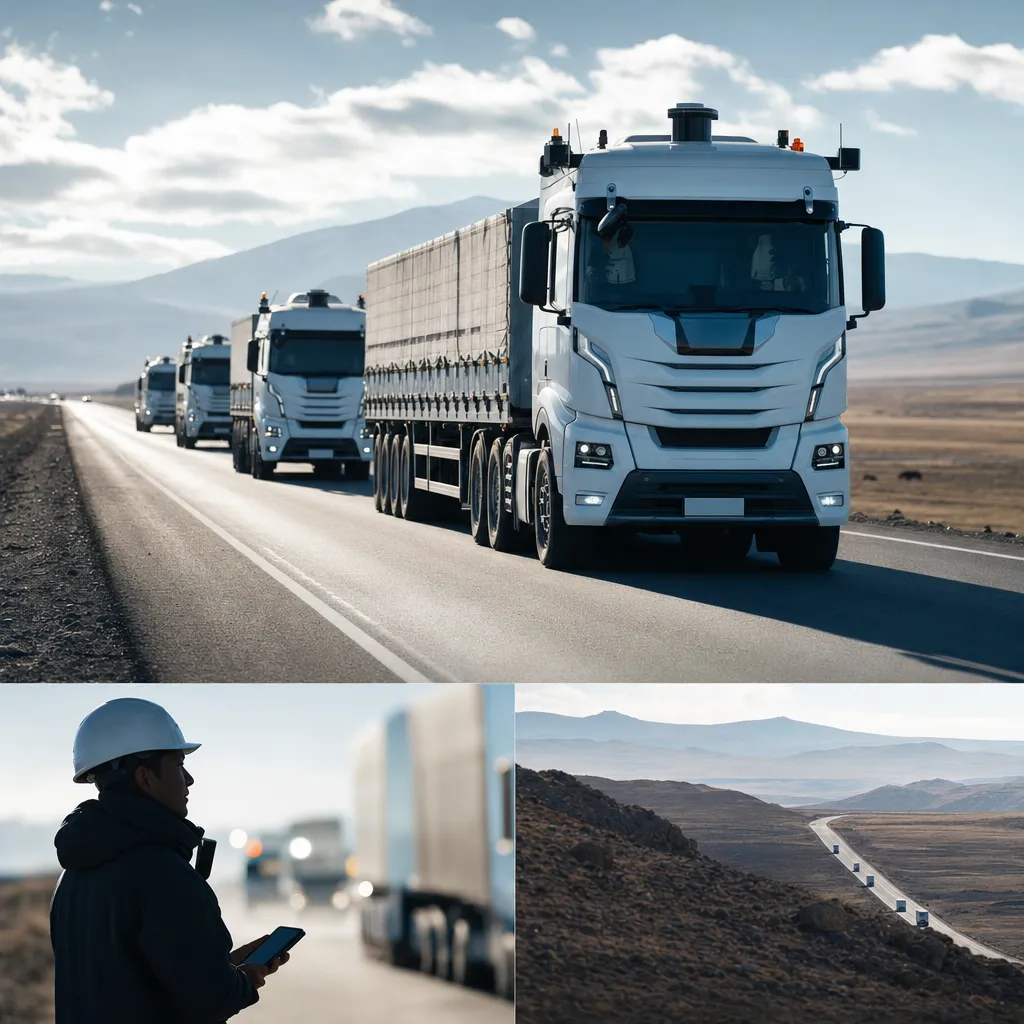
Senior Auto signed a strategic agreement to operate autonomous heavy-duty trucks for coal transport and China-Mongolia cross-border freight — expanding commercial autonomous trucking into some of the world's most demanding terrain.
Senior Auto signed a strategic agreement this week with the Eastern Partnership Business Council and Mongolia's Taiji Zond LLC to operate autonomous heavy-duty trucks for coal transport and China-Mongolia cross-border freight — expanding commercial autonomous trucking into some of the world's most demanding terrain. The move is a significant milestone: it demonstrates that commercial autonomous trucking is moving beyond the controlled interstate highway corridors where the technology was developed, into extreme-environment resource logistics that has historically resisted automation.
The China-Mongolia cross-border freight corridor handles coal, minerals, and industrial goods across terrain that is nothing like the flat, well-mapped American highway. Routes cross high-altitude steppe, deal with temperature swings from -40°C winters to summer heat, and involve border crossings with complex documentation requirements. If autonomous trucking can work reliably in this environment, the addressable market for the technology expands substantially.
The Commercial Case for Mongolia
Mongolia is the world's second-largest landlocked country and heavily dependent on export of coal, copper, and other extractive resources. Transport is a persistent bottleneck. The country has a severe shortage of qualified heavy-duty truck drivers — a structural labor problem compounded by the demanding conditions and remote routes — and cargo volumes are growing as China's industrial demand for Mongolian coal has remained elevated.
According to Manila Times / PR Newswire, Senior Auto's agreement covers autonomous heavy-duty truck operations for coal transport within Mongolia and cross-border freight routes between Mongolia and China. The Eastern Partnership Business Council will facilitate regulatory and operational coordination across the border, while Taiji Zond provides local operational infrastructure.
The labor economics are the clearest argument: autonomous trucks don't require rest stops, don't face recruitment challenges in remote regions, and operate at consistent speeds through conditions that cause driver fatigue and safety incidents. For a country where trucking infrastructure development is a government priority and driver labor is structurally constrained, autonomous systems are not a futuristic option — they're a near-term operational solution.
Get this in your inbox.
Daily AI intelligence. Free. No spam.
Senior Auto's Positioning
Senior Auto has been building its autonomous trucking capability with a focus on markets that Western AV companies have not prioritized — specifically, emerging market resource logistics where terrain is challenging, driver labor is scarce, and operational volumes justify the investment in autonomous infrastructure.
This strategy is different from the dominant North American approach. Companies like Waymo Via, Aurora, and Kodiak Robotics have targeted U.S. interstate freight routes — well-mapped, weather-managed, heavily regulated. Senior Auto is targeting resource corridors in markets where mapping infrastructure is less developed, weather conditions are more extreme, and regulatory frameworks are still forming. The commercial autonomy question in those environments is different: reliability in difficult conditions matters more than achieving the last 0.1% of autonomous performance on optimized routes.
Implications for Autonomous Trucking
The expansion into Mongolia is part of a broader geographic diffusion of commercial autonomous trucking that has accelerated through 2026. Routes now in commercial operation span:
- United States: Kodiak, Aurora, and Waymo Via on Texas and southwest interstate corridors
- China: WeRide, PonyAI, and DeepRoute on highway freight routes
- Germany: Einride operating Level 4 electric freight routes
- Mongolia: Senior Auto, beginning coal and cross-border freight operations
Each new geography adds to the collective case that autonomous trucking is not a single-market technology but a global commercial reality developing at different speeds in different regulatory and operational environments.
For resource and energy companies operating logistics in remote or demanding terrain environments — mining operations in Africa, Central Asia, and South America — the Mongolia deployment is worth watching as a proof case. The question is whether autonomous trucking can maintain reliability and safety records in uncontrolled terrain conditions over sustained commercial operations, not just controlled trials.
What to Watch
Watch for Senior Auto to publish operational safety and reliability data from the Mongolia deployment over the next 12 months. The routes and terrain conditions involved make this a genuine technical test for autonomous trucking in extreme environments. Watch also for Mongolian government commentary on how autonomous freight fits into the country's broader transport infrastructure strategy — if the government treats this as a template, it could accelerate additional autonomous freight corridors across Central Asian resource routes.
Source: Manila Times / PR Newswire, November 2026
Did this help you understand AI better?
Your feedback helps us write more useful content.
Get tomorrow's AI briefing
Join readers who start their day with NexChron. Free, daily, no spam.