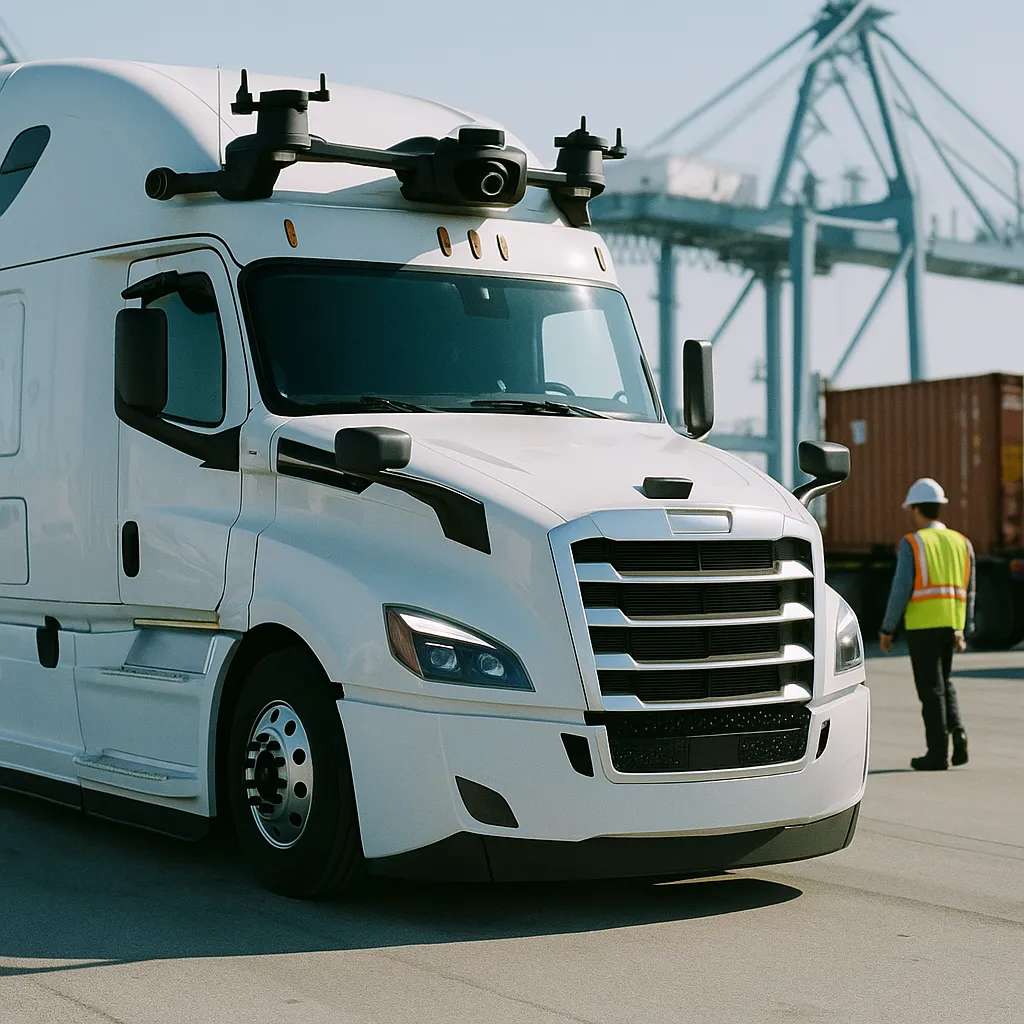
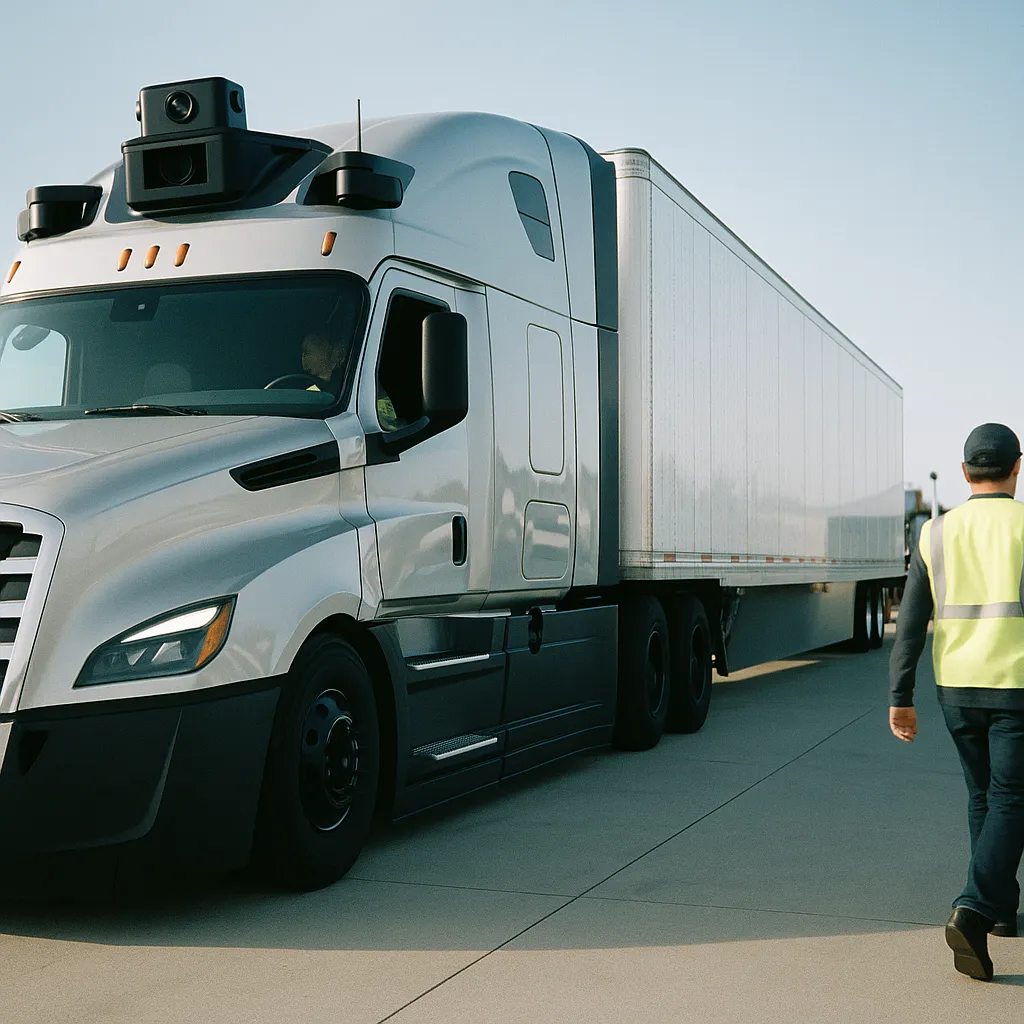
Maas Auto completed a 3,379-km fully autonomous freight run from Long Beach to Georgia in three days — the world's longest self-driving freight haul, on the actual commercial supply chain.
An Autonomous Truck Just Crossed the United States With No Human Driver. Here's Why That's a Turning Point.
By Hector Herrera | April 23, 2026 | Transport
A self-driving truck completed a 3,379-kilometer freight run from the Port of Long Beach, California to a Hyundai Mobis parts plant in Georgia in three days — with no human driver intervention at any point on the route. It is the longest fully autonomous freight haul ever completed on public roads, and it happened on the actual logistics network that moves American goods.
This is not a test track demonstration. This is the commercial supply chain.
What Actually Happened
According to Seoul Economic Daily, the run was completed by Maas Auto in partnership with logistics companies Lotte Global Logistics and LX Pantos. The cargo: automotive components traveling from a major U.S. port to a manufacturing plant — a route and cargo type representative of real industrial supply chain operations, not a carefully staged demonstration.
The key details:
- Route length: 3,379 km (approximately 2,100 miles)
- Duration: Three days
- Human intervention: None over the full route
- Partners: Lotte Global Logistics, LX Pantos
- Destination: Hyundai Mobis plant in Georgia
The "no human intervention" claim is the threshold that separates this run from earlier long-haul autonomous demonstrations, most of which involved a safety driver in the cab who could take control, or human drivers handling specific segments — highway on-ramps, construction zones, complex intersections. Completing a transcontinental route without intervention across all those conditions is a materially harder engineering problem.
Why It Matters Beyond the Distance Record
Setting aside the record, what does a completed coast-to-coast autonomous freight run demonstrate that was not demonstrated before?
System reliability over extended operation. Long-haul autonomous trucking involves sustained operation through diverse conditions: multiple states, changing weather, different traffic densities, varied highway geometry, construction zones, weigh stations, and fuel stops. A short autonomous demonstration proves capability in a controlled window. A 3,379-kilometer run proves the system can handle that entire distribution of conditions without failure.
Supply chain integration. The run was organized by actual logistics companies moving actual cargo for an actual automotive manufacturer. That means the technology interacted with real port terminal software, real scheduling systems, and real receiving dock operations — not a simulated logistics environment. When autonomous truck advocates say the technology is "supply chain ready," this run is the evidence basis for that claim.
Get this in your inbox.
Daily AI intelligence. Free. No spam.
Commercial routing. Long Beach to Georgia is not an arbitrary route chosen for favorable conditions. It is one of the highest-volume freight corridors in North America, carrying automotive parts, consumer goods, and manufactured products from a major Pacific port to the industrial Southeast. Demonstrating reliable autonomous operation on that specific route has direct commercial implications.
The Industry Context
Long-haul trucking in the United States is running a structural driver shortage. The American Trucking Associations has estimated the shortfall at over 60,000 drivers, with projections suggesting it could reach 160,000 by the end of the decade as the existing driver population ages and the work becomes harder to staff. Rates for reliable experienced drivers have increased substantially.
Autonomous long-haul trucking addresses the economics of that shortage directly — not by replacing the entire truck driving profession, but by enabling the specific highway miles that are most routinely handled. The dominant deployment model for autonomous long-haul has been hub-to-hub: the truck drives autonomously between major distribution centers on interstate routes, while human drivers handle the first and last miles through complex urban environments and loading docks.
The Maas Auto run suggests the hub-to-hub model can handle the full span of a transcontinental route without the handoffs that most autonomous trucking deployments currently require.
What Is Still Hard
Completing a transcontinental run does not mean autonomous long-haul trucking is ready for immediate broad commercial deployment. Several challenges remain:
Regulatory clarity. Autonomous commercial vehicles operate under a patchwork of state regulations. Most states permit testing on public roads; commercial deployment at scale requires clearer federal frameworks that are still being developed by FMCSA (the Federal Motor Carrier Safety Administration).
Edge case accumulation. A single successful run demonstrates the system handled the conditions encountered on that run. Achieving the reliability required for full commercial deployment — where failures have supply chain and safety consequences — requires accumulating millions of miles across a wider distribution of edge cases.
Weather conditions. Long-haul routes in northern states and mountain passes involve snow, ice, and severe weather that autonomous systems handle less reliably than clear-highway conditions. A Long Beach-to-Georgia route in April is not the hardest possible test of all-weather capability.
Insurance and liability frameworks. Who is liable when an autonomous truck is in an accident? The regulatory and insurance infrastructure for answering that question at scale is still being built.
What to Watch
Two signals over the next 12 months will define whether this run marks the beginning of a commercial inflection point or remains a milestone demonstration: first, whether Lotte Global Logistics and LX Pantos announce commercial contracts for autonomous freight on similar routes — that would signal the logistics industry is ready to trust the technology for actual cargo. Second, whether FMCSA responds to accumulated autonomous trucking data with updated commercial deployment rules.
The Port of Long Beach to Georgia in three days, no driver. The record stands. The question is how quickly the supply chain catches up to it.
Hector Herrera is the founder of Hex AI Systems and editor of NexChron.
Did this help you understand AI better?
Your feedback helps us write more useful content.
Get tomorrow's AI briefing
Join readers who start their day with NexChron. Free, daily, no spam.