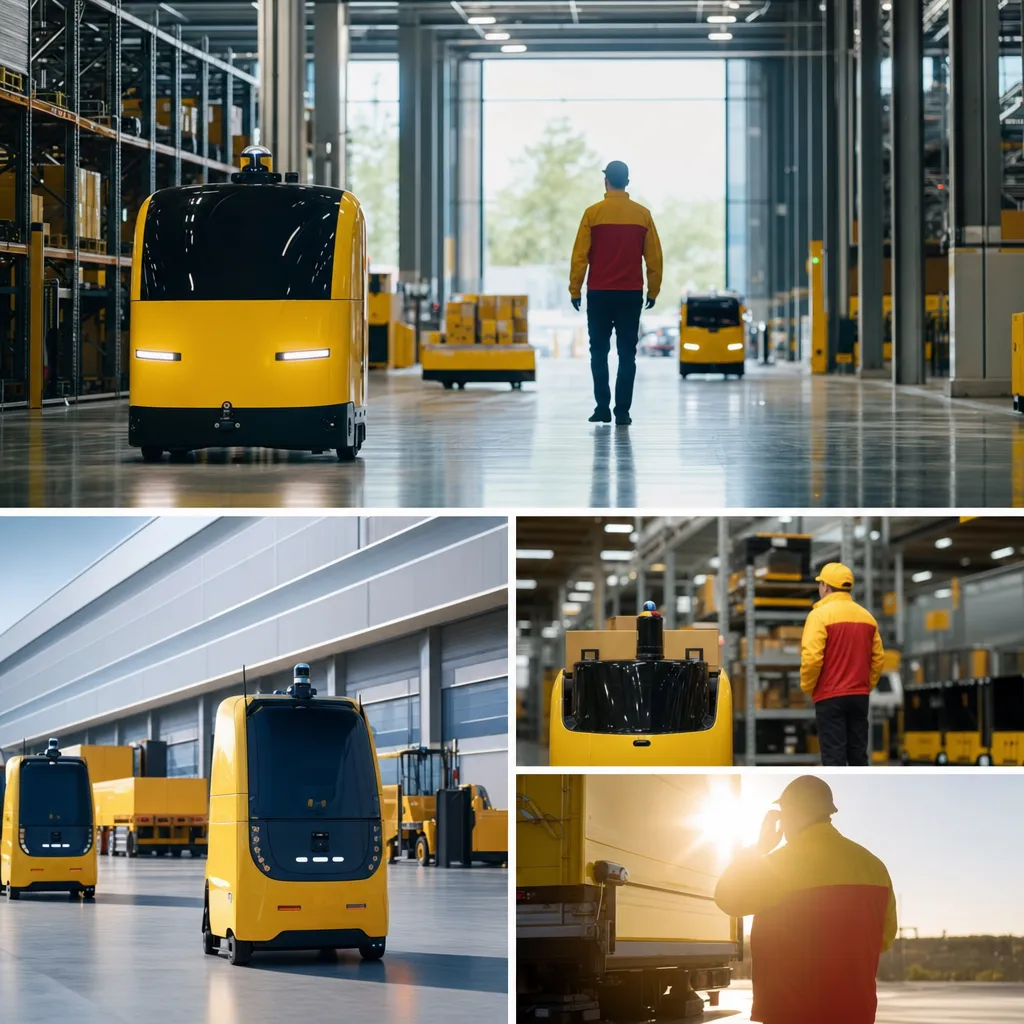
DHL has graduated AI-powered autonomous vehicles from its Fast Forward Challenge into full daily production operations at its Advanced Regional Center in Singapore, marking a milestone for the logistics industry AV adoption curve.
By Hector Herrera | October 30, 2026
DHL has graduated AI-powered autonomous vehicles from its Fast Forward Challenge innovation program into full daily operations at its Advanced Regional Center in Singapore. The transition marks a logistics industry milestone: a major global shipper has moved past the autonomous vehicle pilot phase and integrated AVs as a standard part of warehouse operations at production scale.
The distinction between pilot and production matters in logistics. Pilots run under special conditions — dedicated oversight, limited throughput, structured environments — that make them expensive and unrepresentative of real operating demands. Production deployment means the robots are running standard shifts, handling live shipments, without dedicated supervision for each vehicle. According to Computer Weekly, the Singapore facility now depends on autonomous vehicles as a core component of its daily throughput.
What Changed
DHL's Fast Forward Challenge is structured as an internal innovation competition: teams propose autonomous technologies, the most promising receive resources, and the best performers earn a pathway to full deployment. The autonomous vehicles that advanced through this process addressed a high-frequency operational bottleneck: internal transport movements between receiving docks, storage areas, and outbound loading — movements that occur dozens to hundreds of times per shift in a high-throughput facility.
The Advanced Regional Center in Singapore is among DHL's highest-volume facilities in Southeast Asia. That context matters: DHL didn't graduate its AV program by testing it in a simplified environment. The production deployment is operating in a complex, real-demand setting from day one.
Get this in your inbox.
Daily AI intelligence. Free. No spam.
Why This Is a Logistics Industry Signal
Major logistics operators watch each other's deployment decisions closely. DHL committing AVs to production at a flagship Southeast Asia facility sends a direct signal to competitors — FedEx, UPS, DB Schenker, Kuehne+Nagel — that the technology has crossed the reliability threshold required to stake daily operations on it.
The economic argument for autonomous vehicles in warehouse operations has always been clear: labor is the largest cost driver in distribution, and AVs run continuous shifts without fatigue, sick leave, or turnover. The barrier to adoption was not the economic case — it was reliability. Autonomous systems need to operate predictably enough that logistics managers can plan around them rather than work around them.
DHL's production deployment suggests that threshold has been reached, at least for the class of internal logistics movement the Singapore vehicles are handling: defined routes, structured environments, repetitive workflows. These are conditions where AI-guided navigation systems have become highly reliable.
The Fast Forward Program as an Adoption Model
DHL's approach — running an internal competition to surface viable autonomous technologies, then funding the winners through pilot to production — is worth noting as a model. Rather than purchasing off-the-shelf AV systems and deploying them across the network, DHL tested in competition conditions that forced competing approaches to prove performance before earning production access.
That model results in slower initial adoption but significantly higher-quality production deployments. The AVs now running daily shifts in Singapore have already demonstrated they can perform under operational pressure.
What to Watch
Whether DHL announces expansion of AV operations to other high-throughput facilities in its Asia-Pacific or European network. Singapore as a production reference facility changes the internal calculus for network-wide deployment — the engineering and operational questions have been answered in a live environment.
Also watch how DHL's competitors respond. Once a major logistics operator demonstrates production-scale AV reliability, the competitive pressure to match it builds quickly. The next 12 to 18 months may see several simultaneous announcements from major shippers graduating AV programs from pilot to production, as Singapore 2026 becomes the reference point that internal champions use to push their own companies past the approval threshold.
Did this help you understand AI better?
Your feedback helps us write more useful content.
Get tomorrow's AI briefing
Join readers who start their day with NexChron. Free, daily, no spam.