AI tools are now active at the script, casting, and VFX stage in Hollywood, and the labor contract provisions negotiated in 2023 are being outpaced by capabilities that didn't exist when the ink dried.
AI Has Moved to the Center of Hollywood Production. The 2023 Contracts Didn't Cover This.
By Hector Herrera | May 5, 2026 | Creative
AI tools have moved from post-production curiosity to production-stage necessity in Hollywood, and the industry's compensation structures haven't caught up. Two years after the 2023 strikes that produced landmark AI provisions in SAG-AFTRA and WGA contracts, those provisions are being tested — and in some cases outpaced — by capabilities that didn't exist when the ink dried, according to reporting by DevX.
The pattern is consistent: AI is doing more, workers are getting paid less, and the contract language negotiated to prevent the first thing isn't preventing the second.
What Changed Since the 2023 Strikes
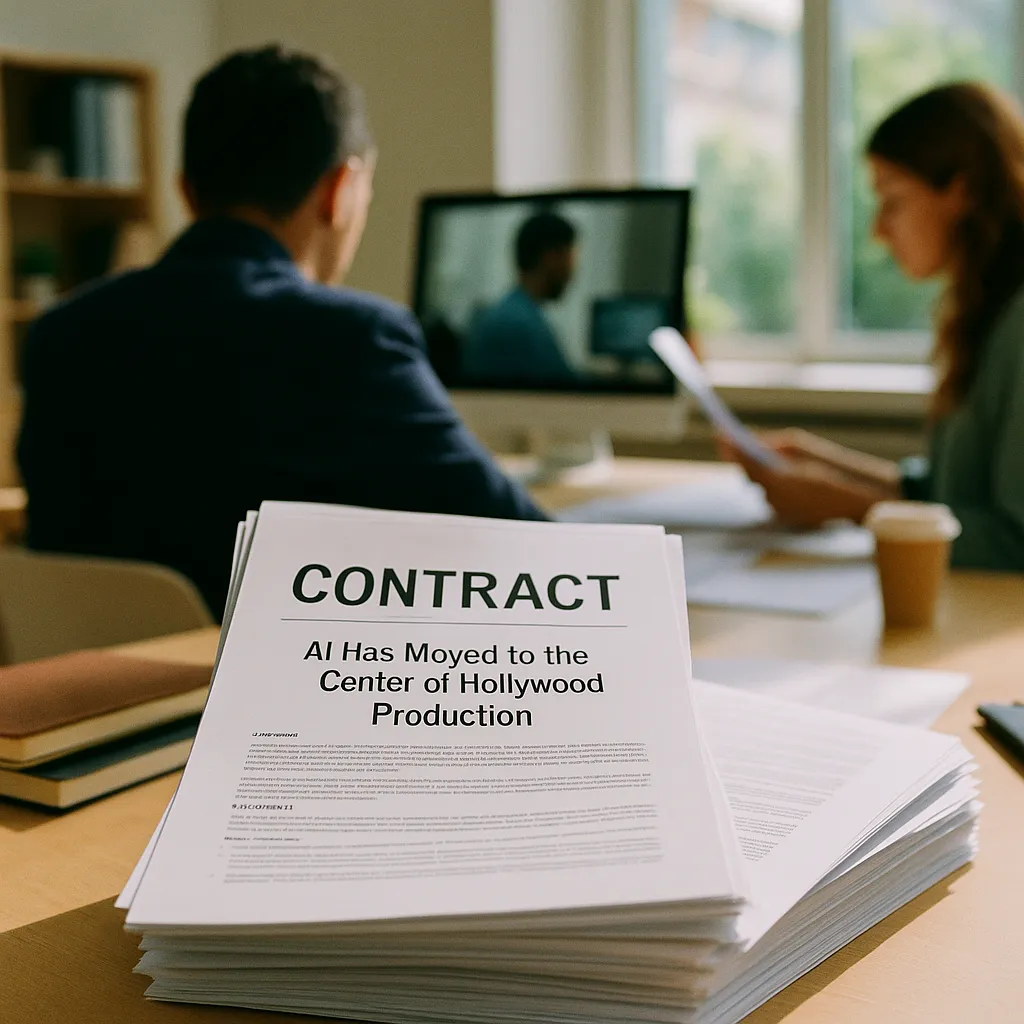
The 2023 WGA and SAG-AFTRA strikes were partly about AI — specifically, about studios using AI-generated likenesses and AI-assisted writing to reduce labor costs. The contracts that ended those strikes included real guardrails: consent requirements for digital likeness use, minimums for AI-adjacent work, disclosure requirements for AI-generated material.
Those contracts were written for the AI of 2023. The AI of 2026 is different in kind, not just degree. Tools available today can iterate on screenplay drafts at scale, generate photorealistic crowd scenes, de-age actors without manual frame-by-frame work, and model box office outcomes by cast configuration with a specificity that would have seemed like science fiction when the strikes ended.
Where AI Is Now Active
The DevX reporting documents AI involvement across production stages that were human-only two years ago:
Script development: AI tools are iterating on drafts, testing alternate plot structures, and flagging dialogue that underperforms with test audience data. The workflow that's emerged at several studios: AI generates a "starting point" draft that human writers then revise. This technically complies with WGA contract language requiring human writers, while practically reducing the writing budget required per project.
Casting: Some studios are using AI models to predict box office return by cast configuration — which actors, in which combinations, in which genres, testing against historical performance data. The output influences which actors receive offers. This is not in any existing guild contract.
VFX and visual production: AI-generated environments, de-aging, and crowd replication are reducing per-project headcounts among traditional VFX artists. The tools have moved from experimental to production-standard faster than IATSE (the International Alliance of Theatrical Stage Employees, which represents many VFX workers) anticipated.
Get this in your inbox.
Daily AI intelligence. Free. No spam.
Compensation disputes: Multiple grievance proceedings are active across the guilds, testing whether current contract provisions adequately cover AI-adjacent workflows. The rate at which cases are being filed suggests the provisions were insufficient.
Who Is Most at Risk
Writers won specific protections against AI replacing writing room staff, but the "AI assistance versus AI replacement" line has become a gray zone. Studios characterize AI-generated drafts revised by humans as assisted human writing. Writers characterize the same workflow as AI writing minimally cleaned up by humans to satisfy a contract requirement. Both descriptions are accurate descriptions of the same thing.
Actors secured consent requirements for digital likeness, but enforcement requires individual actors to monitor how their likenesses are being used and file their own grievances. Mid-tier and background actors — the population most economically vulnerable to digital replacement — have the least institutional capacity to do that monitoring.
VFX artists have the least protection. IATSE contracts do not have the AI-specific provisions that WGA and SAG-AFTRA won. AI's impact on VFX headcounts is moving faster than IATSE's contract cycle.
The executives making these decisions are not making them irrationally. The financial case for AI-assisted production is real — cost reduction per project is documented, even if the effect on project quality is contested.
Has AI Made Better Movies?
This is the honest question that the industry's promotional materials don't answer directly.
Several AI-assisted productions have underperformed at the box office relative to projection. Studios attribute this to market factors — shifting audience preferences, release timing, competition — rather than production method. Whether AI-assisted production has measurably changed output quality in either direction is a question that requires controlled data nobody has published.
What is clear: studios are using AI because it reduces costs. Whether it also improves outcomes is genuinely unknown, and the industry is not conducting the kind of rigorous internal analysis that would resolve the question. Business decisions are being made on cost data; quality impact is being assumed.
The Next Contract Cycle
The next SAG-AFTRA and WGA contract negotiations begin in 2026-2027. These will be the first opportunity for the guilds to renegotiate AI provisions with 2026 AI capabilities as the actual baseline — not the anticipated capabilities from 2023.
What the guilds need going in:
- Systematic data on AI's actual impact on hiring, wages, and working conditions since 2023 — not anecdotes
- Specific contract language that addresses the "AI-assist starting point draft" gray zone
- Enforcement mechanisms that don't require individual workers to self-monitor and self-report violations
What the studios will argue:
- AI tools improve productivity and reduce costs that make projects possible
- Prohibition of AI assistance would make Hollywood less competitive with international productions that face no such restrictions
- The consent and disclosure framework from 2023 is functioning as designed
The outcome of those negotiations will set the terms for the rest of the decade. The 2023 contracts bought time. The 2026-27 contracts will determine whether the film and television workforce maintains meaningful economic participation in an AI-assisted production era, or whether the guardrails become artifacts while the practice evolves around them.
Hector Herrera covers AI in creative industries for NexChron. Source: DevX, May 2026.
Did this help you understand AI better?
Your feedback helps us write more useful content.
Get tomorrow's AI briefing
Join readers who start their day with NexChron. Free, daily, no spam.