C.H. Robinson reports its AI agents have completed more than 3 million shipping tasks, while Aurora targets 200+ driverless trucks by year-end — marking the end of the pilot phase in freight AI.
AI Moves From Pilot to Production in Logistics: 3 Million Tasks Automated, Autonomous Freight Scaling
By Hector Herrera | May 7, 2026 | Transport
AI in freight and logistics has passed a milestone that matters: it is no longer experimental. C.H. Robinson, one of the world's largest freight brokers, reports that its AI agents have completed [more than](/finance/majority-americans-ai-personal-finance-2026) 3 million shipping-related tasks — eliminating manual, repetitive work across its logistics network at a scale that signals the technology has moved firmly into operations. In parallel, autonomous trucking is scaling on commercial corridors in ways that would have seemed premature two years ago.
This is not a collection of promising pilot results. The numbers reflect deployed, production systems operating in live freight environments — and they set a new baseline for what "AI in logistics" actually means in 2026.
The Numbers Behind the Shift
The scale of AI deployment in logistics is now large enough to be specific:
- 3 million tasks completed by AI agents at C.H. Robinson, covering quote generation, carrier matching, shipment tracking, and exception management
- 200+ driverless trucks targeted by Aurora Innovation for commercial Sun Belt operations by end of 2026
- $575 million in autonomous freight market value in 2026, projected to reach $3.25 billion by 2035
- AI-powered telematics, predictive maintenance, and route optimization are now becoming baseline contractual expectations in fleet agreements — not premium add-ons
These aren't projections from a vendor deck. They are operational figures from companies with live deployments managing real freight at commercial scale.
What the Transition Actually Looks Like
The shift from pilot to production in logistics AI is not a single event. It is the accumulation of incremental deployments that collectively cross a threshold. At C.H. Robinson, AI handles the volume of work that would have required hundreds of additional operations employees to do manually. That is not a future scenario — it is Q1 2026 reality.
For carriers, AI is changing the unit economics of fleet operations. Predictive maintenance systems that flag potential mechanical failures before they occur are reducing roadside breakdowns and insurance claims. Route optimization algorithms that incorporate real-time traffic, weather, regulatory data, and fuel prices are recovering hours of delivery time per week across a fleet. These improvements compound: a carrier operating 500 trucks recovers meaningful cost and time from each percentage point of optimization.
Get this in your inbox.
Daily AI intelligence. Free. No spam.
The implications reach into driver management. AI-powered dispatch systems optimize driver hours against Hours of Service (HOS) regulations automatically, reducing both compliance exposure and the manual scheduling burden on operations managers. For carriers that have competed primarily on price, AI creates a new competitive dimension: the ability to deliver better service at lower cost by operating networks more efficiently.
Autonomous Trucking: Past the Debate About Whether, Into the Debate About When
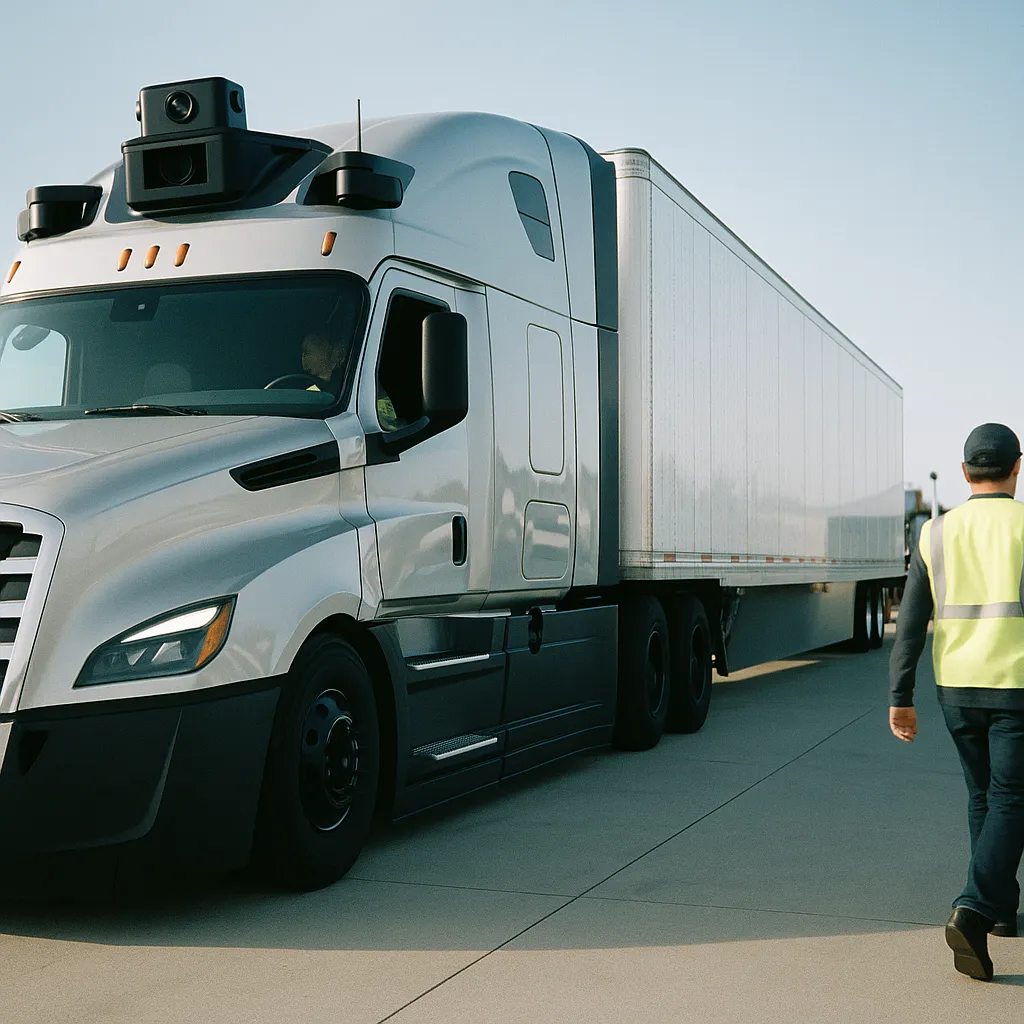
Aurora Innovation's commercial Sun Belt deployments have settled the question of whether autonomous commercial vehicles will operate at scale on U.S. roads. The question now is how fast the regulatory and infrastructure environment will allow the transition to accelerate.
Aurora's approach focuses on defined corridors where the regulatory pathway is clearest. The Sun Belt strategy is not just about weather — it reflects where state regulatory frameworks are most accommodating. Texas, Arizona, and Florida have created environments where commercial AV operations can proceed without the friction that slows deployments in other states.
The $3.25 billion 2035 projection for autonomous freight assumes continued regulatory progression. A high-profile safety incident or significant regulatory setback could compress that trajectory materially. Conversely, if Aurora's 200-truck milestone is met on schedule, it accelerates every similar deployment conversation across the industry — with investors, with customers, and with regulators who are watching commercial viability before finalizing AV trucking frameworks.
What Shippers and Fleet Operators Should Be Doing Now
The gap between AI-enabled and non-AI-enabled logistics providers is widening fast, and it shows up in measurable ways: cost, reliability, capacity visibility, and the quality of real-time data available to the shipper. Procurement teams that don't understand AI capabilities when evaluating logistics partners are likely leaving margin on the table.
Practical priorities:
- Audit your carrier's AI capabilities during evaluation. Ask specifically about predictive maintenance integration, AI-driven routing, and automated exception management. The answers now distinguish tier-one carriers from the rest.
- Review predictive maintenance data sharing in fleet contracts. If your carrier's AI generates maintenance forecasts and capacity predictions, you should have access to that data — it directly affects your supply chain planning.
- Build autonomous freight into 2027 planning. If your supply chain runs through Sun Belt corridors, the carrier mix available to you is changing. Understanding how autonomous carriers will price capacity — and how their service level characteristics differ from human-driven fleets — matters for contracts you're writing now.
What to Watch
Aurora's year-end milestone for 200+ driver-out trucks is the most immediate credibility test for autonomous commercial freight. If Aurora meets the target, it accelerates deployment conversations across the industry. If it falls short, expect a recalibration of timelines — but not a reversal. The underlying economics of autonomous freight are too compelling for this to be a question of if, only when.
Separately, watch for C.H. Robinson's next milestone disclosure. The 3 million tasks figure is the first time a major freight broker has put a specific operational number on AI automation at this scale. If it becomes standard practice for brokers to disclose AI task volumes, it will create a new benchmark for evaluating logistics providers — one that traditional capacity metrics don't capture.
Reporting based on AI Business Magazine's April 2026 analysis of AI adoption in logistics and autonomous freight.
Did this help you understand AI better?
Your feedback helps us write more useful content.
Get tomorrow's AI briefing
Join readers who start their day with NexChron. Free, daily, no spam.