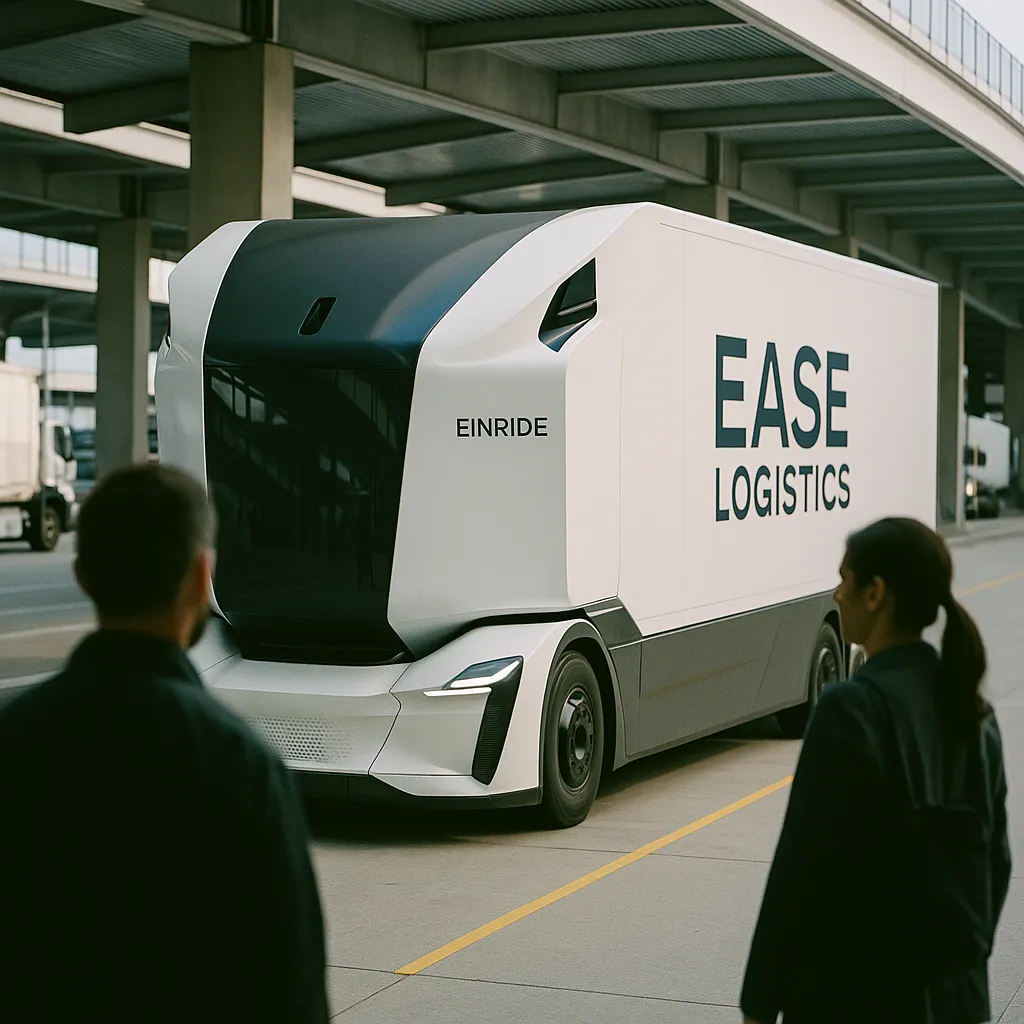
Chinese manufacturer XCMG unveiled a cab-less autonomous electric truck designed for industrial parks and ports — removing the driver's cab entirely to produce a vehicle purpose-built for environments where a human will never operate it.
Chinese heavy equipment manufacturer XCMG has unveiled a fully autonomous, cab-less electric truck designed for closed industrial parks and port logistics — removing the driver's cab entirely to produce a vehicle purpose-built for environments where a human will never sit in it.
The design choice is significant. Most autonomous trucks on the market are conventional trucks with added sensors and software, built to operate on public roads where regulatory approval requires maintaining the capability for a human driver to take control. XCMG's vehicle abandons that constraint entirely, positioning it for the substantial segment of industrial freight that never leaves a controlled site.
The vehicle
According to The Driven, the cab-less tractor uses LiDAR, cameras, and onboard AI to navigate fixed-route environments autonomously — moving containers, trailers, and bulk cargo between loading zones, storage areas, and staging points without any human operator present or on standby.
Removing the cab lowers the vehicle's center of gravity and reduces overall weight, improving both stability under heavy loads and energy efficiency per kilometer. The electric drivetrain produces zero tailpipe emissions, a growing requirement in Chinese port and industrial facilities responding to urban air quality regulations.
XCMG has not published range figures or battery capacity specifications for the truck tractor, but the use case — fixed-route loops in a contained environment — favors overnight charging at defined return points rather than long-haul range.
Why the closed-site market is a smart entry point
Get this in your inbox.
Daily AI intelligence. Free. No spam.
The economics of autonomous trucking work best in predictable, controlled environments. Variable road conditions, pedestrian traffic, construction zones, and weather create the edge cases that make Level 4 autonomy on public roads expensive to achieve and slow to certify.
Inside an industrial park or port, the environment is measurable and largely static. Routes are fixed. Speeds are low. Obstacles are predictable. AI navigation systems trained on this kind of environment can achieve high reliability faster and at lower cost than highway autonomous systems.
Several players have already validated this logic commercially — Venti Technologies in North American port and yard environments, and Westwell in Chinese container terminals. XCMG's entry brings the scale and manufacturing cost advantage of China's largest construction machinery manufacturer into a market that is maturing but not yet consolidated.
China's strategic position
China is moving faster than Western manufacturers on purpose-built autonomous industrial vehicles partly because the regulatory pathway for closed-site operation is more defined — domestic standards for autonomous industrial vehicles operating within designated zones have been clearer and faster to obtain than public-road AV approvals in either the U.S. or EU.
XCMG has manufacturing scale that startup AV logistics companies cannot match. At full production rates, XCMG produces tens of thousands of heavy machinery units annually. Applying that manufacturing infrastructure to autonomous industrial vehicles means the unit economics of cab-less autonomous trucks can get competitive with conventional vehicles faster in China than in markets where the supply chain remains bespoke.
What to watch
XCMG has not announced commercial pricing or delivery timelines. The truck was unveiled rather than launched — meaning customer pilots, safety certifications for industrial environments, and supply chain readiness remain ahead of it.
The near-term signal to watch is whether Chinese port operators — the most data-dense, efficiency-driven logistics operators in the world — begin placing orders. Chinese ports have already deployed thousands of automated guided vehicles (AGVs) and overhead cranes. A cab-less autonomous truck that interoperates with existing port automation infrastructure would fill a key gap in fully automated port operations. If XCMG can demonstrate that integration, the commercial case becomes straightforward.
Did this help you understand AI better?
Your feedback helps us write more useful content.
Get tomorrow's AI briefing
Join readers who start their day with NexChron. Free, daily, no spam.