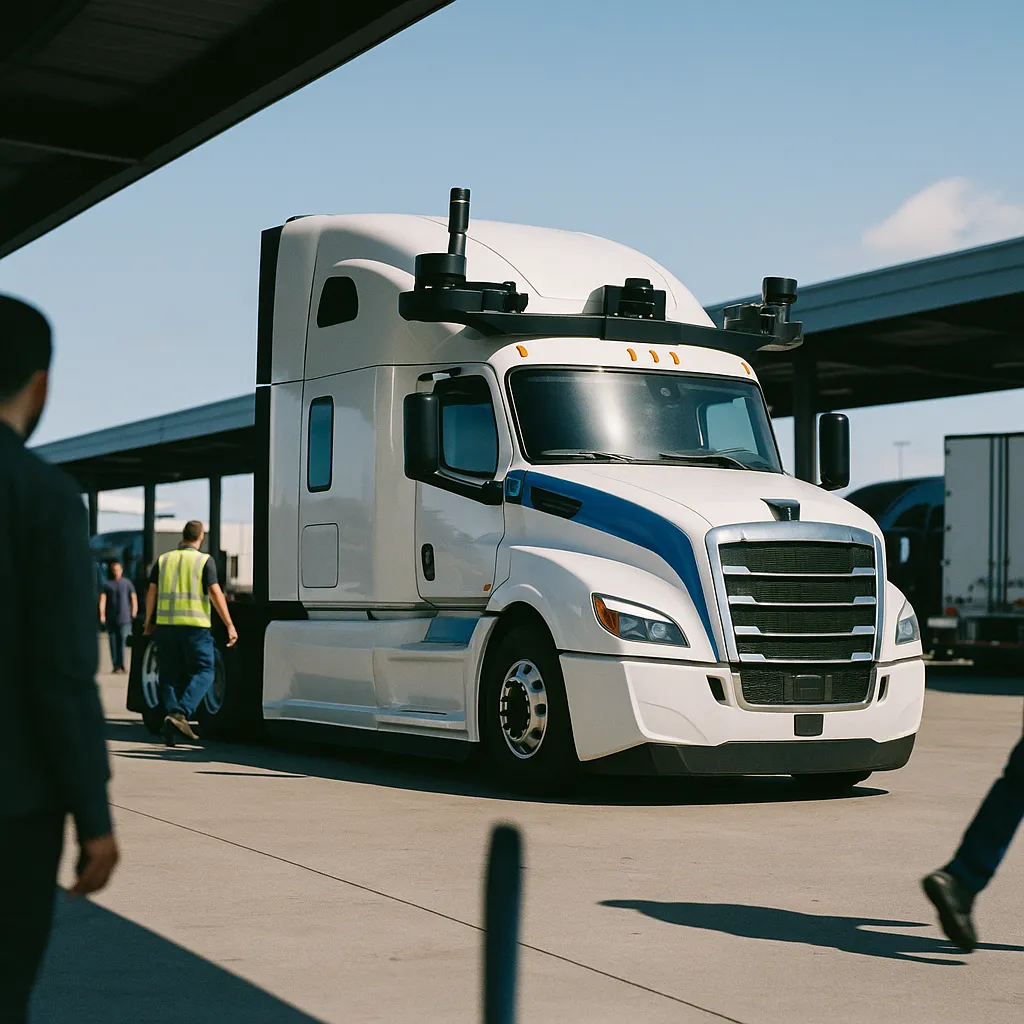
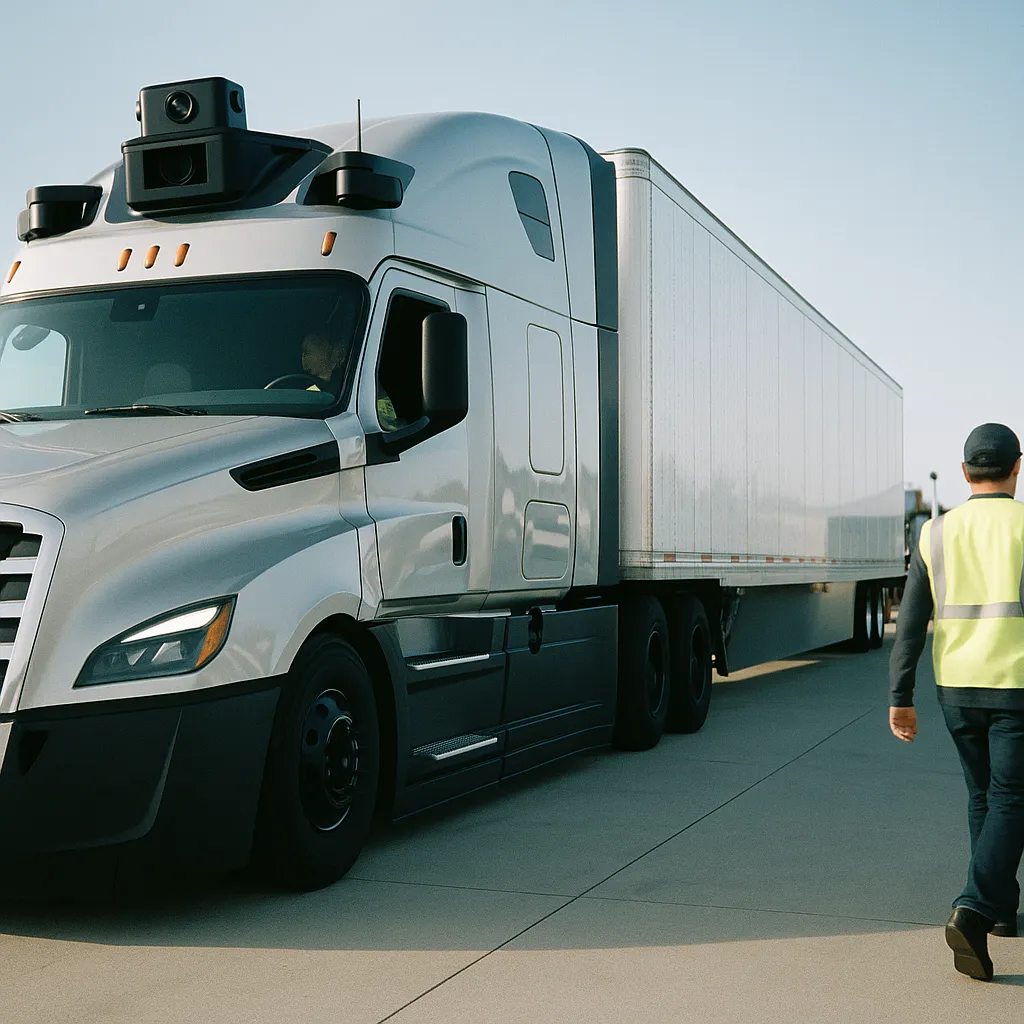
Aurora Innovation has driven 250,000 fully driverless commercial trucking miles across Sun Belt freight lanes with zero system-attributed collisions — a milestone analysts are calling the autonomous trucking inflection point.
Aurora Hits 250K Driverless Miles With Zero Crashes
Date: 2026-06-08
Slug: aurora-250k-driverless-miles-commercial-trucking-2026
SEO Keyword: autonomous trucking commercial miles 2026
Meta Title: Aurora Hits 250K Driverless Miles With Zero Crashes
Meta Description: Aurora Innovation reaches 250,000 driverless commercial miles with zero collisions, as analysts call 2026 the inflection year for autonomous trucking.
Source URLs: ["https://www.nextmsc.com/blogs/what-is-driving-the-next-phase-of-autonomous-vehicle-adoption-in-2026"]
Tags: ["autonomous-trucking", "aurora-innovation", "kodiak-robotics", "gatik", "driverless", "freight", "logistics", "transport-2026"]
TL;DR
- Aurora Innovation has logged 250,000 driverless commercial trucking miles across ten Sun Belt freight lanes with zero system-attributed collisions.
- Kodiak Robotics (with J.B. Hunt) and Gatik (with Walmart) are posting comparable milestones, signaling an industry-wide shift, not an isolated company story.
- Industry analysts are calling 2026 the inflection year when autonomous trucking moves from extended proof-of-concept into scaled commercial freight infrastructure.
Aurora Innovation has crossed 250,000 miles of fully driverless commercial freight operations across ten Sun Belt lanes — with no collisions attributed to the Aurora Driver system. This is not a test; these are live freight lanes carrying real commercial cargo for paying customers, and the milestone, combined with parallel achievements from Kodiak Robotics and Gatik, is shifting how the logistics industry calculates the timeline for autonomous trucking at scale.
Industry analysts tracking the sector are no longer asking whether autonomous commercial trucking will achieve commercial viability. The question has moved to how fast the network expands beyond the initial Sun Belt corridors.
The State of Autonomous Trucking Heading Into 2026
The autonomous trucking sector spent most of the early 2020s in a prolonged testing phase that, to outside observers, looked indistinguishable from stagnation. Companies burned through capital. Timelines slipped. Safety drivers remained in cabs. A few high-profile exits — including TuSimple's collapse under regulatory scrutiny in 2023 — reinforced skepticism about whether the technology was as close to deployment as the industry claimed.
What changed was discipline, not just technology. The companies that survived rationalized their geographic ambitions, focused on specific freight corridors rather than attempting national coverage immediately, and invested deeply in the edge-case handling that causes driverless systems to fail. The result is a smaller number of companies operating in tighter geographies with far more operational credibility than the sector had two years ago.
Aurora, Kodiak, and Gatik are the primary survivors of that shakeout, and each has taken a distinct approach to proving the model before scaling it.
Aurora: 250,000 Miles and the System-Attributed Collision Standard
Aurora's 250,000-mile mark across ten Sun Belt commercial freight lanes is the headline number, but the qualifier matters as much as the figure. Zero system-attributed collisions means zero incidents where the Aurora Driver — the company's autonomous driving system — was at fault. A system-attributed collision is one caused by the AV's own decisions or failures, not by the unpredictable actions of other human drivers on the road. The distinction is important because any vehicle operating on public roads will eventually be involved in incidents caused by other drivers; the question for autonomous system safety is whether the system itself is the cause.
Get this in your inbox.
Daily AI intelligence. Free. No spam.
Aurora's ten Sun Belt lanes connect major freight nodes across Texas, Arizona, and Florida — the geography is not accidental. These corridors combine high freight volume, favorable weather year-round (reducing the sensor degradation caused by snow and ice), and regulatory environments that have been proactively accommodating to autonomous commercial vehicle testing and operation. Texas in particular has become the de facto national proving ground for autonomous trucking, with a regulatory framework that allows driverless commercial operation without the patchwork of permits required in states with more restrictive rules.
The commercial model is also proving out. Aurora is not running its own freight; it is operating as a technology provider on lanes where its shipper and carrier partners are paying customers. That commercial structure — technology company selling miles rather than owning trucks — is what separates a viable long-term business from a capital-intensive trucking operation. It also aligns Aurora's incentives with safety and uptime: the company only gets paid when the system runs reliably.
Kodiak and Gatik: The Peer Milestones That Make This an Industry Story
Aurora's number matters more because it is not standing alone. Kodiak Robotics, operating driverless freight lanes with J.B. Hunt — one of the largest trucking carriers in the United States — is posting comparable safety and operational milestones on its own corridor network. J.B. Hunt's involvement is significant: this is not a startup-to-startup partnership, it is a major incumbent carrier treating autonomous trucking as a core logistics capability, not an experiment.
Gatik has taken a different route, literally. Rather than long-haul interstate corridors, Gatik has focused on middle-mile logistics — the high-frequency, fixed-route movements between distribution centers and retail locations. Its partnership with Walmart on driverless routes is an operationally different use case: shorter distances, predictable stops, and the kind of route consistency that plays to autonomous systems' strengths. Walmart's scale means that even a relatively small number of Gatik lanes represents meaningful freight volume.
The three companies are not competing for the same exact freight, which is useful context: the autonomous trucking opportunity is large enough to support differentiated strategies, and multiple simultaneous commercial deployments across different lane types strengthen the industry-wide case.
What This Means for Carriers, Drivers, Shippers, and Costs
The freight industry's cost structure is under pressure from multiple directions, and autonomous trucking addresses the most persistent one: driver availability and compensation. The American Trucking Associations has documented a persistent driver shortage that fluctuates with economic conditions but has not resolved structurally. Autonomous systems operating on fixed interstate corridors do not eliminate the need for drivers — local pickup and delivery still requires human operation — but they reduce the driver-hours required for the highest-volume, most repetitive portion of a long-haul movement.
For large shippers, the operational implications extend beyond cost. Autonomous trucks can run legally for more consecutive hours than human drivers under federal Hours of Service regulations, which cap daily drive time to prevent fatigue-related accidents. A driverless truck running a Texas-to-Florida corridor can, in principle, operate through the night and deliver at a time that optimizes warehouse receiving schedules rather than driver rest requirements. That scheduling flexibility has real supply chain value that does not show up directly in per-mile cost comparisons but affects inventory management and delivery reliability.
For existing truck drivers, the transition is more complicated. Middle-mile autonomous displacement is real; the jobs most directly at risk are the long-haul interstate runs that autonomous systems are being built to perform. The mitigation argument — that demand for freight will grow and local driving jobs will remain human-operated — is plausible but has not been tested at scale. What the industry has not done well is build retraining pathways that match the timeline of deployment rather than lagging behind it.
For freight carriers and logistics operators, the strategic question is when to integrate autonomous capacity rather than whether to. The carriers partnering with Aurora and Kodiak now are building operational familiarity and procurement relationships that carriers who wait will have to build under competitive pressure later.
What to Watch
The Sun Belt footprint will not stay static. Watch for Aurora and Kodiak to announce corridor expansions into the Midwest — the I-35 and I-70 corridors connecting Texas freight nodes to distribution centers in Kansas City, Chicago, and Columbus are logical extensions of existing Sun Belt operations. Weather complexity increases, but the operational learnings from 250,000 Sun Belt miles provide a foundation.
Watch for regulatory movement at the federal level. The National Highway Traffic Safety Administration (NHTSA) has been developing a federal framework for autonomous commercial vehicles that would preempt the current state-by-state patchwork. A federal AV framework would dramatically simplify the pathway to national network operation and is the single regulatory lever most likely to accelerate scale.
Watch the economics of the technology stack. Aurora's sensor and compute costs have been declining with volume; the unit economics of the Aurora Driver improve as miles accumulate. Watch for the company to publish or disclose cost-per-mile figures that would let the market directly compare autonomous operations against driver-operated lanes. Transparency on that number — even directionally — would accelerate carrier adoption decisions.
2026 looks like the year the industry stopped proving it could work and started proving how fast it could grow. The 250,000-mile mark is the credibility baseline. The question now is what the number looks like at the end of 2027.
Hector Herrera covers AI in transportation and logistics for NexChron.com.
Did this help you understand AI better?
Your feedback helps us write more useful content.
Get tomorrow's AI briefing
Join readers who start their day with NexChron. Free, daily, no spam.