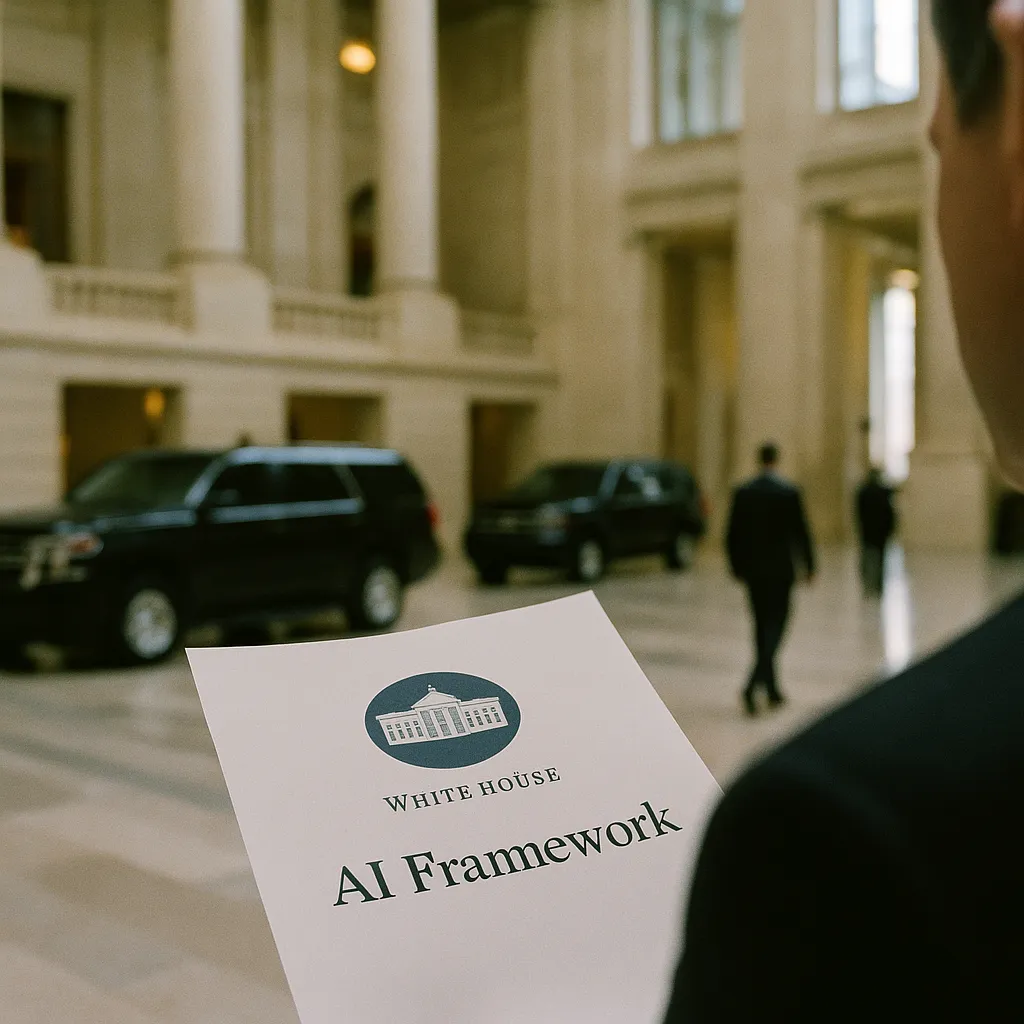
The Trump administration wants Congress to override state AI laws that impose undue burdens — and refuses to create any new federal AI regulator to fill the gap.
White House AI Framework Would Wipe Out State AI Laws — and Skip a Federal Regulator
By Hector Herrera | April 24, 2026 | Government
The Trump administration's AI policy framework, released in March 2026, calls on Congress to override state AI laws that "impose undue burdens" on AI development — setting up a direct collision with dozens of state laws already on the books. At the same time, the framework explicitly refuses to create any new federal AI regulator, leaving a governance gap at precisely the moment AI systems are entering healthcare, law, financial services, and employment decisions at scale.
The National Policy Framework for Artificial Intelligence is the most detailed statement yet from the current administration on how AI should be governed in the United States — and its central thesis is that existing federal agencies should handle AI oversight, states should not impose their own rules, and a unified national standard should prevail. Holland & Knight's analysis of the March 2026 document provides the most thorough public read of its provisions.
What the Framework Actually Says
The preemption recommendation is the most consequential provision. The framework recommends that Congress pass legislation preempting — legally overriding — state AI laws that the administration determines impose "undue burdens" on AI innovation or deployment.
The practical effect: state laws regulating automated employment decisions (Colorado, Illinois), facial recognition (several states), AI in healthcare (multiple states), and AI transparency requirements (various) could all be nullified by a single federal statute. States that have spent years building out AI consumer protections would see that work superseded.
The framework's alternative to new federal regulation routes oversight through existing agencies:
- FTC handles consumer protection issues involving AI
- FDA handles AI in medical devices
- EEOC handles AI in employment decisions
- NHTSA handles autonomous vehicles
- No new dedicated AI agency or regulator
The Problem With This Architecture
The problem with routing all AI oversight through existing agencies is that none of them were designed for AI. Their statutory authority, enforcement capacity, and technical expertise are all calibrated for different problems.
Get this in your inbox.
Daily AI intelligence. Free. No spam.
The FTC can bring unfair and deceptive practices cases after harm occurs. It cannot proactively approve AI systems before deployment, mandate algorithmic audits across an industry, or require structured transparency disclosures the way a dedicated AI regulator could.
According to Holland & Knight's assessment, major liability questions remain unresolved under the framework's structure: when an AI system causes harm, who is legally responsible — the developer, the deployer, or the end user? Existing tort law and product liability doctrine was written before autonomous AI systems existed. The framework doesn't resolve this.
What This Means for Different Stakeholders
For AI companies and enterprise AI deployers: The framework is good news in the short term. No new dedicated regulator means no new compliance structure to build against. Federal preemption, if enacted, would eliminate the current patchwork of state laws that create compliance complexity for products deployed nationally.
For companies operating in states with stronger AI protections: The calculus depends entirely on whether Congress acts and which state laws federal preemption would reach. Until that legislation exists, state laws remain in force.
For consumers: The framework's outcome depends entirely on how vigorously existing agencies enforce AI-related harms. Consumers in states with stronger AI protections — mandatory algorithmic auditing, consent requirements, right to explanation — could lose those protections under federal preemption without equivalent federal replacements.
For legal teams advising on AI compliance: Maximum uncertainty. Congressional action is not guaranteed. State AGs in California, Colorado, and New York are unlikely to stand down. The EU AI Act continues to apply to systems deployed to European users regardless of what the US government decides domestically.
What to Watch
Whether Congress introduces and advances a federal AI bill in 2026 that operationalizes the preemption recommendation — and if so, how broadly "undue burden" is defined. How California's legislature and attorney general respond; California has historically led US tech regulation, and a federal preemption fight over AI could ultimately reach the Supreme Court.
And whether the EU's AI Act creates market pressure that effectively forces US companies to comply with higher transparency and accountability standards regardless of what federal law requires — making the domestic regulatory debate less determinative than it appears.
Hector Herrera covers AI policy and government for NexChron.
Did this help you understand AI better?
Your feedback helps us write more useful content.
Get tomorrow's AI briefing
Join readers who start their day with NexChron. Free, daily, no spam.