AI Job Cuts Reach 50,000 in 2026 as Entry-Level Hiring Collapses
Companies have linked nearly 50,000 layoffs to AI in 2026, but economists warn the bigger story is a collapse in entry-level hiring that isn't showing up in standard layoff data.
Top Stories
All Sections
Finance
About
16 results for "labor market"
Companies have linked nearly 50,000 layoffs to AI in 2026, but economists warn the bigger story is a collapse in entry-level hiring that isn't showing up in standard layoff data.
April 2026 job openings hit a 12-month peak, yet application volume fell 10%. New ICIMS data shows 78% of Gen Z job seekers believe AI is changing available roles — and only 19% feel confident about their career trajectory.
Unemployment for workers aged 22-27 has risen to 5.4% as AI cuts early-career knowledge work—while Ford, AT&T, and others ramp up hiring for skilled trades.
37% of business leaders plan to replace human employees with AI by end of 2026, largely by not replacing departing workers — a silent downsizing that labor statistics are not yet capturing.
Yale SOM researchers find AI's most damaging near-term labor impact is not mass layoffs but a silent contraction in entry-level hiring — companies let AI handle junior tasks and simply don't backfill the headcount.
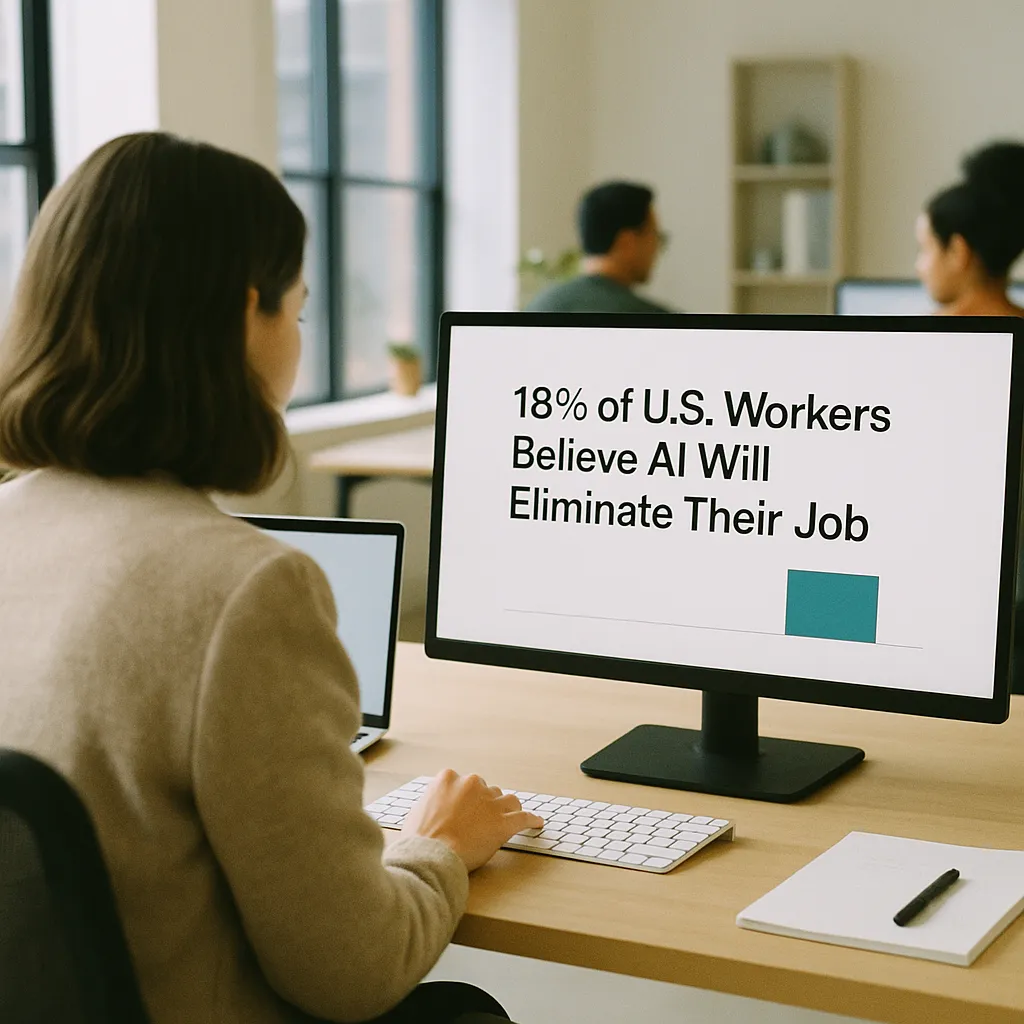
New Gallup data finds 18% of U.S. workers believe their job could be eliminated by AI within five years — and the number is higher, not lower, among workers whose companies have already deployed AI tools.
Goldman Sachs projects AI will displace 6–7% of the U.S. workforce over 10 years — roughly 10 million workers — with white-collar earners under $80,000 most exposed.
UNICEF Innocenti research finds women hold 86% of jobs most exposed to AI-driven displacement — concentrated in administrative, clerical, and customer-service roles that prior automation waves left untouched.
Yale's Budget Lab analyzed March 2026 CPS data and found no measurable economy-wide labor disruption from AI — raising sharp questions about whether companies citing AI for layoffs are engaging in AI-washing.
A new Gallup survey finds 18% of US workers believe AI will eliminate their job within five years — rising to 23% at organizations that have already deployed AI tools.
The U.S. tech industry eliminated ~80,000 jobs in Q1 2026, with 47.9% formally attributed to AI — the first quarter AI is the plurality cause of tech-sector layoffs.
Anthropic's new labor market research finds AI is augmenting most roles rather than eliminating them — but with sharp task-level variation that existing economic models miss.
Goldman Sachs calculates AI is eliminating 16,000 U.S. jobs per month, with Gen Z workers bearing the brunt as AI automates the entry-level white-collar roles they depend on.
Goldman Sachs found AI directly responsible for 16,000 U.S. job eliminations per month, with Gen Z workers concentrated in the white-collar roles hit hardest.
AI is eliminating roughly 16,000 U.S. jobs every month, and Generation Z workers are absorbing a disproportionate share of that displacement — because they are concentrated in exactly the roles AI automates first.
Goldman Sachs research finds AI is now eliminating 16,000 U.S. jobs per month, with Gen Z workers bearing disproportionate impact due to their concentration in entry-level white-collar roles that AI automates most effectively.