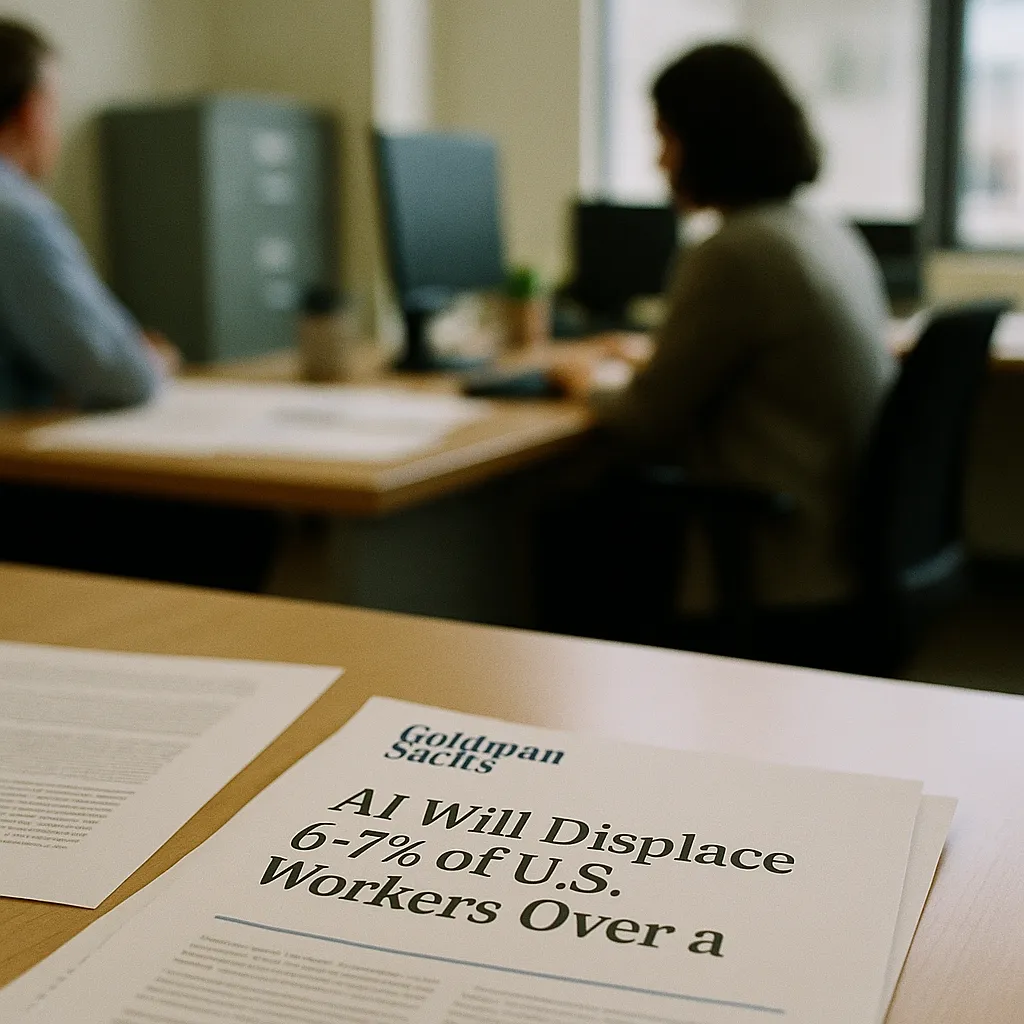
Goldman Sachs projects AI will displace 6–7% of the U.S. workforce over 10 years — roughly 10 million workers — with white-collar earners under $80,000 most exposed.
Goldman Sachs: AI Will Displace 6–7% of U.S. Workers Over a Decade
By Hector Herrera | May 6, 2026 | Work
Goldman Sachs economists project that AI will displace 6 to 7 percent of the U.S. workforce over roughly a 10-year adoption cycle — a number that sounds modest until you do the math: it represents approximately 10 million workers. That figure is notably more measured than the viral forecasts of mass automation that have dominated headlines, but the Goldman analysis also contains a finding that gets less attention: tasks equivalent to 25% of all U.S. work hours are already technically automatable with current AI systems.
The Forecast in Context
The labor displacement debate has been pulled in two directions. One camp produces projections of 40–50% of jobs at risk, drawing on task-automation studies from the early 2020s. The other camp cites historical precedent from prior technology waves — mechanization, computing, the internet — and notes that displaced workers tend to find new roles in new industries over time.
Goldman's projection sits in neither extreme. The bank is not arguing that AI will spare the workforce. It is arguing that the displacement will play out over a decade, not overnight — and that the pace of adoption, not the ceiling of capability, is what determines how severe the transition shock feels.
That framing matters for policy, for employers, and for workers trying to figure out what to learn next.
Get this in your inbox.
Daily AI intelligence. Free. No spam.
Who Is Most Exposed
The Goldman analysis points to white-collar workers earning under $80,000 annually as the most exposed cohort. This is a departure from the earlier automation wave, which primarily displaced blue-collar manufacturing and routine back-office work. AI's current capability profile — language, reasoning, document processing, customer communication — maps directly onto the mid-skill, mid-wage service jobs that were previously considered automation-resistant.
The tasks most at risk include:
- Data entry and document processing — AI handles these at near-human accuracy and far higher speed
- Customer service scripting — AI agents now handle complex multi-turn conversations across regulated industries
- First-pass analysis and reporting — summarization, trend identification, routine financial modeling
- Paralegal and compliance research — document review and citation work, already being automated at law firms and banks
- Entry-level coding and QA — though this affects higher earners too
Notably, the analysis finds that high-skill, high-wage knowledge workers face significant task automation but not necessarily job displacement — because their roles involve judgment, client relationships, and novel problem-solving that AI augments rather than replaces. A senior attorney whose junior associates are replaced by AI doesn't lose her job; she loses her leverage to bill for research hours.
Why 10 Years, Not Tomorrow
The bank's 10-year timeline reflects how technology actually diffuses through the economy, not how fast any particular AI model improves. Enterprise adoption involves procurement cycles, integration work, regulatory approval (especially in finance and healthcare), workforce retraining, and cultural change management. Most Fortune 500 firms are still in early-stage AI deployment despite two-plus years of intense investment.
The industries moving fastest — financial services, legal, healthcare administration, customer support — are also the ones with the highest white-collar density in that under-$80K band. That concentration means even a gradual 10-year displacement curve could land hard on specific sectors and specific cities.
What Employers Are Actually Doing
The data on enterprise AI spending suggests the displacement is already underway at the task level, even if job counts haven't moved sharply yet. Firms are automating tasks, not eliminating headcount in bulk — at least for now. They're using AI to avoid backfilling attrited roles, to let teams handle higher volumes without hiring, and to shift staffing mix toward fewer, higher-skilled workers.
That pattern is consistent with Goldman's 6–7% displacement projection. It doesn't require mass layoff announcements. It plays out quietly through attrition, hiring freezes, and restructured job descriptions.
What to Watch
The leading indicator isn't layoff announcements — it's job posting volume in the exposed categories. If postings for data entry, customer service, and junior analyst roles drop meaningfully over the next 18 months even as the broader labor market stays tight, that's evidence the Goldman timeline is playing out on schedule or faster. Congress has produced no legislative response to AI-driven labor displacement; the policy gap is significant and growing.
Did this help you understand AI better?
Your feedback helps us write more useful content.
Get tomorrow's AI briefing
Join readers who start their day with NexChron. Free, daily, no spam.