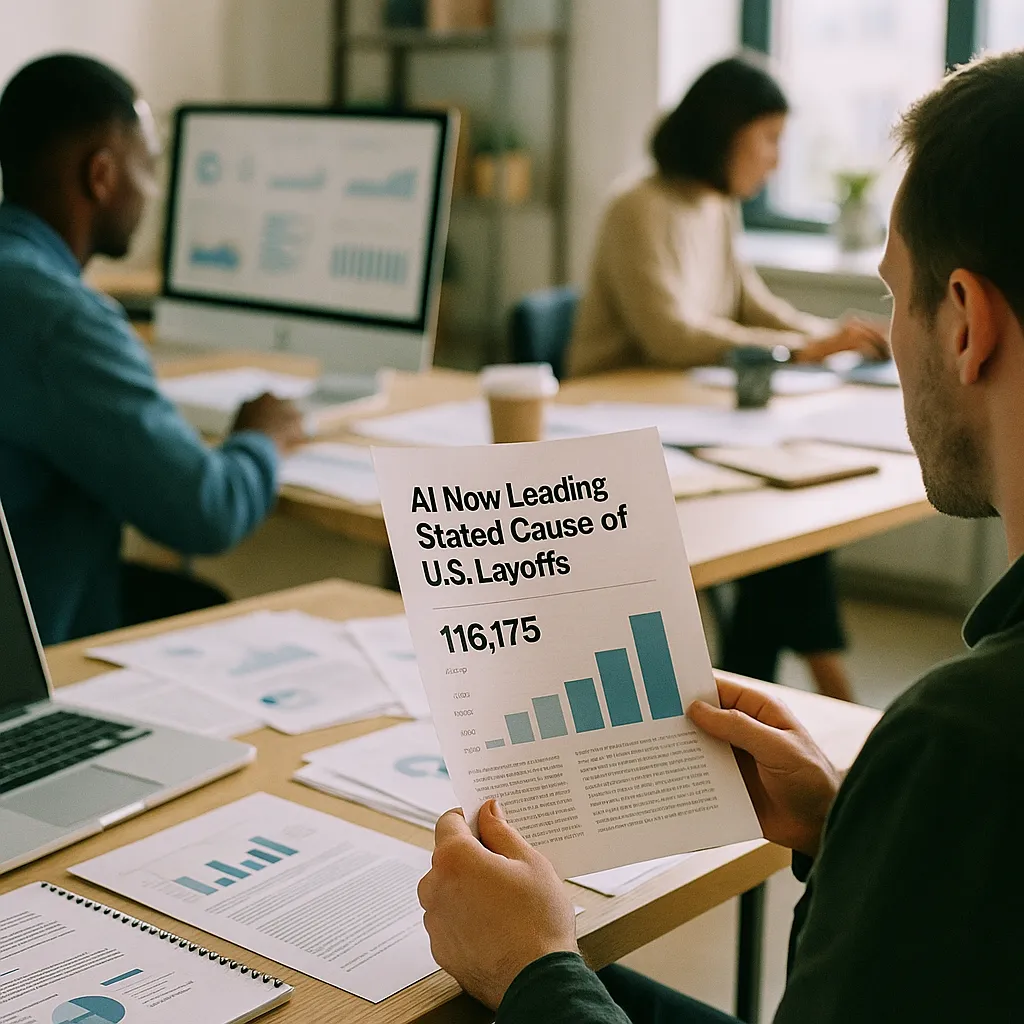
Goldman Sachs found AI directly responsible for 16,000 U.S. job eliminations per month, with Gen Z workers concentrated in the white-collar roles hit hardest.
AI Is Eliminating 16,000 U.S. Jobs Per Month — and Gen Z Is Paying the Highest Price
By Hector Herrera | April 23, 2026 | Work
A Goldman Sachs analysis released earlier this month put a concrete number on AI-driven job displacement: roughly 16,000 U.S. positions eliminated per month, directly attributable to AI tools. The data point is significant not just for its scale, but for who is absorbing the losses — Gen Z workers, the cohort that entered the workforce just as AI became capable enough to do their jobs.
This is not a prediction. It is current-state data from April 2026.
What the Data Actually Says
Goldman Sachs' analysis, reported by Fortune on April 6, found that AI is directly responsible for approximately 16,000 U.S. job eliminations per month. The figure represents direct displacement — positions that were cut because an AI tool now handles the work — rather than the broader category of jobs that have been restructured or modified.
A companion study cited by CNN adds the long-term context that makes this number alarming: technology-displaced workers' real earnings remain 10 percentage points below their peers a full decade after displacement. This is not a temporary disruption followed by retraining and recovery. For many workers, it is a permanent earnings reduction.
The sectors hit hardest are white-collar administrative and content roles:
- Data entry and processing
- Customer support and triage
- Legal assistance and document review
- Billing, coding, and claims work
- Basic content writing and research
These are not senior engineers or product managers. These are entry-level and mid-tier roles that have historically served as the on-ramp to professional careers.
Why Gen Z Is Disproportionately Exposed
Gen Z workers — broadly, those born between 1997 and 2012, now ages 14–29 — are concentrated in exactly the job categories that current AI handles best. The generation entered a workforce where the "starter job" in many white-collar fields was administrative, clerical, or content-oriented. Those are the roles disappearing.
Get this in your inbox.
Daily AI intelligence. Free. No spam.
There is a structural irony here. Gen Z is the most digitally fluent generation in history. They grew up with smartphones, adopted AI tools faster than their older colleagues, and built careers on digital platforms. But fluency with tools that exist is different from being structurally insulated from tools that replace you.
The on-ramp is being automated away. Junior roles in law firms, insurance companies, healthcare billing departments, and marketing agencies are the positions most exposed. These were the roles where you learned the industry, built your network, and accumulated the judgment that eventually made you valuable at senior levels. When those roles disappear, the pathway to those senior levels is disrupted with them.
The Goldman analysis does not say these workers are unemployable. It says they are displaced — and that the earnings recovery from that displacement takes a decade or more.
The Retraining Problem
The standard policy response to labor displacement is retraining — community college programs, workforce development grants, employer-sponsored upskilling. There are at least two reasons that response is insufficient here.
First, retraining programs are designed to transition workers into fields with labor shortages. The current AI displacement is moving fastest in white-collar knowledge work — the very category that previous waves of retraining directed displaced manufacturing workers toward. The "retrain into office work" pathway that worked during factory automation is not available when the automation is in office work.
Second, the earnings data is damning. If displaced workers' real earnings remain 10 points below peers a decade later, one of three things is true: the retraining is not happening at scale, it is not working, or workers are re-entering the workforce in structurally lower-paying roles regardless of what skills they acquire. Any serious policy response has to account for which of those is happening.
What Businesses and Workers Should Do
For businesses deploying AI in roles that have historically been staffed by early-career workers:
- Audit your automation roadmap for hiring implications. If a process is being automated, the junior roles that supported that process need explicit attention — either redesign or clear transition paths, not accidental elimination.
- Invest in internal mobility before external displacement. Organizations that automate without building pathways for affected employees create both labor market damage and organizational culture problems.
- Do not conflate efficiency gains with workforce planning. Saving 200 hours a month on data entry does not tell you where the three people who did that work should go next.
For workers — especially those in early-career positions:
- Skills that AI currently cannot replicate reliably: relationship management, cross-functional judgment, physical presence, creative direction (as distinct from creative execution), negotiation, and contextual interpretation of genuinely ambiguous information.
- The career move that still makes sense: moving from execution to direction. Using AI to do work faster is itself a skill. Knowing when the AI output is wrong is a skill. Building workflows that combine AI and human judgment is a skill that employers will pay for.
- Do not wait for employer-sponsored retraining. The pace of displacement is faster than most corporate learning and development programs.
What to Watch
Two data points worth tracking over the next 12 months: first, whether the 16,000/month figure holds steady, accelerates, or decelerates as organizations complete their initial AI deployment cycles and economic incentives shift. Second, whether Congress responds to the earnings data with policy — portable benefits, wage subsidies, or retraining investment — or treats this as a private sector problem. As of April 2026, there is no federal legislation specifically designed to address AI-driven labor displacement.
The number is 16,000 per month. The question is whether the country has a plan for the next 16,000.
Hector Herrera is the founder of Hex AI Systems and editor of NexChron.
Did this help you understand AI better?
Your feedback helps us write more useful content.
Get tomorrow's AI briefing
Join readers who start their day with NexChron. Free, daily, no spam.