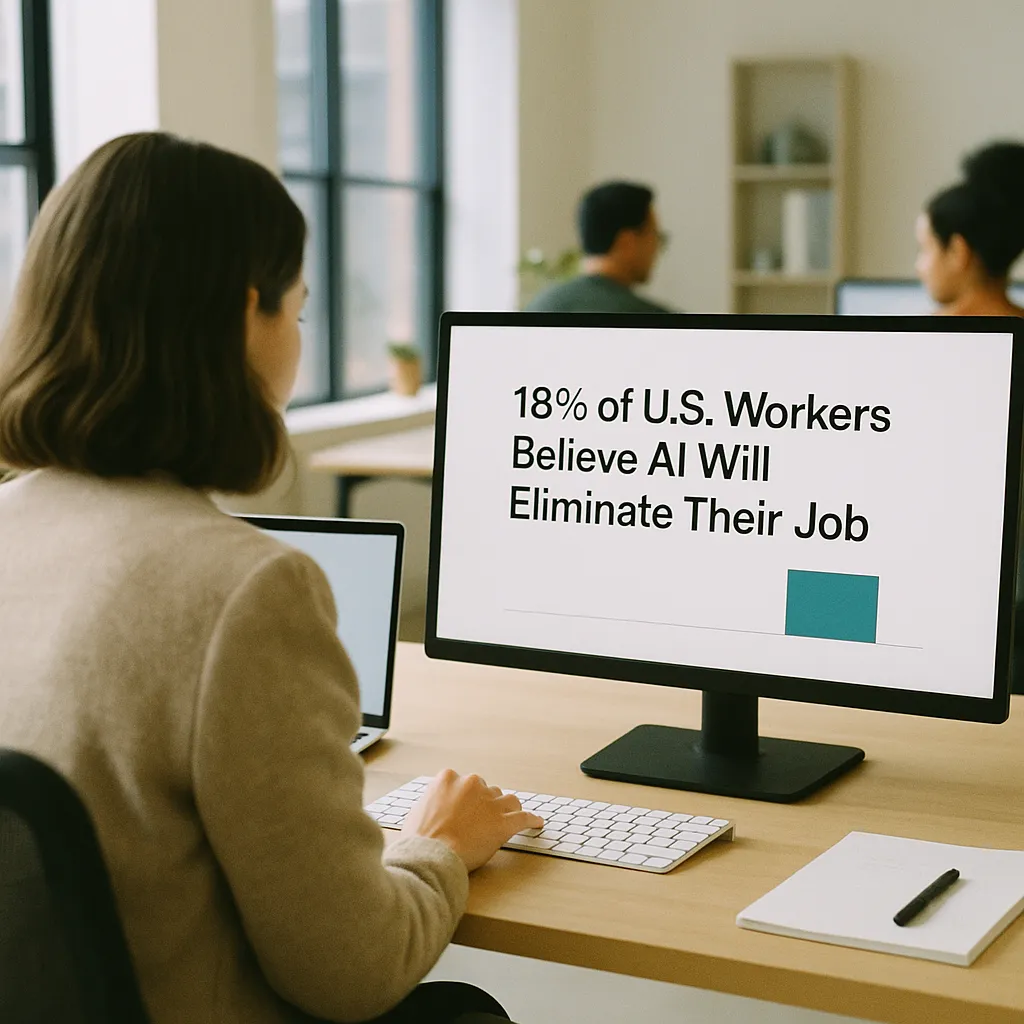
A new Gallup survey finds 18% of US workers believe AI will eliminate their job within five years — rising to 23% at organizations that have already deployed AI tools.
Gallup: 18% of US Workers Believe AI Will Eliminate Their Job Within Five Years
By Hector Herrera | April 30, 2026 | NexChron.com
Nearly one in five American workers believes AI will eliminate their job within five years — and that number rises to nearly one in four among employees who already work at AI-adopting organizations. Gallup's new survey is the most comprehensive measurement of AI job anxiety in the US workforce to date, and it reveals a disconnect that every employer deploying AI tools needs to take seriously: workers and employers are reading the same AI deployment story very differently.
The Numbers
Gallup's survey finds:
- 18% of all US employees consider it very or somewhat likely that AI will eliminate their job within five years
- That figure rises to 23% among workers at organizations that have already deployed AI tools — meaning firsthand experience with AI at work increases, not decreases, job elimination concern
- The anxiety is not confined to lower-wage or lower-skill workers. Concern is significant across income levels and industries, including sectors like finance, legal services, and professional services where AI is being deployed aggressively
The finding that exposure to AI increases fear of replacement is counterintuitive to the narrative most employers are using when they deploy AI tools. The standard management line is: "AI will make your job easier, not eliminate it." Workers who have actually seen AI deployed are less convinced.
What Gallup Says About the Reality of Job Elimination
Gallup's analysis makes an important distinction: task automation is not the same as job elimination.
The survey finds that most jobs in the US economy are unlikely to disappear entirely due to AI in the near term. What is changing, and changing substantially, is the composition of work within those jobs. Routine, repetitive, and information-processing tasks are being automated. What remains for human workers tends to require judgment, relationship management, creativity, and physical presence — elements that are harder to automate and more valuable to employers when AI handles the rest.
That framing is actually more threatening to many workers than outright job elimination. A job that eliminates its existing role is easy to see. A job that changes so substantially that your existing skills no longer match what's required is harder to plan for — and that kind of gradual displacement is what Gallup's data suggests is already underway.
The Employer-Employee Perception Gap
The most important finding in Gallup's data isn't the 18% headline. It's the gap between what employers say about AI and what employees are observing firsthand.
Employers deploying AI tools have consistently communicated that AI will augment worker productivity, not replace headcount. Many of those employer communications have been made in good faith — the intent at deployment often genuinely is productivity improvement, not headcount reduction.
But employees are watching what actually happens after AI is deployed. When productivity increases lead to team restructuring, when fewer new hires are made, when certain roles stop appearing in job postings — workers register those signals. The Gallup data suggests the employees closest to AI deployment are updating their beliefs toward concern, not reassurance.
Get this in your inbox.
Daily AI intelligence. Free. No spam.
This is a trust problem as much as a labor market problem. The employers who manage it well will be the ones who communicate honestly about what AI deployment means for specific roles — including acknowledging when the answer is "yes, fewer people will do this task" — and who invest in retraining and transition programs before workers feel blindsided.
Who Is Most Concerned
Gallup's data identifies several dimensions of AI job anxiety that are worth unpacking:
By industry: Workers in sectors with high AI deployment velocity — finance, legal services, customer service, administrative functions — show elevated concern. Manufacturing workers, counterintuitively, show lower concern than white-collar workers in information-intensive roles, partly because manufacturing workers have experienced automation waves before and understand the pattern.
By AI adoption at employer: The 23% figure for workers at AI-adopting organizations versus 18% overall is the starkest finding. Being at a company that has deployed AI is correlated with greater personal job anxiety, not less.
By role type: Workers whose jobs are primarily defined by information processing — data entry, basic analysis, document review, customer inquiry handling — report the highest concern. Workers in roles requiring complex judgment, physical presence, or interpersonal skills report lower (though still notable) concern.
What Employers Should Be Doing Differently
Gallup's analysis implies several concrete actions for organizations deploying AI:
Communicate honestly about what AI changes in specific roles. Generic reassurance that "AI won't take your job" is undermined when workers can see AI handling tasks that used to be part of their job description. Specific, role-level communication is more credible than company-wide talking points.
Invest in reskilling before it's urgent. Waiting until displacement is imminent to invest in worker retraining creates a much harder transition problem than beginning that investment when AI tools first arrive. Workers who feel the company is preparing them for the changed role are less anxious, not more.
Measure worker anxiety as a deployment metric. Most AI deployment projects track productivity metrics and cost savings. Few track employee sentiment about job security as part of the deployment review. Gallup's data suggests that's a gap — worker anxiety about AI is a leading indicator of turnover risk, productivity drag, and union organizing activity.
The Bigger Picture
The Gallup survey lands at a moment when the AI labor displacement debate has moved from academic economics to daily workplace experience. The question is no longer theoretical. Workers at companies deploying AI tools are observing the effects firsthand — and what they're observing is generating real anxiety at meaningful scale.
18% of the US workforce believing their job will be eliminated within five years represents tens of millions of people making career decisions, savings decisions, and political decisions based on that belief. Whether or not those workers are correct in their predictions, the belief itself is an economic variable.
Employers, policymakers, and AI developers who dismiss that anxiety as irrational are misreading the data. Gallup isn't measuring whether AI will eliminate jobs. It's measuring what workers believe — and that belief has its own consequences.
What to Watch
Watch for labor contract negotiations in industries with high AI adoption to increasingly include explicit language about AI deployment notification, retraining rights, and headcount protection clauses. Early versions of these provisions are already appearing in healthcare and legal sector union contracts.
Also watch whether the Gallup anxiety numbers move in Q3 and Q4 2026 as AI deployment accelerates. If concern continues to rise even as employers communicate reassurance, it will signal that the employer message isn't landing — and that more structural responses are needed.
Sources: Gallup
Did this help you understand AI better?
Your feedback helps us write more useful content.
Get tomorrow's AI briefing
Join readers who start their day with NexChron. Free, daily, no spam.