PwC's Global AI Jobs Barometer: AI Skills Now Command a 62% Wage Premium
PwC's 2026 AI Jobs Barometer finds AI has split the global labor market into two tracks, with AI-skilled roles growing 69% since 2019 and commanding a 62% wage premium.
Top Stories
All Sections
Finance
About
18 results for "AI jobs"
PwC's 2026 AI Jobs Barometer finds AI has split the global labor market into two tracks, with AI-skilled roles growing 69% since 2019 and commanding a 62% wage premium.
The Real Deal's June 2026 cover investigation finds leading CRE firms running leaner teams and faster deals, while mid-market brokerages face a widening AI adoption gap worth $34 billion by 2030.
MIT Technology Review's deep dive into 2026 labor data finds AI displacement is real in entry-level and back-office roles — but structurally unequal, hitting workers with the least institutional support hardest.
BCG's 2026 AI at Work report projects 10–15% of U.S. jobs eliminated and 50–55% fundamentally reshaped in five years — while 67% of heavy AI users report higher job satisfaction alongside rising cognitive load.
Infosys reports its under-30 workforce share has fallen to a 15-year low as AI absorbs the routine tasks that fueled mass entry-level IT hiring. Gartner projects AI will also eliminate more than half of middle management positions through 2026.
April 2026 job openings hit a 12-month peak, yet application volume fell 10%. New ICIMS data shows 78% of Gen Z job seekers believe AI is changing available roles — and only 19% feel confident about their career trajectory.
Unemployment for workers aged 22-27 has risen to 5.4% as AI cuts early-career knowledge work—while Ford, AT&T, and others ramp up hiring for skilled trades.
37% of business leaders plan to replace human employees with AI by end of 2026, largely by not replacing departing workers — a silent downsizing that labor statistics are not yet capturing.
General Motors cut more than 600 IT workers and is replacing them with AI engineers and data scientists — and called it a skills swap publicly.
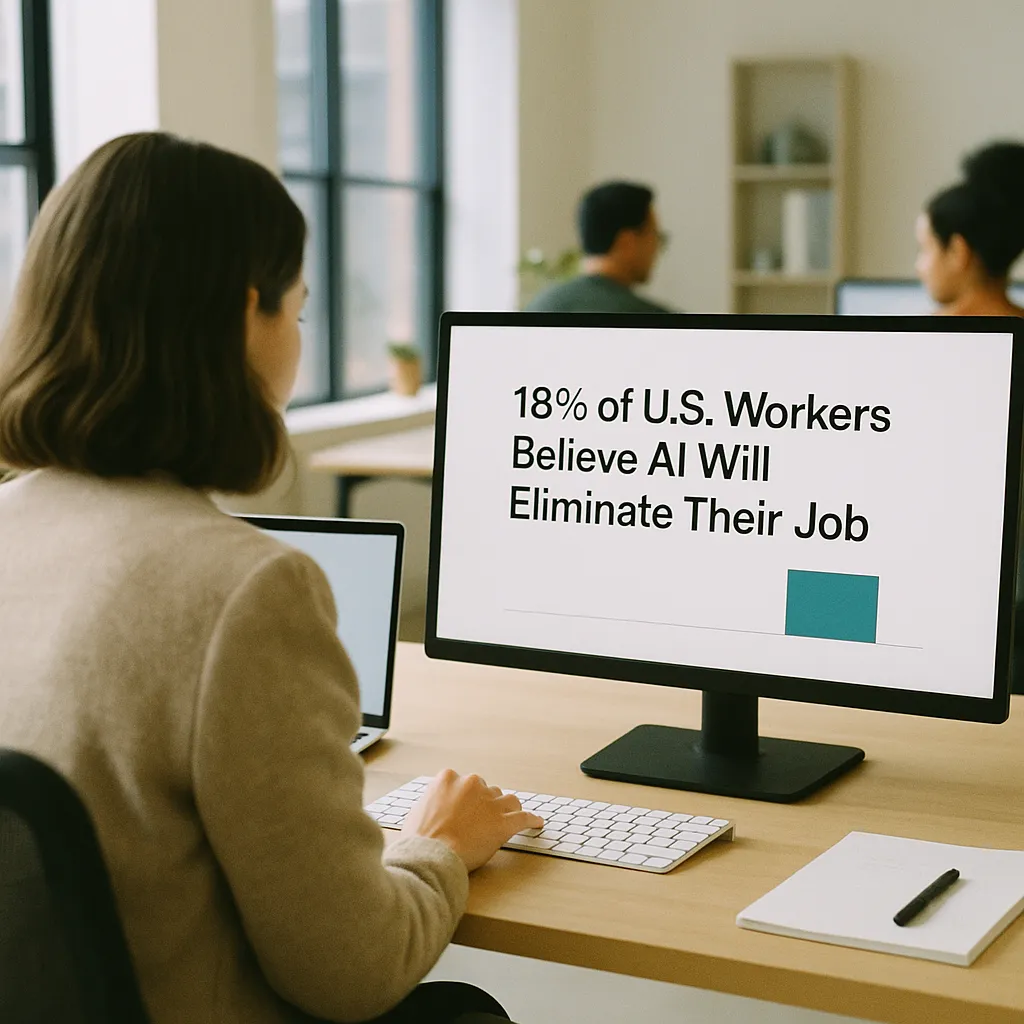
New Gallup data finds 18% of U.S. workers believe their job could be eliminated by AI within five years — and the number is higher, not lower, among workers whose companies have already deployed AI tools.
Yale's Budget Lab analyzed March 2026 CPS data and found no measurable economy-wide labor disruption from AI — raising sharp questions about whether companies citing AI for layoffs are engaging in AI-washing.
A new Gallup survey finds 18% of US workers believe AI will eliminate their job within five years — rising to 23% at organizations that have already deployed AI tools.
Anthropic's new labor market research finds AI is augmenting most roles rather than eliminating them — but with sharp task-level variation that existing economic models miss.
BCG's new report argues the AI-unemployment narrative is wrong: AI will transform 44% of all jobs before eliminating them, creating reskilling pressure that policy is completely unprepared for.
Goldman Sachs calculates AI is eliminating 16,000 U.S. jobs per month, with Gen Z workers bearing the brunt as AI automates the entry-level white-collar roles they depend on.
Global tech layoffs reached 73,000 jobs through April 2026, with companies explicitly citing AI-driven restructuring — and a Gallup survey finding 18% of U.S. workers believe their job will be eliminated by AI within five years.
AI is eliminating roughly 16,000 U.S. jobs every month, and Generation Z workers are absorbing a disproportionate share of that displacement — because they are concentrated in exactly the roles AI automates first.
Goldman Sachs research finds AI eliminates ~25,000 U.S. jobs monthly while creating ~9,000 — a net loss of 16,000 per month, with Gen Z bearing disproportionate displacement in entry-level roles.