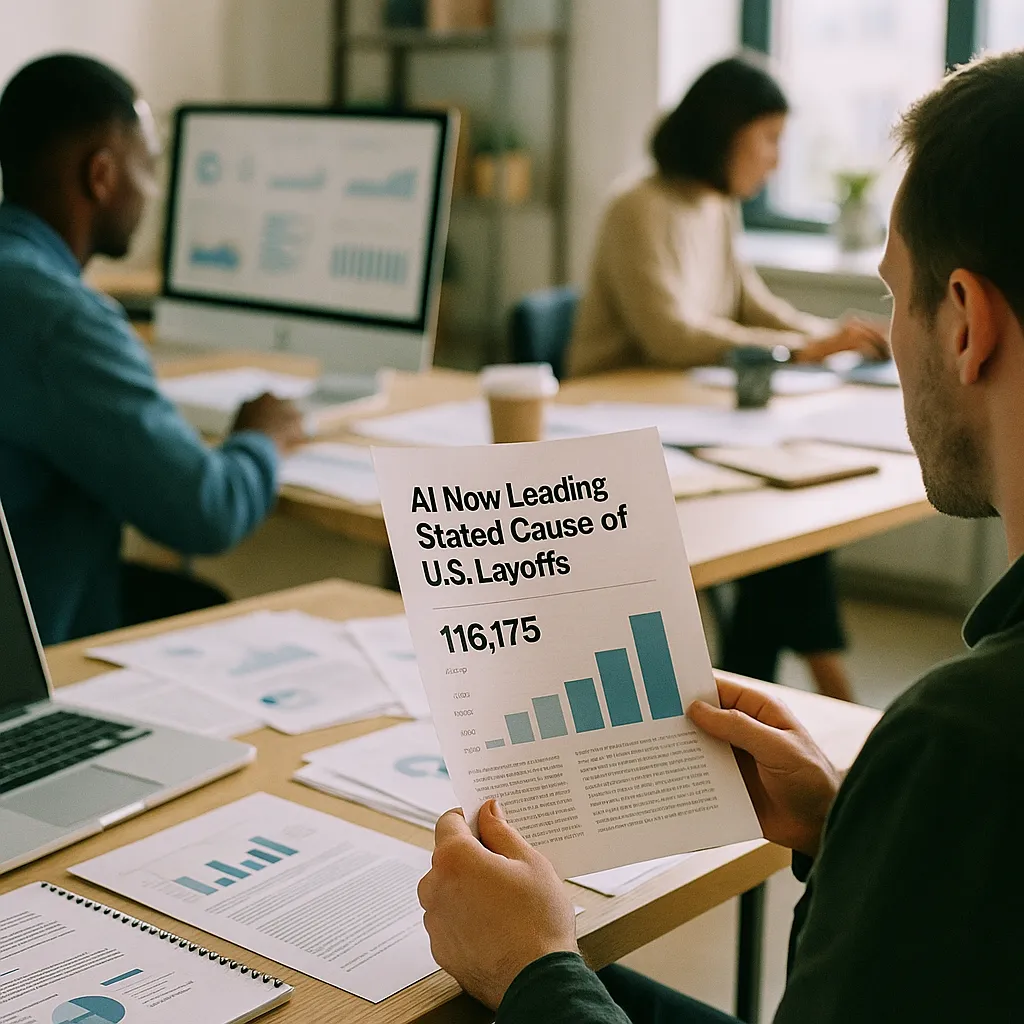
BCG's 2026 AI at Work report projects 10–15% of U.S. jobs eliminated and 50–55% fundamentally reshaped in five years — while 67% of heavy AI users report higher job satisfaction alongside rising cognitive load.
BCG: AI Is Reshaping Jobs Faster Than Companies Are Reshaping Work
By Hector Herrera | June 7, 2026 | Vertical: Work | Type: Data Research
BCG's fourth annual AI at Work report finds that 10–15% of U.S. jobs will be eliminated within five years and 50–55% will be fundamentally restructured — while the workers most affected are simultaneously reporting higher job satisfaction. That gap between what is happening to work and how workers feel about it is the report's central tension, and it has real consequences for how organizations plan the transition.
The Study
BCG's 2026 AI at Work report surveyed 11,749 workers across 14 markets, making it one of the largest recurring studies of AI's workforce impact. This is the fourth edition, which means BCG can show directional change year-over-year rather than just a single snapshot. The 2026 findings are notably more specific about job outcomes than prior editions.
The Numbers That Matter
Job impact projections:
- 10–15% of U.S. jobs projected to be eliminated within five years
- 50–55% of U.S. jobs projected to be fundamentally reshaped — tasks and skill requirements significantly changed, but the role persists
- Combined, roughly 65–70% of U.S. workers are in jobs that will look materially different by 2031
How AI use is already changing work:
- Nearly half of regular AI users now spend more time managing and directing AI than doing the underlying work themselves
- That shift — from doing to directing — is one of the clearest leading indicators of how job descriptions will need to change
The joy paradox:
- 67% of regular AI users report improved job satisfaction
- 41% of regular AI users simultaneously report increased cognitive load
These two numbers coexist because AI tends to eliminate the most repetitive and low-stakes parts of a job while increasing the volume, complexity, and consequentiality of remaining decisions. Workers feel more capable and more stressed at the same time.
Get this in your inbox.
Daily AI intelligence. Free. No spam.
Why the Gap Between Jobs and Companies Is the Real Problem
The report's headline framing — AI is reshaping jobs faster than companies are reshaping work — points to an organizational failure that is distinct from the technological one.
Most companies have deployed AI tools. Fewer have restructured job descriptions, reporting lines, performance metrics, or training programs to reflect how work actually happens now. The result is workers who are using AI intensively under job frameworks designed for a pre-AI environment — different output expectations, evaluation criteria built around individual task completion rather than AI-augmented throughput, and career development paths that don't account for skills like AI direction, output review, and prompt design.
That misalignment creates several problems:
- Performance evaluations become unfair. Workers who are effectively managing AI output are often invisibly more productive than workers doing manual work, but their additional leverage isn't captured in standard productivity metrics.
- Cognitive load accumulates. When AI handles the routine, every remaining decision is a judgment call. Without deliberate workload design, regular AI users absorb more consequential decisions per hour without any structural relief.
- Training pipelines break. Entry-level roles have historically served as the training ground for judgment and domain knowledge. If AI handles the entry-level tasks, organizations need a new theory of how junior employees develop expertise — and most companies don't have one yet.
What Regular AI Users Look Like Now
One of the report's most striking findings is how the experience of work has changed for heavy AI users. Nearly half spend more time directing AI — reviewing outputs, correcting errors, writing prompts, deciding what to hand off versus what to do manually — than on the underlying work itself. That is a fundamentally different skill profile than the same job two years ago.
This is not a transition that happens automatically. Workers who are good at managing AI have developed:
- Clear mental models of what AI does and doesn't do reliably
- Calibrated judgment about when to trust output versus verify
- Prompt-writing fluency that is domain-specific, not generic
- Output-review habits that catch systematic errors before they propagate
Those skills are learnable but are not taught in most corporate training programs. The organizations that build systematic development paths for AI-augmented work will outperform those treating AI adoption as a tool deployment rather than a workflow redesign.
The Satisfaction Data: Why It's Real and Why It's Incomplete
The 67% satisfaction improvement finding is real — and worth taking seriously rather than dismissing as PR spin. AI is removing genuinely tedious work: first-draft writing, data formatting, repetitive research, routine scheduling. Workers who hated those tasks report feeling more capable and more focused on the parts of their jobs that require judgment.
But the 41% cognitive load increase is also real, and it's the number companies are underweighting. When satisfaction is high and churn is low, there is organizational pressure to treat AI adoption as complete. The cognitive load signal suggests it is not: it suggests an accumulation of complexity that is not yet showing up in turnover rates or productivity metrics, but will.
What Organizations Should Do
BCG's findings imply several practical responses:
- Audit job designs against current AI use. If workers are already doing AI direction as a primary activity, job descriptions and performance metrics need to reflect that.
- Build explicit onboarding for AI judgment skills. Prompt design, output review, and decision calibration are learnable — treat them as real training investments.
- Track cognitive load as a leading indicator. High satisfaction combined with high cognitive load is a precursor to burnout. Use it as a signal, not background noise.
- Redesign entry-level roles with explicit learning objectives. If AI does the rote work, what does a junior employee do to develop domain expertise? Companies that answer this question first will have better pipelines in five years.
What to Watch
BCG has run this survey annually since 2023. The directional story over four years is one of faster adoption, higher satisfaction, and rising structural disruption. The 2027 edition will show whether the 10–15% job elimination projection is moving faster or slower than expected, and whether organizations have closed the gap between AI tool deployment and genuine work redesign. Those two numbers — not the benchmark scores of any specific model — are the real pulse check on AI's impact on work.
Hector Herrera covers workplace AI and the future of work for NexChron.
Did this help you understand AI better?
Your feedback helps us write more useful content.
Get tomorrow's AI briefing
Join readers who start their day with NexChron. Free, daily, no spam.