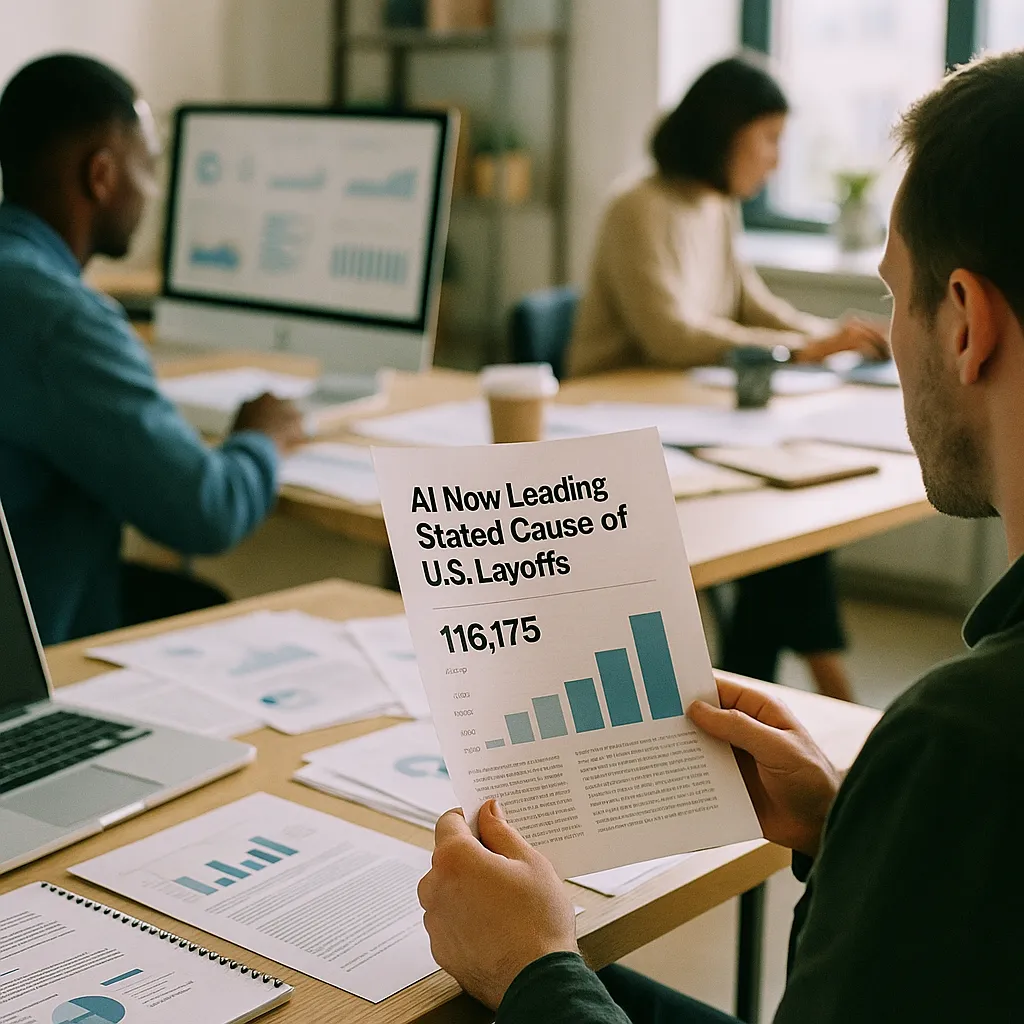
Infosys reports its under-30 workforce share has fallen to a 15-year low as AI absorbs the routine tasks that fueled mass entry-level IT hiring. Gartner projects AI will also eliminate more than half of middle management positions through 2026.
Infosys Young Worker Share Hits 15-Year Low as AI Takes Entry-Level IT Work
By Hector Herrera | June 4, 2026
Infosys, India's second-largest IT services company, reports that the share of its employees under 30 has fallen to a 15-year low — a direct consequence of AI automation absorbing the routine tasks that have historically justified mass entry-level hiring in the IT sector. The finding is not an isolated datapoint. Separately, Gartner projects that through 2026, 20% of organizations globally will use AI to flatten their hierarchies, eliminating more than half of current middle management positions. The entry-level IT collapse at Infosys is the visible early stage of a restructuring that runs the full length of the corporate ladder.
The Business Model That Is Breaking
To understand what the Infosys numbers represent, it helps to understand the business model they are breaking.
For more than two decades, large Indian IT services companies — Infosys, Tata Consultancy Services, Wipro, HCL — built their competitive advantage on a specific equation: hire large volumes of engineering graduates at Indian salary rates, train them on standardized coding, testing, documentation, and data processing tasks, and deploy them on client contracts at margins that beat what clients could achieve with in-house teams in the US or Europe.
The business model required continuous high-volume freshmen hiring. A typical Infosys recruiting year in the 2010s involved hiring tens of thousands of engineering graduates, running them through internal training programs, and absorbing them into delivery teams. This pipeline was not incidental to the business — it was foundational. Fresh hires absorbed routine work so that experienced engineers could focus on higher-complexity tasks.
AI is now absorbing much of that routine work. Code generation tools, automated testing frameworks, AI-assisted documentation, and agentic systems for repetitive data processing tasks have collectively made it possible to deliver the same output with fewer entry-level bodies. The under-30 workforce share does not fall to a 15-year low by accident — it falls because the demand signal for entry-level work has structurally weakened, according to reporting from The Workers Rights.
The Gartner Middle Management Projection
The Infosys data captures the bottom of the corporate ladder. Gartner's projection captures the middle.
Get this in your inbox.
Daily AI intelligence. Free. No spam.
Gartner forecasts that through 2026, 20% of organizations will use AI to flatten their organizational structures, eliminating more than half of current middle management positions. Middle management in IT services performs a specific set of functions: coordinating between senior architects and junior delivery teams, reviewing output quality, managing client communication, tracking project timelines. These are coordination and verification tasks — exactly the category where AI orchestration tools are advancing most rapidly.
AI project management assistants, automated quality review systems, and agentic tools that handle client reporting and status updates do not need a human manager sitting between the AI systems doing the work and the senior executives making strategic decisions. The coordination layer collapses.
Together, the Infosys entry-level data and the Gartner middle-management projection describe a compression of the traditional corporate hierarchy from both ends. Junior roles that fed employees into the management pipeline are disappearing; management roles that absorbed those employees are also disappearing. What remains is a thinner organizational structure with higher expectations of AI fluency at every level.
The Wage Premium Is Real and Growing
The economic consequence of this restructuring is not uniformly negative — but it is concentrated. Workers with AI skills now command wage premiums up to 56% higher than peers performing equivalent roles without AI proficiency.
That premium reflects a simple supply-demand dynamic: organizations that are eliminating AI-absorb-able roles are simultaneously increasing demand for people who can direct, manage, and extend AI systems. The scarcity is at the AI-fluent end of the workforce, not the general engineering end. An IT services employee who can design agentic workflows, evaluate AI output quality, and manage human-AI hybrid delivery teams is more valuable than an employee performing the same functions manually — and the gap is widening.
The problem is the transition: the workers displaced at the entry level of IT services are not, by default, the workers gaining the AI skills premium. Fresh engineering graduates who expected routine IT work as a career starting point are entering a market that has significantly contracted those roles before they ever arrived. The pipeline from education to employment to AI fluency that their predecessors navigated is now compressed or blocked at the first step.
The Macro Scale of the Problem
Infosys's workforce numbers are a signal about the broader Indian IT sector, which employs approximately 5 million people directly and supports a much larger ecosystem of dependent employment. India's IT sector is one of the country's most significant drivers of middle-class income and urban employment. A structural reduction in entry-level hiring — not a cyclical slowdown, but a permanent shift driven by AI capability — has macro-level implications that the country's economic planners have not fully incorporated into workforce development strategies.
The pattern is not unique to India. Entry-level IT roles at US-based technology companies have also contracted, with companies including Google, Meta, Microsoft, and Amazon all reporting reductions in early-career hiring ratios relative to the size of their existing workforces. India's IT services sector is experiencing the same dynamic at larger employment scale.
What to Watch
The near-term indicator is formal hiring targets for 2027. If Infosys, TCS, and Wipro announce substantially reduced engineering graduate hiring targets for the next academic year — as they have quietly signaled in recent earnings calls — that will confirm the structural nature of the shift rather than attributing it to a temporary cycle.
Government response is the second indicator. India's Ministry of Electronics and Information Technology has signaled interest in AI workforce transition programs, but no concrete reskilling infrastructure at the scale needed exists yet. The speed at which national skills programs adapt to specifically target AI fluency — not general coding, but AI orchestration, evaluation, and deployment — will determine how many workers can make the transition before the wage premium for those skills erodes.
Did this help you understand AI better?
Your feedback helps us write more useful content.
Get tomorrow's AI briefing
Join readers who start their day with NexChron. Free, daily, no spam.