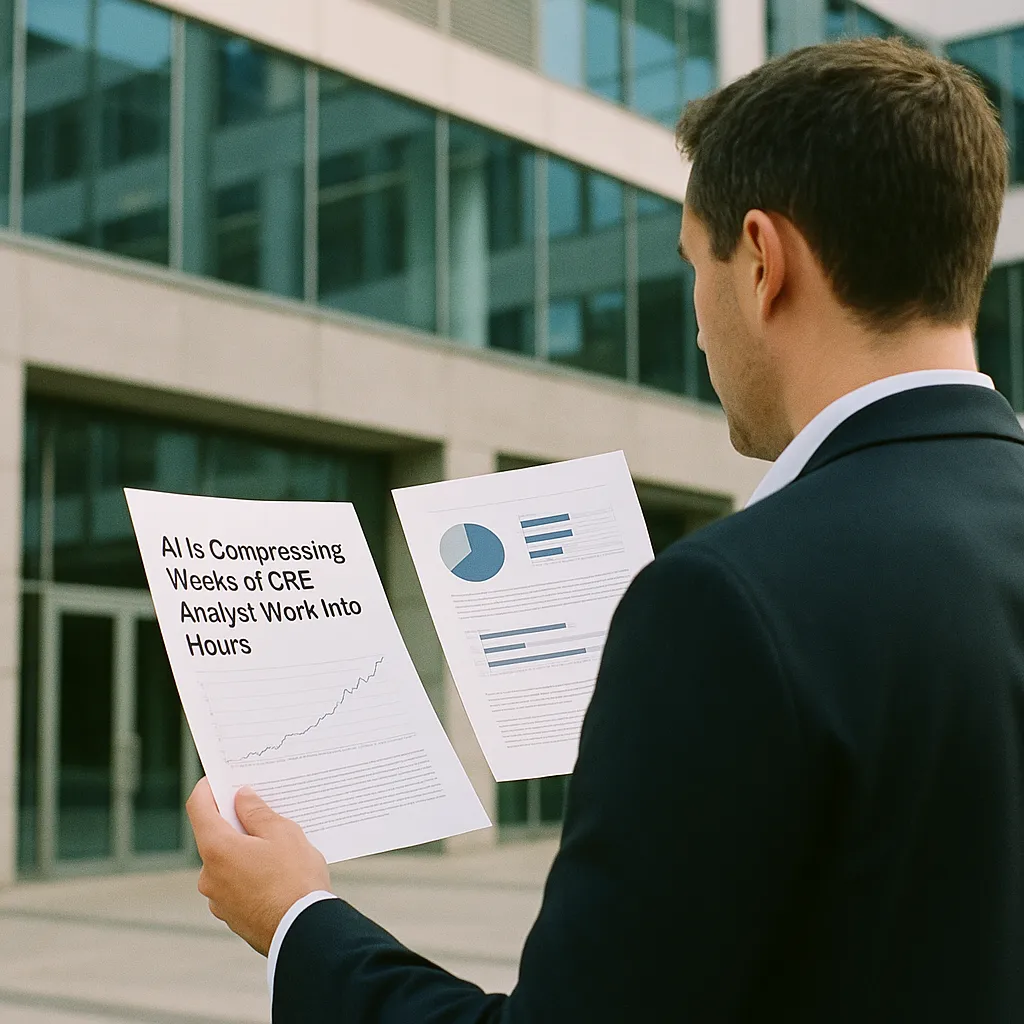
The Real Deal's June 2026 cover investigation finds leading CRE firms running leaner teams and faster deals, while mid-market brokerages face a widening AI adoption gap worth $34 billion by 2030.
AI Is Compressing Weeks of CRE Analyst Work Into Hours — and the Mid-Market Is Falling Behind
By Hector Herrera | June 9, 2026 | Real Estate
Commercial real estate's AI adoption moment has arrived — and it's reshaping who gets hired, how deals get done, and which firms survive the decade. The Real Deal's June 2026 cover investigation finds that leading CRE firms are compressing weeks of analyst work into hours across site selection, market analysis, and deal execution, running leaner teams and closing faster. Morgan Stanley now projects $34 billion in AI-driven efficiency gains for the real estate industry by 2030 — and a widening adoption gap between large firms and mid-market brokerages is determining who captures them.
What's Actually Changing on the Shop Floor
Commercial real estate has historically been a relationship business protected by information asymmetry — knowing what a building was worth, what comparable deals closed at, and which tenants were in play was a moat built on years of market presence and proprietary data. AI is eroding that moat by making comprehensive market data accessible at scale.
According to The Real Deal's investigation, leading CRE firms are now deploying AI across:
- Site selection — AI tools scan zoning data, demographic shifts, traffic patterns, and comparable lease activity to surface opportunities that would take an analyst team weeks to assemble.
- Market analysis — AI-generated comp reports, vacancy analysis, and rent trend modeling are replacing manual research decks that consumed junior analyst time.
- Deal execution — AI-assisted due diligence flags risks in lease abstracts, environmental reports, and title documents, reducing the time from LOI (letter of intent) to close.
- Portfolio management — Predictive maintenance and AI lease abstraction tools are letting asset managers oversee larger portfolios with smaller operational teams.
The pattern is consistent across sectors that AI has touched before: the task compression hits knowledge workers in the middle of the experience curve hardest — the analysts and associates who spent years doing the work that AI now drafts in minutes.
Get this in your inbox.
Daily AI intelligence. Free. No spam.
The Morgan Stanley Number
Morgan Stanley's projection of $34 billion in AI-driven efficiency gains for real estate by 2030 is built on two assumptions: that AI-assisted transaction processing reduces deal cycle times by 20–30%, and that AI-powered portfolio management allows firms to run the same asset base with 15–25% fewer analysts. Both assumptions are already visible in the early deployment data from large institutional CRE firms.
The efficiency gains aren't distributed evenly. Firms with proprietary data — large REITs (real estate investment trusts), institutional brokerages with decades of transaction records — can train AI on their own deal history. That proprietary training layer gives their AI tools a precision advantage over generic market tools that smaller competitors are using.
The Mid-Market Adoption Gap
The investigation's most pointed finding is the divergence between top-tier and mid-market CRE operations. Large firms — the JLLs, CBREs, and Cushman & Wakefields of the sector — are investing at scale: dedicated AI teams, custom integrations with their proprietary databases, and new roles like "AI-augmented analyst" that combine deal experience with AI prompt fluency.
Mid-market brokerages, by contrast, are largely still at the point-solution phase — using AI tools for individual tasks like property description generation or basic comp pulls, but not threading AI through their full deal pipeline. The risk for mid-market firms isn't just efficiency — it's the client expectation gap. When institutional clients are getting AI-generated site analysis in 24 hours from large brokerages, a two-week turnaround from a mid-market competitor becomes a competitive liability.
What Happens to CRE Jobs
The Real Deal frames the workforce question carefully: AI is not eliminating CRE jobs wholesale, but it is eliminating the entry points through which people historically built careers in the sector. Junior analyst roles — the pipeline for senior brokers, asset managers, and investment professionals — are being compressed or removed.
The roles that are growing are hybrid: AI operators who can interpret model outputs, apply market judgment, and manage client relationships that AI cannot. This pattern mirrors what happened in investment banking's analyst cohort over the past two years, where banks have cut junior analyst intake while hiring AI-fluent associates who work alongside automated modeling tools.
What to Watch
The Morgan Stanley $34B efficiency projection has a 2030 horizon — the more immediate signal is the pace of mid-market adoption over the next 18 months. Firms that don't close the AI gap by the time the next real estate cycle turns will be negotiating from a structural cost disadvantage.
Watch for M&A activity as large CRE platforms acquire AI-native proptech tools or acquire mid-market competitors for their client relationships while stripping out the analyst overhead.
Did this help you understand AI better?
Your feedback helps us write more useful content.
Get tomorrow's AI briefing
Join readers who start their day with NexChron. Free, daily, no spam.