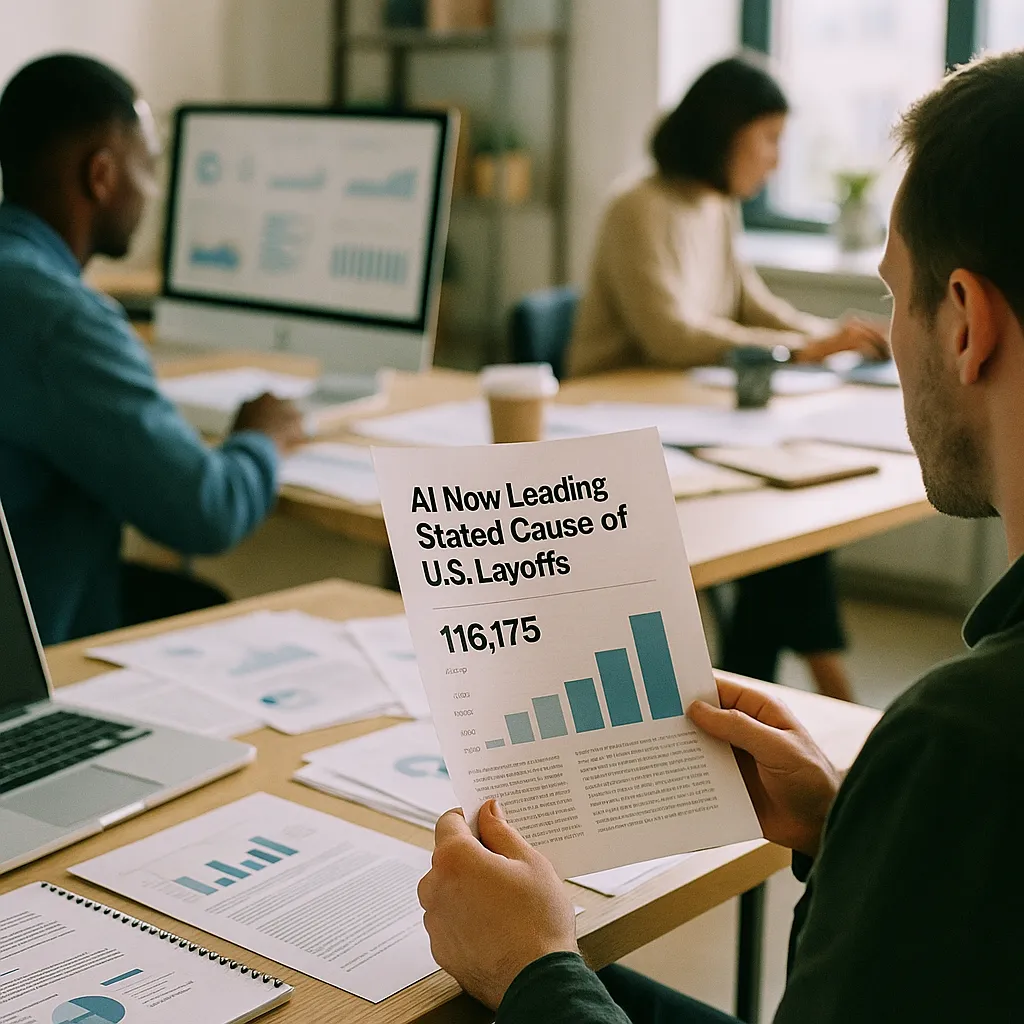
MIT Technology Review's deep dive into 2026 labor data finds AI displacement is real in entry-level and back-office roles — but structurally unequal, hitting workers with the least institutional support hardest.
The AI Jobs Reality: Displacement Is Real, Uneven, and Under-Supported
By Hector Herrera | June 8, 2026 | Work
The AI jobs debate has produced two loud, opposite camps — "AI is coming for your job" versus "don't worry, new jobs will emerge" — and both are wrong in ways that matter. MIT Technology Review's investigation into actual 2026 labor market data finds the transition is far more uneven than either side admits: some roles are experiencing real displacement right now, others are growing because of AI, and the workers caught in the middle have the least institutional support for navigating the shift.
Fears about AI displacing workers have run in cycles since at least 2015. What is different in 2026 is the capability scope: AI systems can now perform knowledge work tasks — writing, coding, data analysis, customer service, legal review — that were previously assumed to require human judgment. This year's employment data is producing the first statistically meaningful signals of disruption in white-collar, back-office, and entry-level knowledge roles that for decades appeared automation-resistant.
What the Data Actually Shows
The MIT Technology Review analysis found:
- Entry-level and back-office roles where tasks can be directly automated are experiencing real job losses — particularly in customer service, data entry, basic financial analysis, and content moderation
- Roles where AI augments human judgment — senior analysts, engineers, creative directors — are growing, with AI tools increasing output per worker rather than replacing the worker
- The transition is structurally unequal: workers in routine knowledge roles face the steepest disruption while having the least access to retraining, relocation support, or institutional guidance
- New jobs are emerging, but they skew heavily toward technical roles requiring skills the displaced workers don't currently have
The analysis explicitly pushes back on the common reassurance that "AI creates more jobs than it destroys." The net job count may eventually prove neutral or positive. But the distribution of job losses and job gains is not random — it tracks closely with existing economic inequality, compounding disadvantage rather than distributing opportunity evenly.
Get this in your inbox.
Daily AI intelligence. Free. No spam.
The Hardest-Hit Roles
Specific job categories showing measurable early displacement include:
- Customer service agents at large enterprises where AI chatbots handle tier-1 support without human escalation
- Data entry and processing clerks across financial services, insurance, and healthcare billing
- Entry-level marketing and content roles where AI produces first drafts at a fraction of the cost
- Paralegal and legal support staff at firms that have deployed contract review and legal research AI
- Medical imaging technicians at facilities using AI-first diagnostic workflows where technologists spend more time supervising AI outputs than performing independent analysis
These aren't hypothetical job categories in future projections. They are roles where hiring has contracted year-over-year in 2025 and 2026, per labor data cited in the MIT analysis.
The Augmentation Cohort
On the opposite side, workers growing their roles with AI assistance include senior software engineers, management consultants, financial advisors, architects, and research scientists. For these workers, AI tools are accelerating output and expanding the scope of what a single person can accomplish — raising their market value rather than threatening it.
The common thread is judgment. Roles that require synthesizing ambiguous information, building client relationships, navigating organizational complexity, or making high-stakes decisions with incomplete data remain resistant to direct replacement. AI is a powerful assistant in these roles — not a substitute.
The Retraining Gap
The MIT analysis identifies the institutional failure at the center of the crisis: the workers most at risk of displacement are the least likely to receive retraining support. Corporate retraining programs, where they exist, tend to serve workers already adjacent to technical roles. Community college and workforce development programs are underfunded and slow to update curriculum to match actual AI deployment patterns.
The workers who most need transition support — mid-career, in declining back-office roles, without four-year degrees — are navigating the shift largely on their own. The analysis calls this a "structural abandonment" of the workers whose jobs AI is actively replacing today, not in some future forecast.
What to Watch
The Federal Reserve's quarterly employment breakdowns by occupation over the next two reporting periods will be key data points for tracking whether the trends MIT identifies qualitatively are appearing in aggregate labor statistics. The political pressure for policy responses — retraining funding, income support, AI labor standards — is rising ahead of the 2026 midterms. The question is whether those responses arrive before the most acute displacement accelerates further, or arrive too late to matter for the workers affected now.
Did this help you understand AI better?
Your feedback helps us write more useful content.
Get tomorrow's AI briefing
Join readers who start their day with NexChron. Free, daily, no spam.