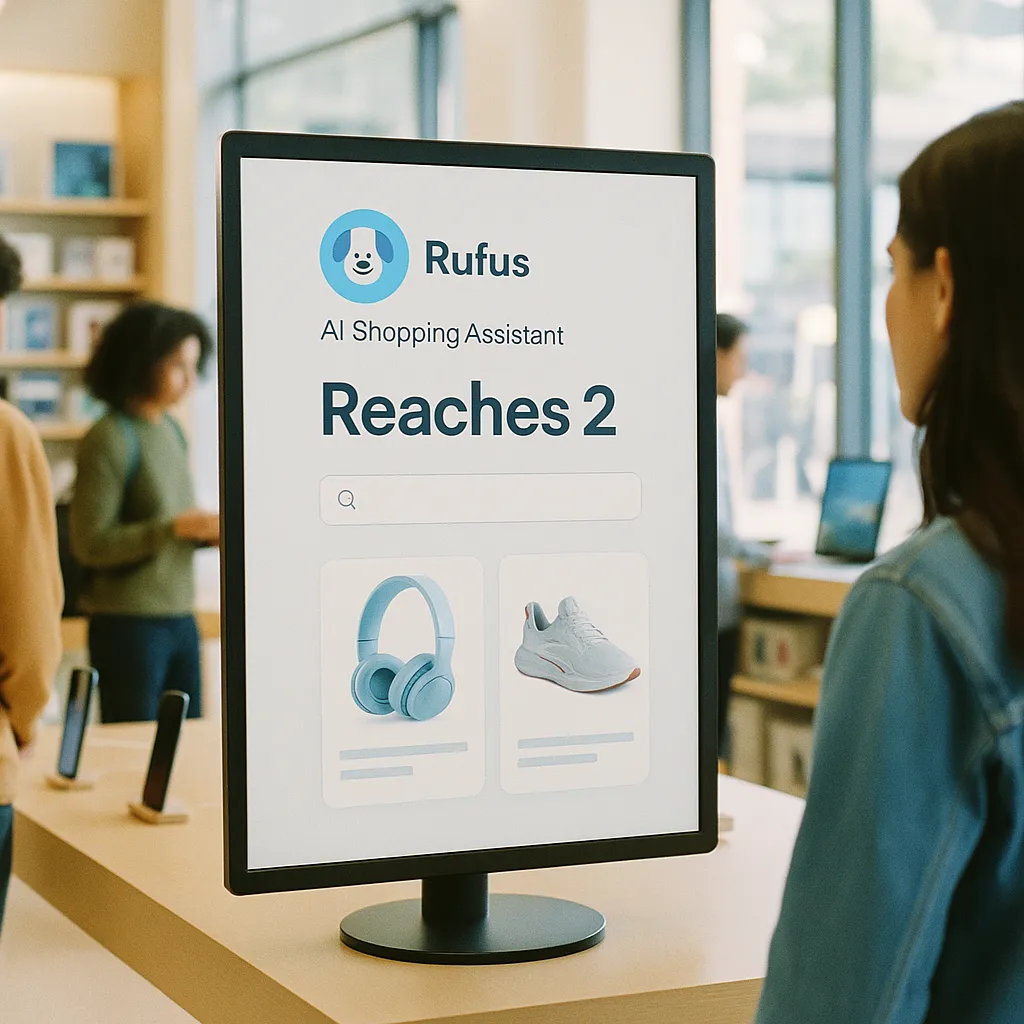
Amazon's AI shopping assistant Rufus has crossed 250 million users — and sellers who haven't adapted for AI-powered discovery face a structural disadvantage heading into Prime Day 2026.
Amazon's AI Shopping Assistant Rufus Reaches 250 Million Shoppers Ahead of Prime Day
By Hector Herrera | June 7, 2026 | Retail
Amazon's AI shopping assistant Rufus has crossed 250 million users — and with Prime Day 2026 starting June 23, sellers who haven't adapted for AI-powered product discovery are walking into the year's highest-stakes sales event at a structural disadvantage.
The milestone, highlighted in a ChannelEngine analysis published via PR Newswire, makes clear that Rufus has moved from experiment to infrastructure. Since Amazon integrated Rufus into Alexa, the assistant now sits at the intersection of voice search, product discovery, and purchase intent across the world's largest e-commerce platform.
How Rufus Changes the Discovery Game
Rufus is a conversational AI assistant embedded in Amazon's mobile app and Alexa interface. Instead of matching keywords to product titles, it answers natural-language questions: "What's the best water bottle for summer hiking?" or "Which coffee maker is easiest to clean?" It then surfaces products based on its interpretation of shopper intent — not the seller's chosen keywords.
That's a meaningful shift for anyone selling on Amazon. A listing optimized for "stainless steel water bottle 32oz insulated" may not surface when Rufus interprets "summer hiking water bottle" — unless the product description, Q&A section, and review responses contain the contextual language Rufus weighs. Sellers who built listings for keyword matching are now evaluated by a conversational model that looks for answers, not exact phrases.
What's at Stake on Prime Day
Prime Day 2025 generated an estimated $24.1 billion in U.S. online spending, up 30% year-over-year. For most third-party sellers, the four-day event represents their single largest revenue window of the year. Prime Day 2026 runs June 23–26.
Get this in your inbox.
Daily AI intelligence. Free. No spam.
Rufus is expected to be more prominently featured this year. Amazon has been testing Rufus-powered shopping guidance in search results, product pages, and promotional surfaces. At 250 million shoppers, it is no longer a sidebar feature — it is part of the core shopping experience.
ChannelEngine's analysis flags three specific readiness gaps that disadvantage sellers heading into Prime Day:
- Empty Q&A sections. Rufus draws from product Q&A to answer shopper questions. Sellers who haven't populated this section — or haven't responded to customer-submitted questions — are leaving critical context signals on the table.
- Thin product descriptions. Short, keyword-stuffed descriptions that don't explain use cases, materials, or real-world scenarios are less useful to Rufus than natural-language descriptions written to answer common questions.
- Unaddressed reviews. Rufus synthesizes review sentiment. Products with unaddressed negative reviews about specific attributes — sizing, durability, ease of use — may be ranked lower for queries where that attribute matters.
What Rufus Actually Rewards
Amazon has not published Rufus's full ranking signals, but the pattern from how the assistant responds is consistent: it rewards listings that answer questions, not just describe products.
A camping gear seller who writes "this tent is designed for two-person backpacking in summer conditions, with a rain fly rated to 2,000mm hydrostatic head and stakes that work in rocky ground" is giving Rufus vocabulary to surface that product for weather-specific queries. A seller who writes "two-person tent, lightweight, durable" is not.
The same principle applies to Alexa voice queries, where Rufus now powers shopping responses on Echo devices. Shoppers who ask Alexa for product recommendations are being served Rufus-selected results. Sellers not in the Rufus-readable catalog are invisible to that audience.
What to Watch
Amazon is unlikely to publish Rufus's exact ranking criteria — consistent with how it handles the standard A9/A10 search algorithm. But the Prime Day window is a forcing function: improvements made before June 23 will compound beyond the sale itself. Listings that earn Rufus visibility during the event tend to hold it afterward.
The broader shift is structural. Conversational AI is now the primary front door for hundreds of millions of Amazon shoppers. That changes how products get discovered, compared, and purchased. Sellers who adapt early build a compounding advantage; those who treat Rufus as optional are ceding ground to competitors who don't.
Sources: PR Newswire / ChannelEngine
Did this help you understand AI better?
Your feedback helps us write more useful content.
Get tomorrow's AI briefing
Join readers who start their day with NexChron. Free, daily, no spam.