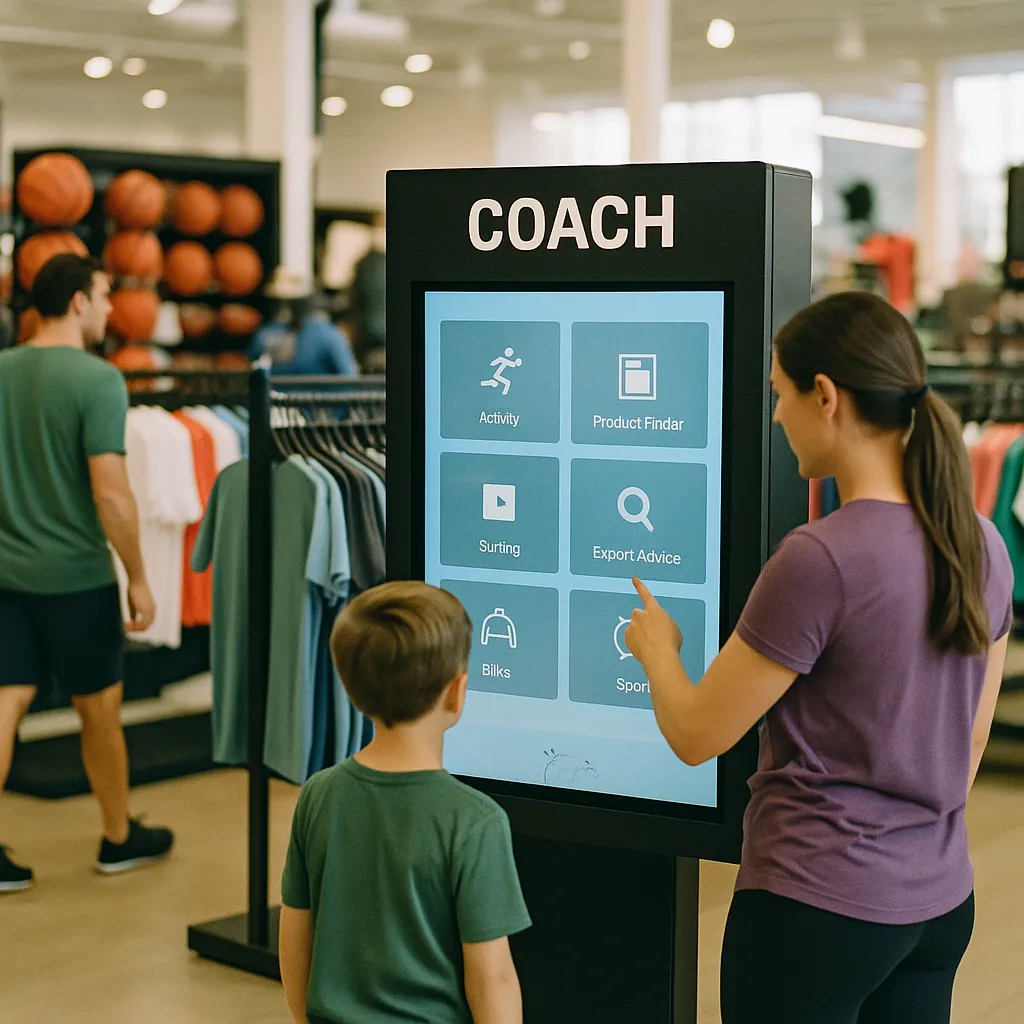
Dick's Sporting Goods is deploying an AI advisor called Coach that answers training questions, recommends products, and tracks fitness progress — blurring the line between coaching and retail in a way previous chatbots haven't.
Dick's Sporting Goods' 'Coach' Is What Agentic Retail Actually Looks Like
By Hector Herrera | June 5, 2026 | Retail
Dick's Sporting Goods is deploying an AI advisor called Coach that answers athletic training questions, recommends products aligned to a customer's fitness goals, and tracks their progress over time — functioning simultaneously as a personal trainer and a salesperson. Built with Adobe's Brand Concierge platform, Coach is a meaningful departure from the AI chatbots that have been bolted onto retail websites for the past two years, and it arrives as the industry converges on a shared conclusion: conversational AI has become the primary driver of online retail conversion.
According to Retail Dive's coverage, conversational AI now drives nearly 45% of all online retail conversions. That figure, if accurate across the industry, means how a retailer's AI talks to customers has become as commercially consequential as inventory assortment or pricing strategy. It explains why nine in ten retailers are planning to increase AI budgets in 2026, according to NVIDIA's 2026 retail survey.
What Coach Actually Does
Most retail AI is a thin wrapper on product search — a more conversational interface for catalog navigation. Coach is structurally different.
The distinction between a transactional assistant and a persistent advisor matters:
- A transactional assistant answers a specific question ("What's a good running shoe for overpronation?") and presents filtered options
- A persistent advisor builds a model of who you are as an athlete — your training schedule, fitness goals, pace, injury history, past purchases, and self-reported progress — and applies that model across every future interaction
Coach is designed to recommend products, but only in context of an ongoing coaching relationship. A customer asking about marathon preparation receives advice about build phases, recovery weeks, and long-run progression — with gear recommendations embedded in that training conversation rather than pushed as a product list. The AI tracks whether recommended gear was purchased and whether the customer's reported performance changed, creating a feedback loop that makes the next recommendation more accurate and the next conversation more relevant.
That feedback loop is the key differentiator. Over time, a persistent AI that knows a customer's history is exponentially more useful than a fresh product-search interface on each visit.
Get this in your inbox.
Daily AI intelligence. Free. No spam.
Dick's Coach represents a category shift that McKinsey quantified in its 2026 agentic commerce analysis: AI agents capable of managing ongoing customer relationships — not just single-session transactions — could generate between $3 and $5 trillion in global commerce value by 2030. The mechanism is conversion lift through relevance: customers who interact with an AI that has context about them convert at higher rates and return more frequently than customers navigating generic product catalogs.
The term agentic commerce (AI that takes actions across multiple sessions and builds persistent context, versus AI that only responds within a single interaction) is the useful framing here. Dick's Coach is agentic in the meaningful sense: it maintains state, learns from interactions, and applies accumulated context to future recommendations. That is architecturally different from what most retail AI does today.
The competitive pressure is clear. Amazon's Rufus AI shopping assistant has been evolving from product search toward contextual recommendation. Walmart's generative commerce integrations are pursuing the same territory. Nike and Under Armour have fitness data from their apps that could feed comparable systems. The retailers that establish persistent AI relationships with customers first will have a compounding advantage: their AI accumulates more context, and more context generates better recommendations, which drives higher retention.
What Dick's Has That Others Don't
The specific advantage Dick's brings to this deployment is domain expertise. Unlike general merchandise retailers building coaching-adjacent AI from scratch, Dick's has actual in-store coaches, athlete brand relationships, and decades of sports performance data that can inform how Coach reasons about training questions. An AI advisor recommending marathon training protocols with backing from real athletic expertise is more defensible than an AI that sources its fitness advice from the same public datasets every competitor uses.
The Questions This Raises
Labor. Dick's employs in-store coaches and fitness associates. If Coach handles the advisory function at scale across digital channels, the role of human in-store staff either shifts toward hands-on fitting and complex assessments — or shrinks. The company hasn't addressed this publicly.
Data and trust. A persistent AI that tracks fitness goals, performance, and purchase history requires customers to share information they haven't traditionally shared with retailers. The value exchange — better coaching in return for more data — is real. Whether customers trust a sporting goods retailer with that level of personal health context is an open question.
Accuracy and liability. Athletic coaching advice has real-world physical consequences. If Coach recommends a training protocol that causes injury, or directs a customer toward equipment inappropriate for their condition, the liability question isn't abstract. Adobe provides the platform infrastructure; Dick's owns the customer relationship and the consequences of recommendations made under its brand.
What to Watch
The proof is in sustained engagement metrics, not launch-week numbers. Early AI feature rollouts typically show strong initial interaction rates driven by novelty. The real test is whether Coach usage sustains at three months and six months — and whether it produces measurable revenue uplift that justifies the Adobe platform costs at scale.
What to watch: Other specialty retailers in adjacent categories (REI, Nike, Under Armour, running specialty chains) are likely to respond with comparable deployments within the next 12 months. Dick's has a first-mover window in the sporting goods segment. The category is converging on an AI-native advisory model for retail, and the brands that build the most useful persistent relationships with customers earliest will be hardest to displace.
Did this help you understand AI better?
Your feedback helps us write more useful content.
Get tomorrow's AI briefing
Join readers who start their day with NexChron. Free, daily, no spam.