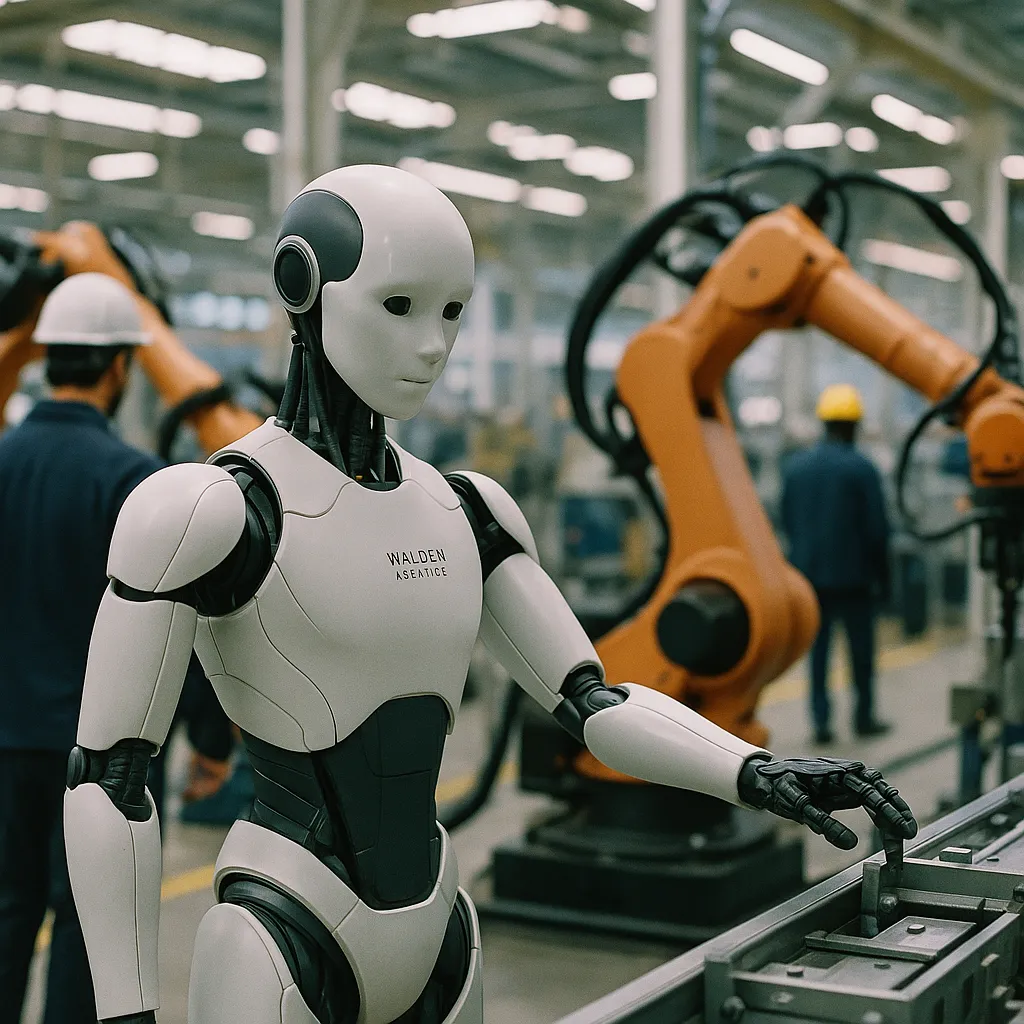
Walden Robotics, spun out of Toyota Research Institute, has run general-purpose robots in sustained full factory production shifts since May 2026 — one of the first to move beyond pilots into live deployment.
Walden Robotics, spun out of Toyota Research Institute in January 2026, has had general-purpose robots running full production shifts alongside human workers since May — one of the earliest companies to cross from controlled pilots into sustained live manufacturing deployment. The company raised $300 million in July 2026, and its production milestone was disclosed at the FullyConnected 2026 conference, as reported by SiliconAngle.
The claim matters because the physical AI industry has spent three years promising this transition and mostly failing to deliver it. Robots that perform well in demos and controlled pilots routinely break down when exposed to the variation of real factory floors — different lighting, unexpected equipment positions, co-workers moving unpredictably, materials placed slightly off-center. Walden's five-month production run is the kind of sustained evidence that separates real deployment from the extended pilot most physical AI companies are still running.
Why pilots keep failing to become production
The core problem in physical AI deployment isn't hardware capability or model performance in isolation — it's generalization under real-world variance. A factory floor changes constantly. Shift changes bring different workers who place materials in slightly different positions. Equipment gets rearranged. A pallet arrives damaged. Lighting varies. Ambient vibration changes when other machinery runs.
Traditional industrial robots handle this by narrowing the problem: deploy in a highly constrained zone, pre-program every allowed position, and alert a human when anything falls outside spec. That works for high-volume, highly repetitive tasks. It doesn't scale to the more general manufacturing work that still requires human judgment.
The physical AI thesis — robots that can learn to handle variability rather than requiring it to be eliminated — has been the industry's north star. Walden is claiming they've built it and it's running in a live factory.
What Walden is claiming
The SiliconAngle reporting from FullyConnected 2026 surfaces three key claims:
- Robots have been running full production shifts — not task windows or demo sessions — since May 2026
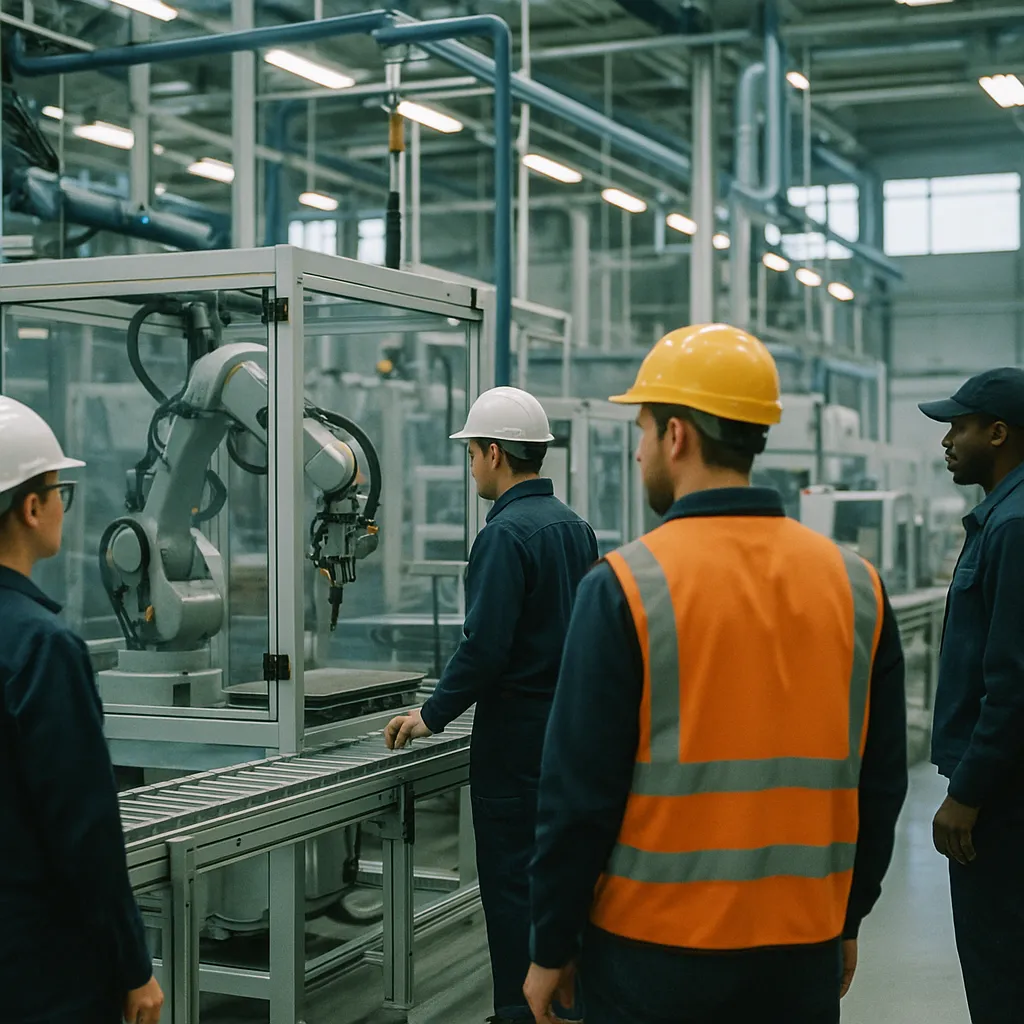
- They operate alongside human workers rather than in segregated automation cells
- The robots learn on the job in live environments, adapting to the variability that causes conventional deployments to fail
The "learn on the job" claim is the most technically significant. It implies the robots are updating behavior in response to what they encounter during production — not executing fixed pre-trained routines. If accurate, this is a meaningful departure from conventional industrial automation, which requires explicit reprogramming to handle new scenarios.
Five months is long enough to have encountered real operational variance. Most factory deployments that fail do so in the first sixty to ninety days when edge cases accumulate. Walden's May-to-October run suggests the system is handling those edge cases consistently enough to keep running.
Get this in your inbox.
Daily AI intelligence. Free. No spam.
Toyota Research Institute lineage
Walden's provenance matters. Toyota Research Institute (TRI) has been one of the most rigorously funded physical AI research programs globally, with years of work on manipulation skills learning, human-robot collaboration, and real-world deployment. TRI's research has focused heavily on diffusion policy — a learning method for teaching robots new manipulation skills from demonstrations rather than hard-coded programming — and on large behavior models that generalize across tasks.
Spinning Walden out rather than commercializing the technology inside TRI is a signal: Toyota wanted the company to move at startup speed. The $300 million raised in July suggests institutional investors believe the underlying science is sound. TRI doesn't spin out companies from research that hasn't cleared significant technical hurdles internally.
What this changes for manufacturing
General-purpose robots that can sustain production work — and improve through deployment rather than requiring expensive reprogramming cycles — change the economics of factory automation in two concrete ways.
First, deployment cost drops. Current industrial automation requires extensive configuration for each new task. Robots that learn from demonstration and generalize to new scenarios reduce that configuration overhead, making automation accessible to manufacturers that can't afford month-long integration projects for each new line or product variant.
Second, the addressable task set expands. Traditional automation is economically viable only for high-volume, highly repetitive tasks. Robots that handle variability can take on the medium-volume, semi-structured work that still occupies a large portion of factory floor labor — kitting, quality inspection, material handling in variable conditions. That's where much of manufacturing labor actually lives.
Whether Walden's system meets the performance standard required to capture that market is the question investors and potential customers are now working to answer. A five-month production run in a single facility is a start, not a proof of scale.
Competitive context
Walden isn't the only physical AI company claiming progress. Figure, Physical Intelligence (Pi), and 1X Technologies are all at various stages of factory and logistics deployment. What differentiates Walden's announcement is specificity: a named timeline (May 2026), a stated format (full production shifts), and a specific claim about learning in live environments.
Most competitors are still presenting demo footage and controlled-environment benchmarks. The industry standard for credibility is shifting toward production evidence — the question is who else can match it and whether Walden can replicate its results at additional sites.
What to watch
Walden's next announcements will be the test. If the May-to-October production run holds under scrutiny, expect the company to announce additional factory deployments in Q4 2026 or Q1 2027. Sustained production results will put competitive pressure on the broader physical AI industry to show comparable live deployment evidence rather than demo footage. The sector has been waiting for someone to prove sustained general-purpose factory deployment is achievable at industrial scale. Walden is claiming they did.
By Hector Herrera
Did this help you understand AI better?
Your feedback helps us write more useful content.
Get tomorrow's AI briefing
Join readers who start their day with NexChron. Free, daily, no spam.