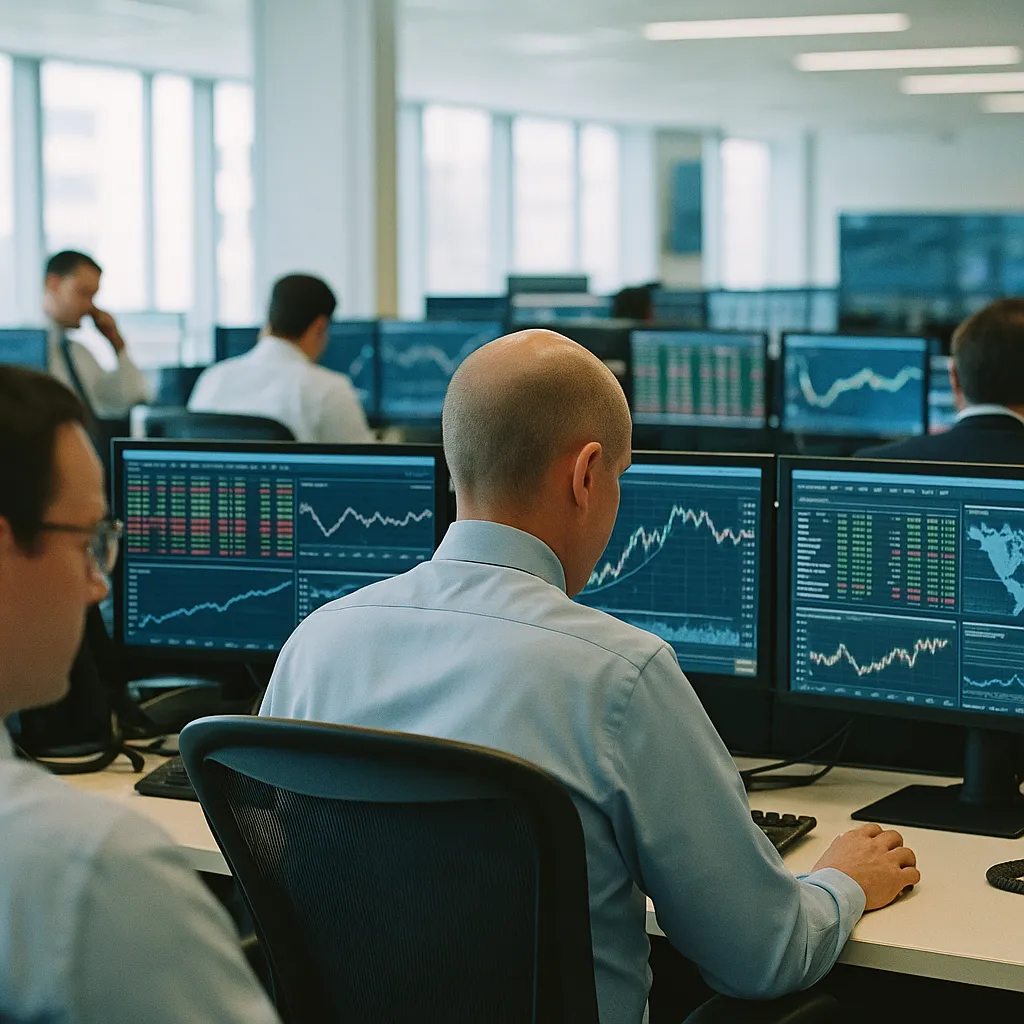
Bank of America's June 2026 fund manager survey finds 56% of institutional investors call the AI stock cycle a 'boom,' not euphoria — signaling professional money still sees runway in the trade.
BofA Survey: Institutional Investors Say AI Rally Is a Boom, Not a Bubble
By Hector Herrera | June 16, 2026 | Finance
Institutional money managers don't think the AI stock rally is over. Bank of America's June 2026 fund manager survey finds that 56% of investors describe the current AI trade as a "boom" — not "euphoria" — signaling that the professionals who move markets believe there's still runway ahead.
That distinction matters more than it sounds. "Euphoria" in investor surveys is a classic late-cycle warning sign: it means allocators think prices have disconnected from fundamentals and a correction is near. "Boom" means the cycle is running hot but still has legs. With AI infrastructure spending projected to stay elevated through the end of 2026, institutional conviction — however cautious — is still pointing up.
What the Survey Found
Bank of America's June [2026 Global](/finance/cambridge-2026-ai-financial-services-report) Fund Manager Survey polled institutional investors managing trillions in assets. Key findings:
- 56% categorize the AI stock cycle as a "boom" — the largest single response category
- Fear of missing out (FOMO) remains a primary driver of AI-related allocations
- Institutional confidence in AI infrastructure spending heading into the second half of 2026 remains intact
- Valuations are elevated, but most respondents don't see them as detached from earnings expectations
The survey doesn't measure retail sentiment — it's professional allocators at major funds, insurance companies, and sovereign wealth vehicles. These aren't Reddit traders chasing momentum. The persistence of "boom" framing among this cohort suggests the AI trade is being treated as a structural investment thesis, not a speculative bet.
Get this in your inbox.
Daily AI intelligence. Free. No spam.
Why FOMO Is Still Running Hot
The AI trade has been unusual in one key way: the companies at the center of it — Nvidia, Microsoft, Alphabet, Amazon, Meta — have actually delivered earnings growth that justifies significant portions of their multiple expansion. That's different from 1999-era dot-com euphoria, where many companies had no revenue at all.
When fundamentals are partly backing the move, FOMO has a rational component. Fund managers who underweighted AI infrastructure names in 2024 and 2025 underperformed. That performance pressure doesn't disappear. In H1 2026, the story is the same: missing the AI trade has a real career cost for professional allocators.
The risk isn't that the trade has no basis — it's that the basis gets priced in too aggressively, leaving less upside than current allocations assume.
Valuations: Elevated but Not Disconnected
AI-adjacent stocks are expensive by historical standards. Nvidia's forward price-to-earnings ratio has traded above 30x for most of 2025 and 2026. Microsoft and Alphabet aren't cheap. But the BofA survey finds that most institutional respondents tie these valuations to a continued buildout of AI infrastructure — data centers, chips, power, and model training capacity — that shows no signs of decelerating.
Capital expenditure announcements from the major hyperscalers (Amazon, Microsoft, Google, Meta) have continued to surprise to the upside in 2026. As long as that spending holds, the earnings case for the AI infrastructure stack holds with it. The risk scenario in the survey: a spending slowdown or evidence that AI returns on investment aren't materializing at the enterprise level.
What This Means for Investors
The BofA findings aren't a buy signal — surveys measure sentiment, not value. But they do clarify where institutional thinking sits at the midpoint of 2026:
- The AI trade is not considered over. Professional allocators are not rotating out.
- FOMO-driven allocation is still a market force, which means momentum can persist even if individual valuations look stretched.
- The "euphoria" threshold hasn't been crossed — at least not in the opinion of the people moving the most capital.
For retail investors, the takeaway is context: you're not buying into a trade that institutions have abandoned. You're buying into one that they believe still has room. Whether that view is right depends on execution — on whether AI spending translates to measurable enterprise productivity gains in the next 12–18 months.
What to Watch
The BofA fund manager survey runs monthly. Watch the July reading for any shift from "boom" to "euphoria" framing — that transition has historically preceded corrections in prior technology cycles. Also watch Q2 earnings from Nvidia and the hyperscalers: if capex guidance is cut or revenue growth misses, the sentiment picture can shift fast.
Did this help you understand AI better?
Your feedback helps us write more useful content.
Get tomorrow's AI briefing
Join readers who start their day with NexChron. Free, daily, no spam.