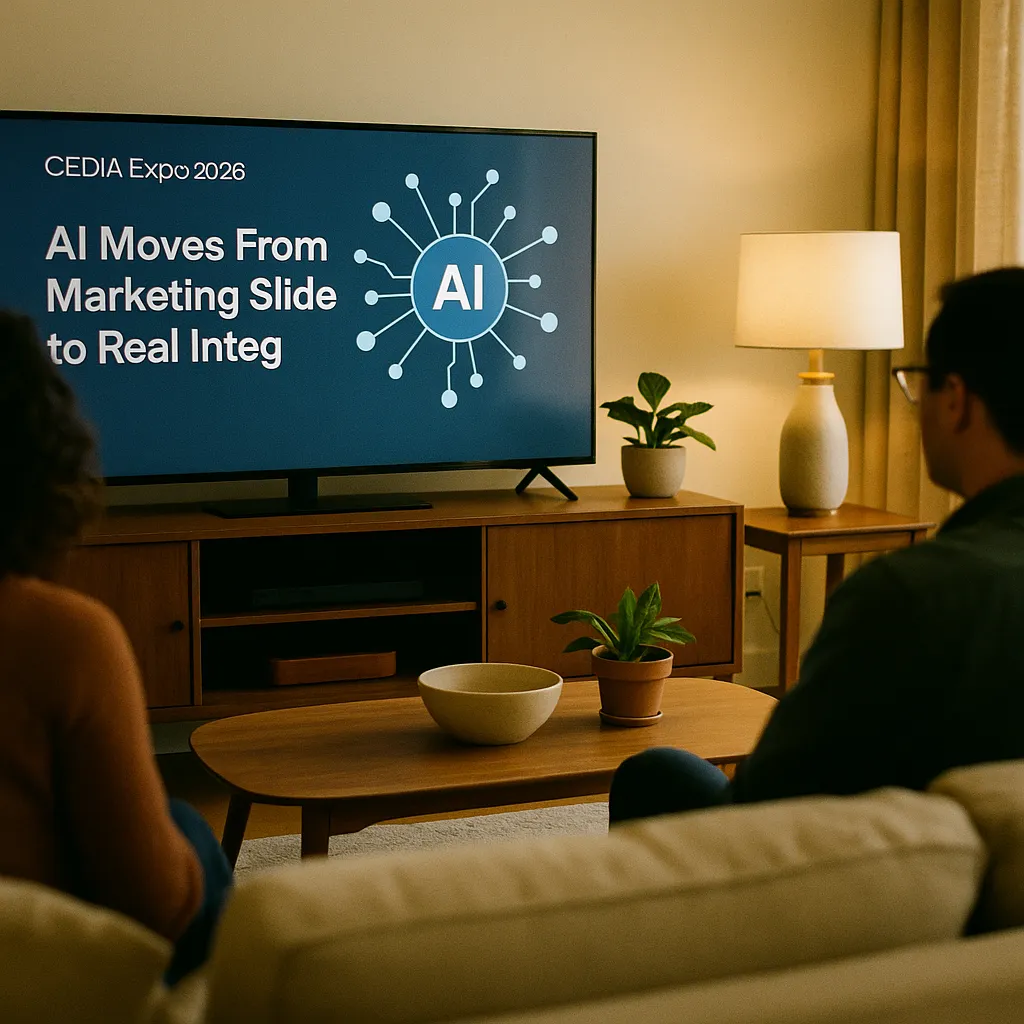
CE Pro's floor report from CEDIA Expo 2026 finds AI moved from demo to deployment across Savant, Josh.ai, and Control4 — a complete reversal from 2025, when AI at CEDIA was primarily a marketing slide.
CEDIA Expo 2026: AI Moves From Marketing Slide to Real Integrator Work on Smart Home Floors
By Hector Herrera | September 30, 2026 | Home
AI moved from the marketing slide to the tool bag at CEDIA Expo 2026. CE Pro's floor report from the smart home industry's flagship annual trade show found that nearly every major platform — Savant, Josh.ai, Control4 — demonstrated AI handling real integrator and homeowner tasks, not chatbot demos. CE Pro called it a complete reversal from 2025, when AI at CEDIA was primarily a vendor talking point.
For integrators who attend CEDIA to evaluate what they will actually install in client homes over the next 12 months, the shift is significant. The question is no longer whether AI will work in smart home deployments. It's which platform's implementation is reliable enough for professional installation.
What Was on the Floor
The demonstrations at CEDIA 2026 clustered around two capability types:
Conversational system control. Savant's new AI personal assistant handles lighting scenes, HVAC scheduling, entertainment system configuration, and air quality management through natural conversation. A homeowner asking "make the living room feel like sunset" triggers Savant's AI to adjust warm lighting, dim to a specific level, and reduce display brightness — without the homeowner needing to know what those specific settings are called or where they live in the app.
CE Pro noted the system handled multi-system commands that previously required integrator programming. A single conversational instruction coordinating lighting, climate, and entertainment across three subsystems is not a trivial integration task in traditional home automation. Savant's AI handles it without a rule being written in advance.
Natural-language automation rules. Josh.ai introduced the ability for homeowners to type or speak automation rules in plain language — "turn off all lights at 11pm except the kitchen" — without requiring integrator intervention to implement. For integrators, this is a meaningful change in the support call equation. Homeowners who can modify simple automations themselves generate fewer service calls for rule adjustments. A single integrator firm handling dozens of active client accounts can accumulate significant labor overhead from low-complexity support requests that AI-self-service would eliminate.
Get this in your inbox.
Daily AI intelligence. Free. No spam.
Control4 demonstrated AI-assisted configuration capabilities aimed at reducing programming time during initial installation, though CE Pro's report focused primarily on Savant and Josh.ai as the standout end-user-facing implementations.
What Changed in 12 Months
At CEDIA 2025, AI demonstrations were characterized by chatbot interfaces layered over existing home automation systems. The demonstrations showed AI could be asked questions about the home, but couldn't reliably execute multi-system commands or modify automation logic without human confirmation at each step. The gap between vendor promises and what integrators could actually deploy was visible on the show floor.
The 2026 shift reflects two things: a year of model improvement, and more importantly, integration work. Connecting an AI system to reliably control lighting, climate, entertainment, and security in real time requires deep integration with existing home automation middleware — the layer of software that connects hardware devices across different brands and protocols. Building that integration layer takes years of engineering work. Savant and Josh.ai have been building it. CEDIA 2026 is where that investment reached a deployable threshold.
The contrast with last year's show is the most credible signal in CE Pro's report. Industry trade shows are where vendors over-promise. When the floor reporter says AI has crossed from demo to deployment, it carries weight.
What This Means for Integrators
AI-capable platforms are becoming a client expectation. Homeowners who use AI assistants daily will increasingly expect their home systems to work the same way. That expectation will show up in consultations and competitor comparisons. Integrators who cannot demonstrate conversational home control at the specification stage will be at a disadvantage in competitive bids.
The labor economics are shifting. Platforms that reduce post-installation support calls and enable homeowner self-service on simple automations reduce integrator labor costs per installation. For integrators running high-volume residential businesses, that efficiency difference has a direct margin impact. Savant and Josh.ai's implementations are both pointed at this: reduce the number of calls a homeowner makes to their integrator for routine adjustments.
The installation premium is not disappearing. AI self-service for simple rules does not eliminate the need for professional integration work. Complex multi-room systems, custom hardware configurations, and security-critical integrations still require integrator expertise. AI changes the support burden after installation; it doesn't replace the installation itself.
Platform selection carries more long-term weight. An integrator who recommends a platform whose AI implementation underperforms in production faces client relationship consequences that are harder to recover from than a single hardware failure. Evaluating AI reliability before recommending a platform — not just booth demos — will become a standard part of integrator due diligence.
What to Watch
Josh.ai and Savant are both independently owned, which makes them acquisition candidates as AI-native home automation becomes a strategic asset for consumer electronics majors and property technology platforms. A significant acquisition in this space in the next 18 months would accelerate market consolidation.
Control4's parent company, Snap One, will need to demonstrate competitive AI capabilities in the next product cycle or risk losing mindshare with integrators evaluating platform switches. The September CEDIA result was mixed for Control4: present but not highlighted as a leader.
The most meaningful near-term signal will be whether Josh.ai or Savant publish reliability data from production deployments — uptime figures, error rates for multi-system commands, homeowner self-service success rates. When AI home automation platforms start publishing performance metrics rather than demo videos, the market will have crossed from early adoption to mature deployment.
Did this help you understand AI better?
Your feedback helps us write more useful content.
Get tomorrow's AI briefing
Join readers who start their day with NexChron. Free, daily, no spam.