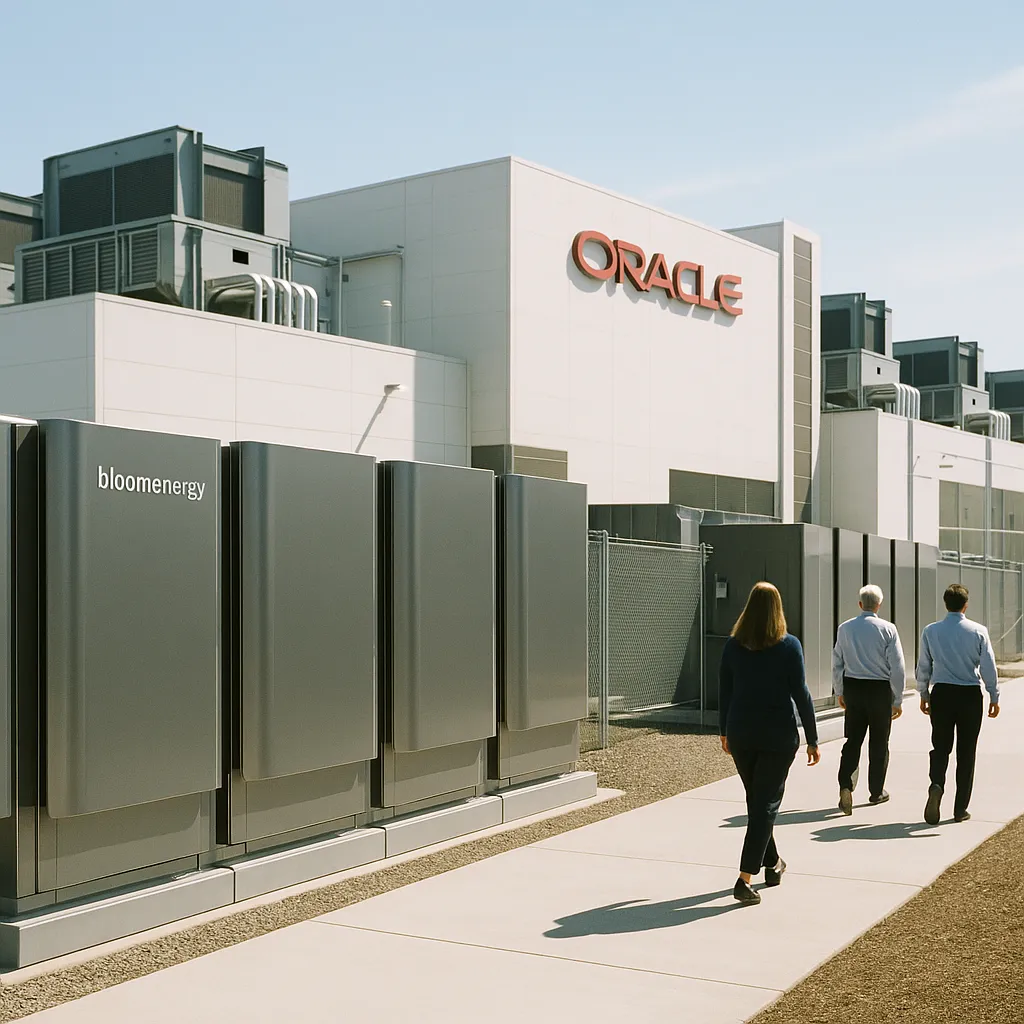
Oracle has contracted up to 2.8 gigawatts of power from Bloom Energy's stationary fuel cells for AI data centers — bypassing utility interconnection queues that average four years and establishing off-grid power as a mainstream AI infrastructure strategy.
Oracle and Bloom Energy Ink 2.8 GW Deal to Power AI Data Centers with Fuel Cells
By Hector Herrera | April 22, 2026 | Energy
Oracle has agreed to purchase up to 2.8 gigawatts of power from Bloom Energy for its AI data centers, with 1.2 gigawatts already under contract and deploying now. The deal bypasses the utility grid entirely — Bloom's stationary fuel cells can be installed in weeks, compared to the four-year average wait time for utility interconnection approvals. It is the most visible signal yet that the AI power crunch has grown acute enough to force major operators off the traditional energy grid.
Why This Deal Is Happening
Building AI data centers is no longer primarily a construction problem. It's a power problem.
Large language models and AI inference workloads require enormous amounts of electricity — and they require it reliably, at high density, in exactly the locations where data center operators want to build. The U.S. power grid, which was not designed for this demand spike, is struggling to respond. Utility interconnection queues — the waiting lists for new grid connections — now average over four years in most major markets. For an AI industry operating on six-month competitive cycles, a four-year wait for power is not a planning inconvenience. It's a strategic blocker.
Bloom Energy's solution sidesteps the queue entirely. Its solid oxide fuel cells — which generate electricity through an electrochemical reaction rather than combustion — can be manufactured, shipped, and installed in weeks. They don't require a utility connection to function. They run on natural gas (with a pathway to hydrogen as the hydrogen supply chain matures). And they operate at high efficiency with low emissions compared to diesel generators or grid power from coal-heavy regions.
The Numbers
The scale of this deal is worth sitting with:
- 2.8 gigawatts total contracted capacity — equivalent to roughly two large nuclear power plants
- 1.2 GW already under contract and in active deployment
- $7.65 billion in data center contracts Bloom has secured in the last 90 days alone
- Weeks to install, versus 4+ years for utility interconnection
That $7.65 billion in 90-day bookings represents Bloom's entire previous market cap, multiple times over. The company's stock surged on the Oracle announcement, consistent with the RENIXX renewable energy index spike noted in industry coverage.
Get this in your inbox.
Daily AI intelligence. Free. No spam.
The 2.8 GW figure also contextualizes the scale of Oracle's AI infrastructure ambitions. Oracle announced in January 2026 that it would invest $100 billion in U.S. AI data center capacity alongside Microsoft and SoftBank as part of the Stargate initiative. That level of buildout requires power that simply isn't available through normal utility channels at the needed speed.
How Bloom Fuel Cells Work
A solid oxide fuel cell converts fuel directly into electricity through a chemical reaction — not combustion. Natural gas enters one side; ambient air enters the other. Inside the cell, at high temperature, the fuel is oxidized electrochemically. The reaction produces electricity, heat (which can be recovered for additional efficiency), water vapor, and CO₂.
Compared to:
- Diesel generators: much lower emissions, no NOx (nitrogen oxide), no particulates, quieter operation
- Gas turbine peakers: similar fuel, but fuel cells are modular and don't require cooling towers or large mechanical systems
- Grid power: independent of transmission capacity, location-flexible, faster to deploy
The emissions profile is not zero — Bloom cells still burn natural gas. But they're materially cleaner than backup generation alternatives, and they can run on biogas or hydrogen blends where those fuels are available, allowing progressive decarbonization as the supply chains mature.
What This Means for the AI Energy Ecosystem
For data center operators: Bloom's deal with Oracle validates off-grid fuel cell power as a mainstream strategy — not a stopgap. Expect Amazon, Microsoft, Google, and Meta to evaluate similar arrangements. Microsoft's partnership with Constellation Energy to reopen Three Mile Island and Google's investment in nuclear startups reflect the same underlying reality: grid power is not arriving fast enough.
For the utility industry: The AI boom was supposed to be a windfall for utilities — unprecedented new load, guaranteed long-term revenue. Instead, the fastest-moving AI operators are bypassing utilities entirely, building distributed off-grid power generation that utilities have no role in. If this pattern persists at scale, it changes the utility investment thesis materially.
For Bloom Energy: The company spent years as a niche player in clean energy. The AI power crisis has made its specific product — modular, fast-deployable, natural-gas stationary fuel cells — exactly what the fastest-growing industry in the world needs. $7.65 billion in 90 days is not a product cycle. It's a category inflection.
For policy makers: Off-grid AI data centers running on natural gas represent a significant emissions policy question. The power is cleaner than diesel backup generation but not zero-carbon. As these deployments scale from gigawatts to potentially tens of gigawatts, their aggregate emissions become relevant to state and federal climate accounting. Expect regulatory attention.
What to Watch
The Oracle-Bloom relationship will likely deepen. Watch for Oracle to increase its contracted capacity toward the full 2.8 GW ceiling and for Bloom to announce additional hyperscaler partnerships in the next 90 days. The more interesting longer-term question is whether Bloom can transition its Oracle deployments from natural gas to hydrogen as green hydrogen supply chains develop — which would make this off-grid power strategy carbon-neutral at scale.
Also watch the utility regulatory response. Some state regulators are already examining whether large-scale off-grid data center power generation requires utility-style permitting and oversight, even without grid connection.
Hector Herrera covers AI infrastructure and energy for NexChron.
Did this help you understand AI better?
Your feedback helps us write more useful content.
Get tomorrow's AI briefing
Join readers who start their day with NexChron. Free, daily, no spam.