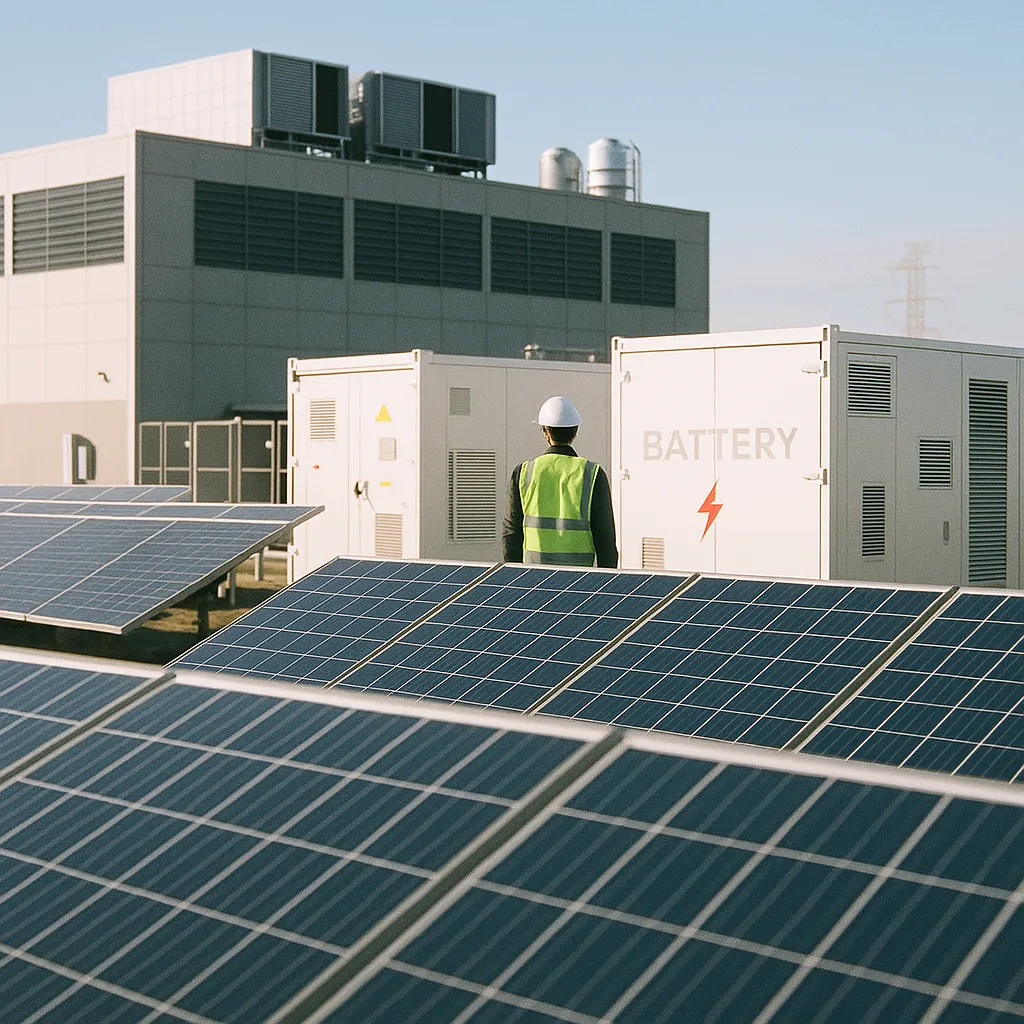
The European Commission launched AI.grids, a coordinated initiative to develop AI models specifically for grid management and planning, estimating demand-side flexibility could cut EU electricity costs by more than 71 billion euros per year.
EU Launches AI Grid Initiative Targeting €71 Billion in Annual Electricity Savings
By Hector Herrera | June 4, 2026
The European Commission published a package of measures on June 3 to digitalize Europe's energy system — and the centerpiece is the AI.grids Community of Practice, a coordinated initiative to develop AI models specifically for grid management and planning. The Commission estimates that demand-side flexibility enabled by AI could reduce electricity costs for EU consumers by more than €71 billion per year. That figure represents a 64% reduction in consumption costs — and arrives at a moment when the same AI data centers driving grid strain are being positioned as part of the grid solution rather than solely its problem.
The Dual Pressure on European Grids
European electricity grids are being squeezed from two directions simultaneously.
On the supply side, the rapid buildout of renewable energy — solar and wind — is introducing intermittency that traditional grid management tools were not designed to handle. Unlike coal or gas plants, solar and wind produce electricity when the sun shines and wind blows, not when demand peaks. Balancing supply and demand across an increasingly renewable grid requires faster, more granular decision-making than human operators can execute at scale.
On the demand side, AI infrastructure is adding massive new loads. AI data centers globally are forecast to consume 945 TWh annually by 2030, according to industry projections — a volume equivalent to adding France's entire electricity demand to the global grid within five years. Europe is not immune: hyperscalers are expanding European data center footprints rapidly, and each facility consumes more power than a mid-size industrial facility.
The EU's response is to use AI to manage both problems, according to the Commission's June 3 announcement.
What AI.grids Is
The AI.grids Community of Practice is a structured initiative under the Commission's broader energy digitalization package. Its mandate is to develop AI models specifically trained for grid management and planning — not general-purpose models adapted from commercial use, but purpose-built tools calibrated to the specific physics, regulatory constraints, and operational requirements of electricity grids.
Get this in your inbox.
Daily AI intelligence. Free. No spam.
The Community of Practice model brings together grid operators (transmission system operators and distribution system operators), research institutions, AI developers, and regulators under a coordinated framework — rather than each national grid operator independently building its own tools and duplicating effort.
The Commission's rationale: AI can optimize grid balancing in near-real-time, predict demand spikes and renewable generation variability, and enable demand-side flexibility — the ability to shift consumption patterns (industrial loads, EV charging, building HVAC systems) in response to grid conditions rather than forcing supply to always match demand.
The €71 Billion Number
The Commission's estimate that demand-side flexibility enabled by AI could reduce EU electricity costs by more than €71 billion per year is striking in its scale. To put it in context: €71 billion represents roughly 20% of the EU's total annual electricity expenditure by consumers and industry.
The mechanism is straightforward in concept: when grids can signal real-time price and availability conditions to connected devices and industrial systems, those systems can shift consumption to off-peak periods, absorb surplus renewable generation, and reduce reliance on expensive peaking plants that run only during demand spikes. AI makes this coordination possible at the speed and granularity that physical grid dynamics require.
The 64% reduction in consumption costs figure reflects optimization gains from moving away from flat-rate electricity pricing toward dynamic, AI-mediated demand response. It assumes widespread deployment of smart meters, connected devices, and automated demand-response systems — an infrastructure buildout that is still ongoing across many EU member states.
The Commission's package explicitly addresses AI data centers in both directions. On one hand, data centers are the fastest-growing new load category, requiring costly grid upgrades. On the other, data centers with flexible compute loads and battery backup systems are also potential grid flexibility resources — they can shift intensive computation to periods of surplus renewable generation and throttle back during demand peaks.
This repositioning — from pure consumer to potential grid asset — is significant. It gives data center operators a basis for regulatory accommodation in exchange for participating in grid flexibility programs, and it gives grid operators a new category of dispatchable demand that can absorb renewable surplus rather than curtailing it.
What the Initiative Requires to Work
The AI.grids initiative is a coordination framework, not an automatic deployment program. Success depends on several prerequisites that are not yet in place uniformly across EU member states:
- Smart meter rollout — real-time grid response requires real-time consumption visibility at the grid edge
- Interoperability standards — AI grid management tools need standardized data feeds from diverse grid operators across 27 member states
- Regulatory alignment — demand-side flexibility requires energy market rules that allow consumers and aggregators to be compensated for shifting consumption; those rules vary significantly across EU countries
- Cybersecurity frameworks — AI-controlled grid management systems represent critical infrastructure attack surfaces that require hardened security standards
What to Watch
The AI.grids Community of Practice will need to produce tangible model development milestones to demonstrate progress beyond coordination. Watch for the first pilot deployments — national grid operators that test AI balancing tools in controlled regional environments — as the early proof of concept. The EU's parallel regulatory work on energy market design and demand-response compensation frameworks will determine whether the €71 billion potential is ever realized at scale. If the Commission's timeline holds, early AI grid management deployments should be visible before the end of 2027.
Did this help you understand AI better?
Your feedback helps us write more useful content.
Get tomorrow's AI briefing
Join readers who start their day with NexChron. Free, daily, no spam.