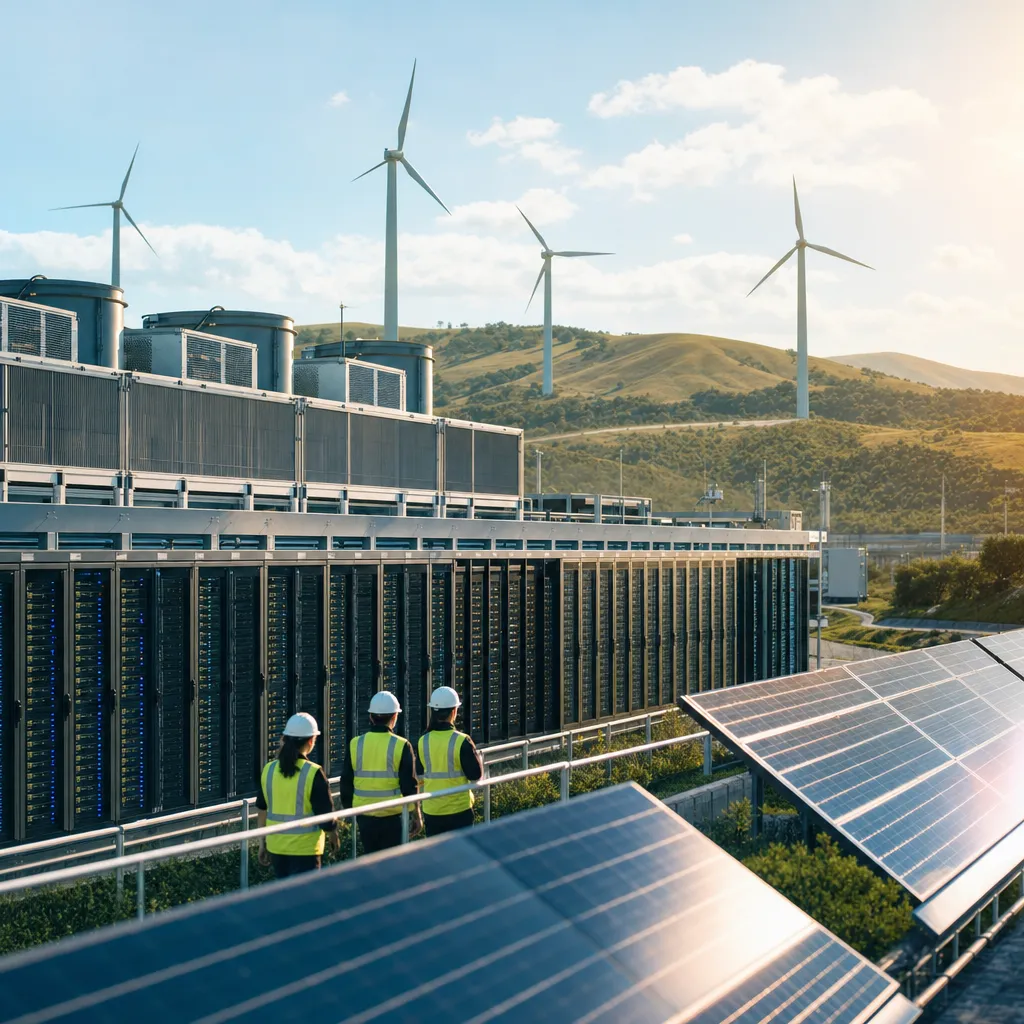
A major MIT Technology Review investigation found only one grid operator across China, the U.S., and Europe with a working AI optimization program — directly challenging the industry narrative that AI and clean energy are natural partners.
TL;DR
- A major MIT Technology Review investigation found only one grid operator across China, the U.S., and Europe with a known, working AI grid optimization program
- The dominant industry narrative — that AI and clean energy are natural partners — has outpaced the actual deployment evidence by years
- AI data centers are on track to consume 10% of U.S. electricity by 2028, making the gap between AI's energy promises and AI's energy demands a first-order policy problem
Table of Contents
- The Investigation
- The Dominant Narrative
- What the Evidence Actually Shows
- What "Grid AI" Actually Means
- Why the Gap Exists
- The Energy Demand Side
- What Would Need to Be True
- What to Watch
For the past three years, one of the most reliable rhetorical moves in the AI industry has been the clean energy pivot: yes, AI uses a lot of electricity, but AI will also optimize the grid, accelerate renewable deployment, and ultimately make the energy system cleaner than it would have been without it. It is a compelling argument. A new MIT Technology Review investigation suggests it is not yet a true one.
MIT Technology Review's investigation, published November 9, reviewed grid operators across China, the United States, and Europe and found only one with a known, deployed, working AI grid optimization program. Most had little to show in public records. The piece is the most rigorous published challenge to the AI-as-climate-solution narrative — and it arrives at a critical moment.
The Dominant Narrative
The story has been told consistently, by AI companies, by energy companies, and by the analysts covering both. It goes like this:
Modern power grids are extraordinarily complex. They must balance supply and demand in real time across thousands of generation sources and millions of consumption points. That balance used to be manageable because supply was relatively predictable (coal plants run at steady output) and demand followed known patterns (peak in the morning, dip at night).
Renewable energy breaks both sides of that equation. Solar and wind are intermittent — they produce power when weather allows, not when demand requires. Integrating large amounts of renewable energy into a grid without destabilizing it requires forecasting, optimization, and control at a speed and scale that human grid operators cannot manage manually.
AI is supposed to solve this. Specifically:
- Machine learning models that predict renewable output hours or days in advance
- Optimization algorithms that schedule generation and storage assets in real time
- Demand response systems that shift flexible loads — industrial equipment, EV charging, water heaters — to absorb excess renewable output or reduce demand during scarcity
The pitch is not implausible. These are exactly the kinds of optimization problems where AI has demonstrated genuine capability in other domains. And the theoretical benefits are significant: better renewable integration, fewer curtailments (times when renewable power is generated but wasted because the grid can't absorb it), lower system costs, reduced need for backup fossil generation.
The problem, according to MIT Technology Review's investigation, is that this is largely still a pitch.
What the Evidence Actually Shows
The investigation's central finding is stark: of all the grid operators reviewed across three major electricity markets — China, the United States, and Europe — only one had a known, working AI grid optimization program in production use.
Most grid operators had:
- Pilot programs or proof-of-concept studies that had not scaled
- Vendor partnerships announced with press releases but no deployment evidence
- Traditional forecasting and optimization tools (rule-based systems, classical statistics) labeled as "AI" in communications materials
- Research collaborations with universities that had produced papers but not production systems
This is not the same as saying AI grid optimization is impossible. Several of the systems that exist are genuinely impressive. Google DeepMind's work with the UK's National Grid, announced in earlier years, produced measurable improvements in wind output forecasting. Utility-scale battery storage systems are increasingly managed with ML-based optimization. Some regional transmission organizations in the U.S. are running AI-assisted congestion forecasting.
But these are exceptions, not the norm — and many of the most-cited examples involve narrow applications (forecasting a single resource) rather than the kind of full-system optimization that would meaningfully reduce the grid's dependence on fossil peaker plants.
What "Grid AI" Actually Means
Part of the problem is definitional. "AI for the grid" covers an enormous range of applications with very different readiness levels:
High readiness (deployed at scale):
Get this in your inbox.
Daily AI intelligence. Free. No spam.
- Predictive maintenance for grid equipment (transformers, substations)
- Short-term load forecasting (hours ahead)
- Basic renewable output forecasting for individual assets
Medium readiness (deployed in pilots):
- Multi-day renewable output forecasting at regional scale
- Battery storage charge/discharge optimization
- Demand response coordination for industrial customers
Low readiness (mostly research):
- Real-time whole-system grid optimization
- Autonomous grid balancing without human oversight
- AI-managed distribution networks at the neighborhood level
When AI companies describe AI as a tool for grid optimization, they are often pointing to the high-readiness applications, which are genuinely deployed and genuinely useful. When critics (or boosters) describe AI "solving" the renewable integration problem, they are often gesturing at the low-readiness applications, which remain largely aspirational.
The MIT investigation appears to have found that the gap between the two is significantly larger than the industry's public communications suggest.
Why the Gap Exists
Grid operators are among the most risk-averse institutions in the global economy. For good reason: when the grid fails, the consequences are immediate, expensive, and sometimes fatal. The 2021 Texas winter storm killed at least 246 people when the grid failed. Rolling blackouts in California in 2020 disrupted millions of customers.
That risk posture creates specific barriers to AI adoption:
Regulatory approval requirements. In the U.S., major changes to grid operations often require approval from the Federal Energy Regulatory Commission (FERC) or state public utility commissions. The approval process for novel operational technologies is slow by design — regulators want to see extensive testing before approving systems that influence critical infrastructure.
Interpretability requirements. Grid operators need to explain their decisions to regulators, courts, and customers. "The AI said to" is not an acceptable explanation when power goes out. Most production-ready AI systems are still difficult to explain in human terms, which makes regulators reluctant to approve their use in control systems.
Data quality and integration challenges. Modern ML requires high-quality, consistently formatted data from thousands of meters, sensors, and generation assets. Many grid operators' data infrastructure is decades old, inconsistent across systems, and not structured for machine learning ingestion.
Liability. Who is responsible when an AI-managed grid makes a decision that causes a blackout or damages equipment? This question remains largely unresolved in utility regulation.
None of these barriers are insurmountable. But they help explain why the deployment of AI in grid operations is running years behind the deployment of AI in industries where the stakes of a bad decision are lower.
The Energy Demand Side
The asymmetry is what makes the MIT investigation matter beyond academic interest.
AI data centers are growing. Fast. The IEA has estimated that AI data center electricity demand could reach 10% of U.S. electricity consumption by 2028 — up from under 2% in 2023. That growth is not hypothetical: hyperscaler capital expenditure announcements in 2025 and 2026 point to hundreds of billions of dollars in new data center construction, all of it requiring power.
This creates a specific tension. The industry argument that AI's energy demands are justified because AI will decarbonize the grid requires that AI grid optimization be deployed before or at the same time as the energy demand surge — not years after. The MIT investigation suggests the deployment timeline is not on track to meet that standard.
There is also a specific concern about where new data centers are being built. Many are sited in regions with significant existing renewable capacity — the Pacific Northwest, Texas, the Southwest — but the connection agreements between new data centers and the grid are frequently structured around 24/7 power delivery, which means data centers are demanding dispatchable (always-on) power, not just renewable power. When renewable output is insufficient, data centers pull from whatever source is on the grid — including natural gas.
The result is that AI energy demand is, in many cases, being met by fossil generation today, with the renewable offset pushed to a future date that hasn't yet arrived.
What Would Need to Be True
For the AI-as-climate-solution narrative to become factually accurate, several things would need to happen:
- Grid operators would need to accelerate AI pilot deployments to production scale — not in one or two markets but across the major grid operators in the U.S., Europe, and China simultaneously
- Regulatory frameworks would need to be updated to allow AI-assisted grid operations while maintaining the safety and interpretability requirements that protect against catastrophic failure
- The AI systems deployed would need to demonstrate measurable renewable integration improvements — not just operational efficiency gains, but actual reductions in curtailment and fossil backup use
- Data center siting and power purchase agreements would need to be structured to match AI energy demand to renewable availability, not just renewable generation capacity
None of these are impossible. Some are actively underway. But the MIT investigation suggests the current pace is not sufficient to close the gap before AI energy demand becomes a first-order climate policy problem — which, by several estimates, it already is.
What to Watch
Watch the Biden and incoming administration's energy permitting decisions for new AI data centers. If federal approval processes begin requiring data centers to demonstrate renewable power delivery — not just renewable power purchase agreements — the industry will face hard choices about site selection and operating economics.
Also watch Google's next annual environmental report. Google has been among the most transparent of the hyperscalers about the gap between its renewable energy goals and its actual 24/7 clean energy delivery. If that gap is growing as Alphabet expands its data center footprint, it will be a significant data point against the industry narrative.
The climate case for AI is not yet made. That doesn't mean it can't be. But the window for making it honestly is closing.
Did this help you understand AI better?
Your feedback helps us write more useful content.
Get tomorrow's AI briefing
Join readers who start their day with NexChron. Free, daily, no spam.