Goldman Sachs data shows AI is eliminating 16,000 US positions per month, with Gen Z disproportionately exposed through their concentration in routine white-collar roles — and 48% of Q1 2026 tech layoffs now explicitly attributed to AI by employers.
AI Is Eliminating 16,000 US Jobs Per Month — and Gen Z Is Taking the Hardest Hit
By Hector Herrera | April 22, 2026 | Work
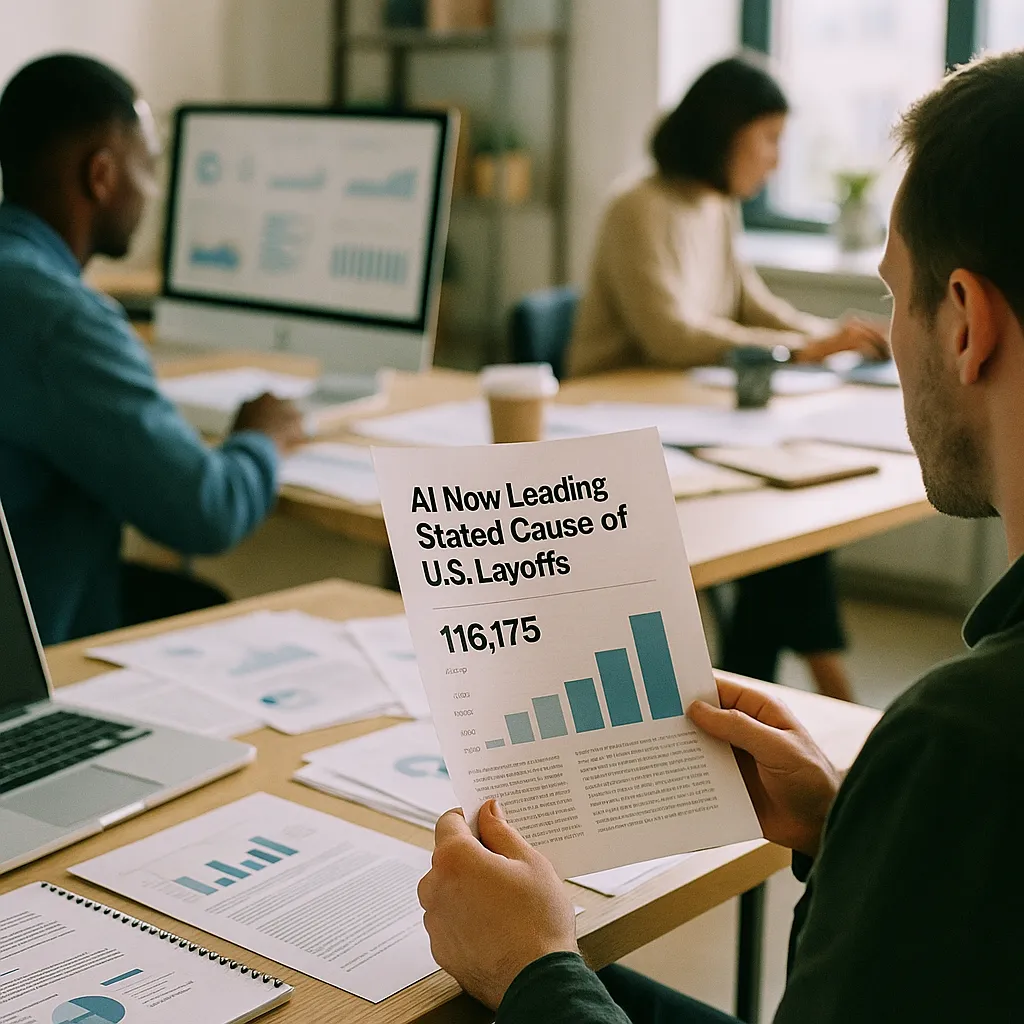
AI automation is eliminating roughly 16,000 American jobs per month, and the workers bearing the most concentrated impact are Gen Z — the generation that entered the workforce just as AI became capable enough to do their entry-level work. Goldman Sachs data analyzed by Fortune shows nearly 48% of all Q1 2026 tech layoffs were explicitly attributed to AI by the employers announcing them, up from under 8% in 2025. That is not a gradual trend. It is a step change.
Why Gen Z Is Disproportionately Exposed
The concentration of AI displacement among Gen Z workers is not random. It reflects a structural mismatch between where this generation entered the workforce and where AI automation has proven most capable, most quickly.
Gen Z workers — those born roughly 1997-2012, and now 14-29 years old — disproportionately hold routine white-collar roles: data entry, legal support, billing and coding, customer service, content moderation, basic research, and administrative coordination. These are exactly the tasks that AI handles best in 2026:
- Data entry and processing: Large language models can extract, normalize, and classify structured data faster and more consistently than humans
- Legal support work: Document review, contract comparison, and basic legal research — tasks that once employed armies of first-year associates and paralegals — are now AI-automated at most major firms
- Billing and coding: Medical and insurance billing, which requires pattern-matching complex rules to specific cases, is a task AI handles without fatigue or error variance
- Customer service: AI chatbots and voice agents now handle the majority of tier-1 customer service volume at companies that have deployed them
These are not peripheral jobs. They are the traditional entry points into professional careers. They are how workers without years of experience or advanced degrees have historically gotten a foothold in finance, law, healthcare administration, and technology.
The 48% Number
The jump from under 8% of tech layoffs attributed to AI in 2025 to nearly 48% in Q1 2026 is the most striking data point in the Goldman Sachs analysis. It suggests that employers have moved from hedging about AI's role in workforce decisions to stating it explicitly.
There are two ways to read this shift:
-
AI's actual displacement impact accelerated sharply between 2025 and 2026, as enterprise AI deployments reached the scale needed to replace headcount rather than just augment it.
-
Employers became more willing to name AI as a layoff cause once doing so became normalized — meaning some portion of this jump reflects disclosure behavior, not necessarily a proportional increase in the underlying displacement rate.
Get this in your inbox.
Daily AI intelligence. Free. No spam.
Both are probably partially true. AI enterprise deployments did accelerate through 2025, particularly in the exact white-collar categories where Gen Z concentrates. And there is certainly a normalization effect — once large companies start attributing cuts to AI without significant backlash, others follow.
Either way, 16,000 jobs per month is the current run rate. At that pace, AI displacement will eliminate roughly 192,000 U.S. positions this year — a number that, while significant, is smaller than total monthly job creation. The macro labor market can absorb it. The workers who held those specific jobs cannot absorb it as easily.
The Career Ladder Problem
The deeper issue is not the monthly number. It is what disappears when entry-level positions are automated away.
A first-year associate at a law firm reviewing documents is not just doing a job. They are learning how legal documents are structured, what matters in discovery, how arguments are built. A junior analyst at a bank running financial models is not just producing spreadsheets. They are developing intuition about capital structures, cash flows, and valuation.
When AI automates the task, it does not provide the learning. The workflow becomes: senior professional → AI → output. The junior professional is no longer in the loop. The skill formation that happens through low-level work — the years of foundational experience that eventually produce senior professionals — gets disrupted.
Industries have not yet developed alternative pathways for this learning. Apprenticeship programs, restructured entry-level roles that focus on AI oversight rather than task execution, and AI-native curriculum in professional schools are all emerging — but slowly. The gap between the pace of AI displacement and the pace of pathway development is where Gen Z workers are getting squeezed.
What Companies Are Doing
The honest picture is mixed. Some companies are:
- Retraining affected workers for AI oversight, quality assurance, and prompt engineering roles — functions that didn't exist three years ago and now exist at significant scale
- Preserving entry-level headcount but shifting the work from execution to supervision of AI outputs
- Absorbing attrition through AI rather than reducing headcount through layoffs — letting natural turnover create savings rather than cutting current employees
Other companies are simply cutting headcount and pocketing the labor cost savings as margin improvement without investing in workforce transition. Both patterns exist; the distribution across industries varies significantly.
What This Means for Workers
If you are a Gen Z worker in a routine white-collar role, the evidence is clear enough to act on:
Roles at high displacement risk in the near term:
- Data entry and processing
- Basic legal research and document review
- Tier-1 customer service
- Administrative scheduling and coordination
- Basic content moderation
Roles with higher durability:
- Work requiring physical presence (field work, skilled trades, in-person services)
- Work requiring genuine relationship management and trust-building
- Work requiring complex judgment in ambiguous, novel situations
- Work requiring AI oversight, quality assurance, and error correction
- Work in industries where AI adoption is structurally slower (regulated healthcare delivery, certain legal contexts requiring licensed professional judgment)
The common thread in durable roles is not education level or prestige. It is irreducibility — tasks that AI systems cannot yet perform reliably enough to replace humans without unacceptable error rates or liability exposure.
What to Watch
The Goldman Sachs data will update quarterly. The Q2 2026 figures, expected in July, will show whether the Q1 spike was a one-time adjustment or the new baseline. Watch specifically for the daily user figures in enterprise AI platforms — when Salesforce, ServiceNow, and Microsoft 365 Copilot report active daily users topping 100 million in enterprise settings, workforce displacement will accelerate further. Those platforms are currently at 30-60 million daily active enterprise users.
Hector Herrera covers AI in the workplace for NexChron.
Did this help you understand AI better?
Your feedback helps us write more useful content.
Get tomorrow's AI briefing
Join readers who start their day with NexChron. Free, daily, no spam.