Goldman Sachs analysis finds AI-driven job displacement is running at 16,000 U.S. positions per month. Gen Z is taking the hardest hit, concentrated in exactly the white-collar roles AI automates first.
AI Is Eliminating 16,000 U.S. Jobs Per Month — and Gen Z Is Taking the Hardest Hit
By Hector Herrera | April 19, 2026 | Work
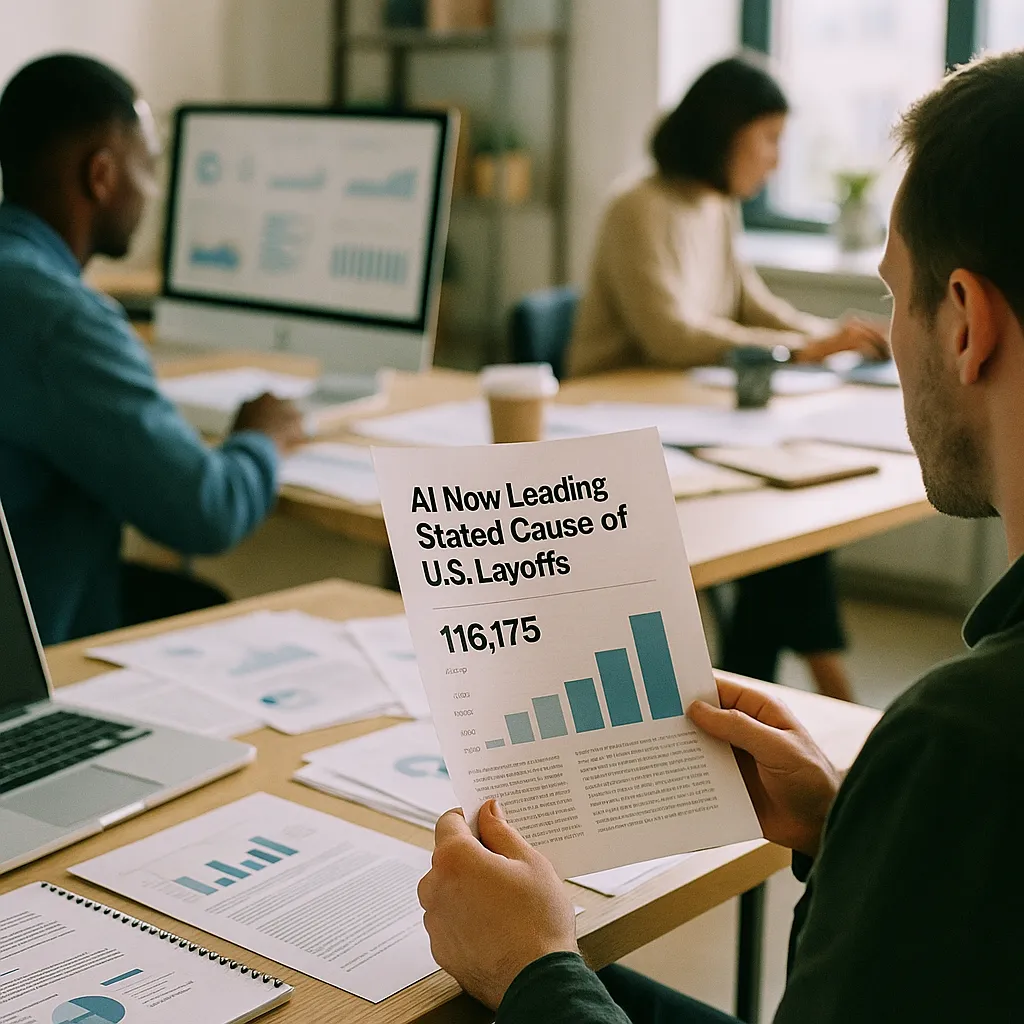
Goldman Sachs analysis finds AI-driven job displacement is running at approximately 16,000 U.S. positions eliminated per month. Nearly half of tech-sector layoffs in Q1 2026 explicitly cited AI as the cause. The generation absorbing most of this impact is Gen Z — the workers who entered the workforce in the last three to five years, concentrated in exactly the routine white-collar roles that AI automates most readily.
What Happened
Goldman Sachs analysis cited by Fortune finds that approximately 16,000 U.S. positions are being eliminated per month as a direct result of AI-driven automation. The figure covers Q1 2026 and represents a significant acceleration: nearly 48% of tech-sector layoffs in Q1 2026 explicitly cited AI as a factor, compared to fewer than 8% just a year ago in 2025.
Gen Z workers — broadly defined as those born between 1997 and 2012, currently ages 14 to 29 — are absorbing a disproportionate share of this displacement. The reason is structural: Gen Z entered the workforce during a period when routine white-collar work was still abundant, and they concentrated in exactly the job categories AI is now automating most aggressively.
Context
The story of AI and jobs is often told in the abstract: AI will transform work, some jobs will disappear, new ones will emerge. The Goldman analysis makes it concrete: a specific number of people, losing specific kinds of jobs, in a specific time period.
The affected roles are not primarily physical or manual. They are white-collar routine jobs: data entry, customer service, legal support, billing and accounts payable, basic research and summarization, content moderation, and coding support. These are entry-level and early-career positions that have historically served as the on-ramp to professional careers. They provided the experience, context, and institutional knowledge that made workers valuable over time.
Get this in your inbox.
Daily AI intelligence. Free. No spam.
When AI eliminates those on-ramps, the damage isn't just the immediate income loss — it's the career trajectory disruption. A 24-year-old who loses a data analysis job to an AI tool isn't just unemployed; they're potentially cut off from the experience accumulation that would have made them a senior analyst in five years.
Details
- Displacement rate: ~16,000 U.S. jobs eliminated per month by AI automation (Q1 2026)
- Tech sector: ~48% of tech layoffs in Q1 2026 cited AI as a factor (vs. <8% in 2025)
- Most affected generation: Gen Z, concentrated in routine white-collar roles
- Job categories most exposed: Data entry, customer service, legal support, billing, content moderation, basic coding tasks
- New roles emerging: AI infrastructure, safety, implementation, and oversight positions
- Gap: Retraining pipelines are far behind displacement rates
The math on displacement: 16,000 per month is approximately 192,000 per year from AI alone — separate from broader tech-sector restructuring, macroeconomic shifts, or other automation trends. That figure is not a prediction. Goldman is counting positions already eliminated.
Impact
For Gen Z workers: The immediate practical reality is that the entry-level job market in white-collar fields has gotten significantly harder — not because of the economy, but because AI is performing tasks that were previously assigned to new graduates. If you're in your mid-20s and job searching in customer service, legal support, data analysis, or content roles, you're competing not just with other humans but with tools that are faster, cheaper, and available 24 hours a day.
What to do about it: The workers who are most protected are those who move up the value stack faster — developing skills in AI oversight, prompt engineering, AI quality assessment, and domain expertise that AI can assist but not replace. The workers most at risk are those doing the same thing they were hired to do three years ago, without acquiring adjacent skills.
For employers: The short-term cost reduction from replacing human workers with AI tools is real and significant. The longer-term risks are less well understood: institutional knowledge loss, reduced pipeline of experienced workers for senior roles, and reputational costs from being seen as a company that displaces workers aggressively. Some employers are navigating this better than others by investing in reskilling programs for displaced workers — these programs are not philanthropy; they're talent pipeline maintenance.
For educators and workforce development systems: Retraining pipelines are, per the Goldman analysis, far behind current displacement rates. This is the central policy failure in the current AI transition. The technology is moving faster than the institutions designed to help people adapt to it. Community colleges, apprenticeship programs, and corporate training programs are all relevant but collectively insufficient at current scale and pace.
For policymakers: 192,000 AI-displaced jobs per year is a number that warrants policy attention. The historical precedents — previous waves of automation in manufacturing, agriculture, clerical work — suggest that the disruption is transitional but the transition can take a decade or longer. The workers who fall through the gap during that transition bear the cost of progress. Whether that cost is shared more broadly — through enhanced unemployment benefits, retraining subsidies, or wage insurance — is a political question that has not been seriously engaged.
What to Watch
The Q2 2026 tech earnings cycle will give the next signal: if major technology companies continue to report AI productivity gains while maintaining or cutting headcount, the 16,000-per-month figure may be an undercount of where things are heading. Watch also for the first significant organized labor response to AI displacement — the rate and scale of displacement are now at levels that historically have triggered collective action.
Hector Herrera covers work and AI for NexChron.
Did this help you understand AI better?
Your feedback helps us write more useful content.
Get tomorrow's AI briefing
Join readers who start their day with NexChron. Free, daily, no spam.