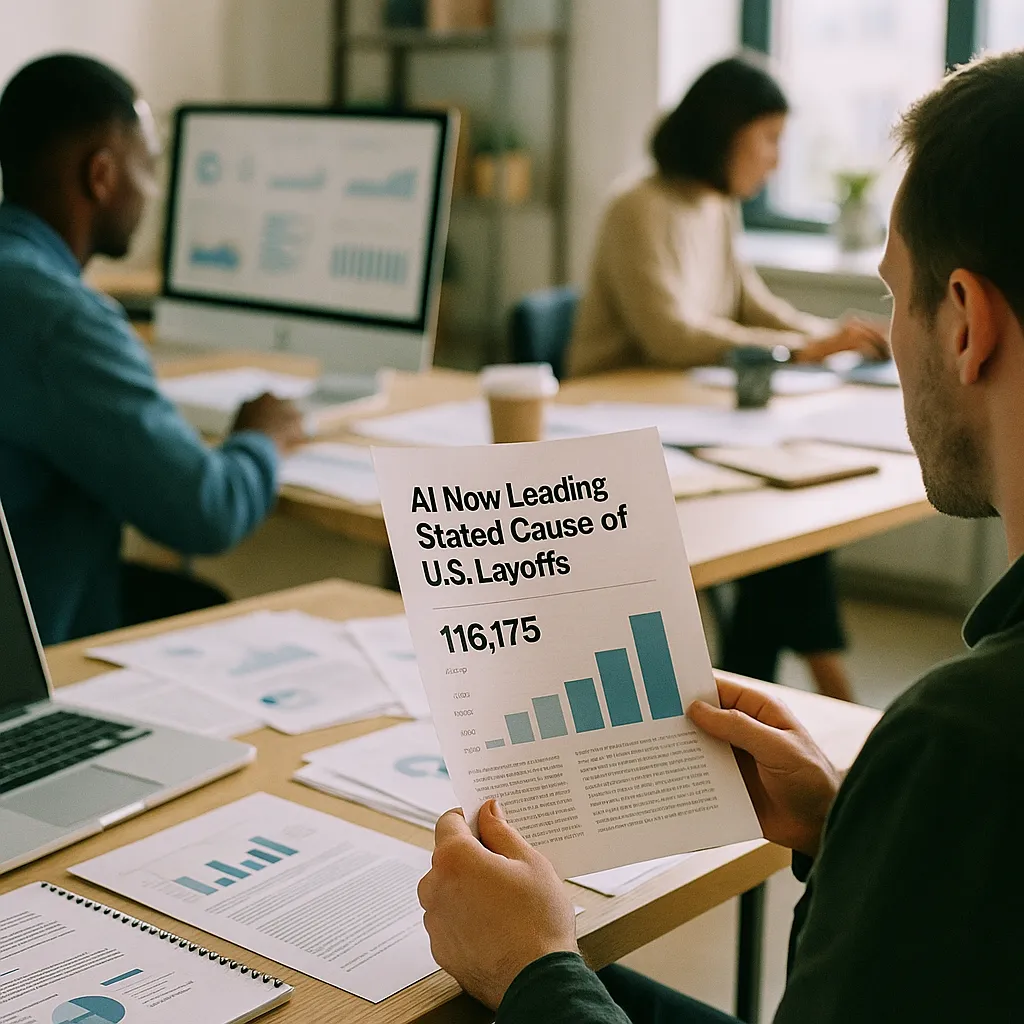
A new Washington Post interactive tool built on BLS data shows white-collar knowledge workers face higher AI displacement risk than factory workers did from previous automation — with women holding 86% of the highest-exposure positions.
The Washington Post's AI Job Exposure Map Reveals Who Is Actually Most at Risk
By Hector Herrera | June 6, 2026 | Work · Data Research
The Washington Post launched a searchable interactive tool that maps AI automation exposure across hundreds of U.S. occupations — and the finding that cuts through the noise is this: white-collar knowledge workers face higher displacement risk from AI than factory workers faced from the previous wave of automation. The tool is built on Bureau of Labor Statistics occupational data and peer-reviewed labor economics research, giving it more rigor than the wave of proprietary AI exposure reports that have flooded the market over the past two years.
The tool lets users search their occupation and see an exposure score alongside the specific task categories most at risk within that role. The methodology matters: it's not measuring whether AI can theoretically do a job, but whether the specific tasks that make up the job — retrieved from the BLS's O*NET occupational database — are tasks that current AI systems can perform with sufficient reliability to displace human labor.
What the Data Shows
The headline finding is that legal, finance, and content creation roles rank among the most exposed occupations in the U.S. economy. This reverses the pattern most people internalized from the previous automation wave, where assembly line workers, warehouse staff, and routine physical labor bore the brunt of displacement.
The underlying reason is that AI systems — specifically large language models (LLMs) trained on vast quantities of professional text — are good at exactly the tasks that define white-collar knowledge work: reading and summarizing documents, producing structured written outputs, analyzing data and identifying patterns, and following rule-based reasoning chains. These are not peripheral tasks in legal and finance roles; they are the primary work.
The gender dimension of this data deserves direct attention. Women hold approximately 86% of the highest-risk positions identified by the analysis — a finding that reflects historical occupational sorting rather than anything about individual capability, but one that has concrete policy implications. Clerical, administrative, data entry, and customer service roles — historically feminized and consistently underpaid — are among the most exposed to AI automation. Unlike manufacturing automation, where workforce transition programs and union contracts created some buffer, these roles lack the organizational infrastructure to cushion displacement.
The Occupations That Are Actually Most at Risk
The tool's granular data reveals that exposure is task-specific, not occupation-wide. Within a single occupation, some tasks are highly automatable while others are not. A few patterns emerge clearly:
Document-intensive roles in law and finance — paralegal work, contract review, compliance monitoring, financial reporting — are at high exposure because they involve reading, synthesizing, and producing structured text from large document sets. AI systems can now do this at comparable or superior accuracy to junior professionals for routine matter types.
Content creation at volume — ad copywriting, social media management, templated journalism, SEO writing — is heavily exposed because AI can produce competent output at these formats faster and cheaper than humans. The threat is not to all writing, but to writing that is defined by production speed and format adherence rather than original insight.
Get this in your inbox.
Daily AI intelligence. Free. No spam.
Data analysis and business intelligence roles face growing exposure as AI tools — from Microsoft Copilot to dedicated business intelligence agents — automate the query-and-visualize cycle that occupies significant hours in analyst roles. The value in these roles is shifting toward problem definition and interpretation, not execution.
Roles with lower exposure share a common thread: they require physical presence, real-time human judgment in unpredictable environments, or relationship management that depends on genuine human interaction. Skilled trades — electricians, plumbers, HVAC technicians — consistently show low AI exposure scores, not because they're simple (they're not), but because the work happens in physical environments that current AI systems can't operate in.
What the Tool Doesn't Tell You
The exposure score measures task automability, not displacement probability. These are related but distinct. A role with high AI task exposure might not see rapid displacement because:
-
Employers choose augmentation over substitution. Many organizations are deploying AI to make existing workers more productive rather than replacing them. A paralegal who can now process twice as many contracts isn't displaced; the firm just needs fewer paralegals when headcount turns over.
-
Regulatory and liability constraints slow adoption. Legal and finance — two of the highest-exposure sectors — are also among the most heavily regulated. AI adoption in these sectors is gated by compliance requirements, professional liability rules, and institutional risk tolerance in ways that manufacturing automation was not.
-
Implementation takes time. The gap between "AI can technically do this" and "organizations have integrated AI into workflows to do this" is measured in years, not months. The exposure scores show theoretical risk, not an immediate employment cliff.
That said, the tool is a genuinely useful resource for understanding directional risk — and the Washington Post's decision to build it on BLS data rather than proprietary AI vendor data gives it credibility that most comparable analyses lack.
What to Do With This Information
If your occupation shows high AI exposure, the response that research supports is not panic but skill portfolio adjustment over a 2-5 year horizon.
Double down on tasks AI can't do well. Judgment in ambiguous situations, client and stakeholder relationships, work that requires organizational context and institutional memory, and anything that involves navigating genuinely novel problems — these are skills with durable value. If your current role lets you build these skills, prioritize that over volume-output tasks that AI is absorbing.
Understand your employer's AI roadmap. High exposure at the occupation level doesn't mean high exposure at your specific organization. Companies that are deploying AI aggressively will have different headcount decisions than those moving slowly. Knowing where your employer sits on that spectrum is the most actionable near-term information.
Policy context. The BLS data underlying this tool is also what Congress uses when evaluating workforce transition programs, trade adjustment assistance, and education funding. The finding that AI exposure is concentrated in sectors with weak union representation and predominantly female workforces should shape policy design in ways that the manufacturing automation response did not.
What to Watch
Q3 2026 BLS occupational employment data will show early signals of whether the theoretical exposure scores are tracking real employment trends. Watch specifically for employment declines in paralegal, compliance, and financial analyst categories — those are the canary-in-the-coal-mine occupations for white-collar AI displacement.
Corporate earnings calls in the legal and finance sectors are increasingly explicit about headcount decisions tied to AI deployment. Pay attention to how law firms and financial institutions discuss associate-level and analyst-level staffing relative to AI tool adoption in their 2026 annual reports.
The Washington Post's tool doesn't predict the future. But it maps the terrain more honestly than most of the AI-and-jobs discourse — and right now, honest maps are what workers, employers, and policymakers most need.
Did this help you understand AI better?
Your feedback helps us write more useful content.
Get tomorrow's AI briefing
Join readers who start their day with NexChron. Free, daily, no spam.