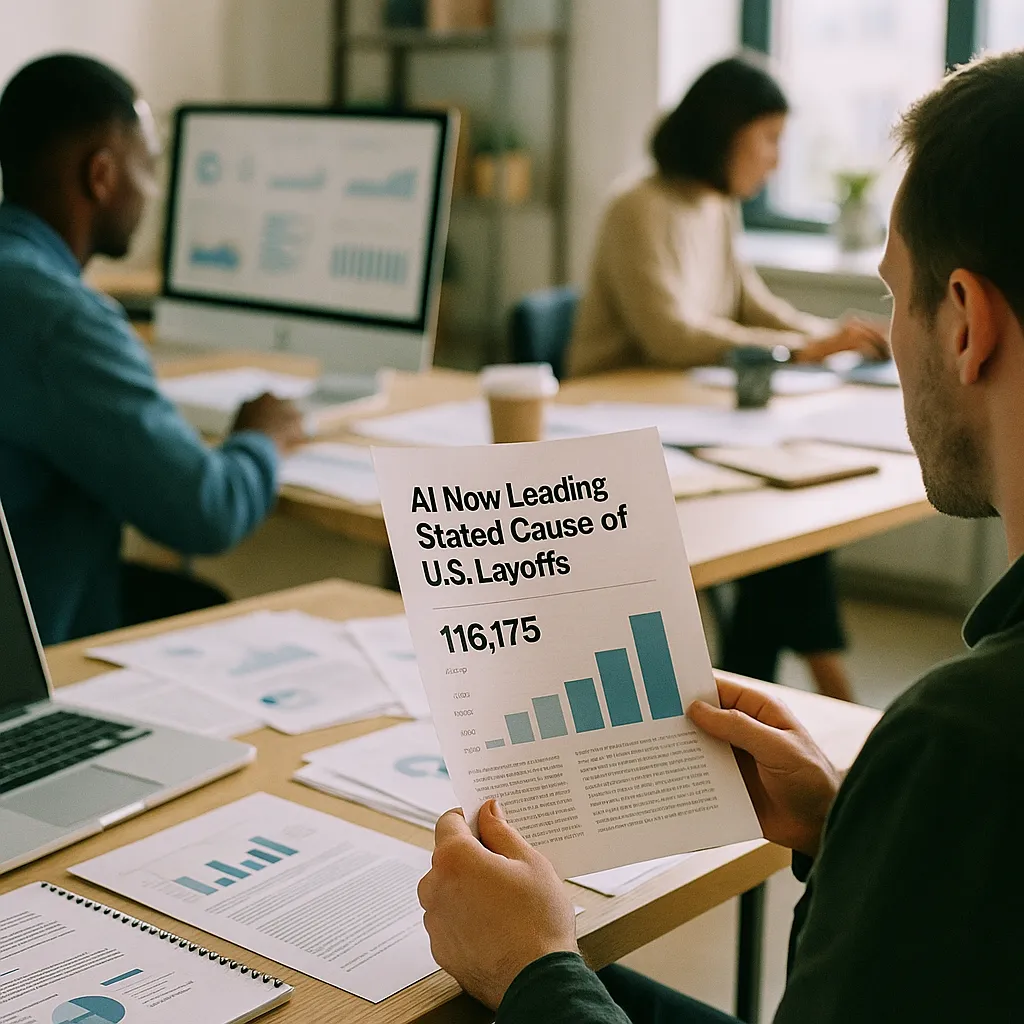
Challenger, Gray & Christmas reports nearly 50,000 U.S. job cuts in 2026 are directly tied to AI — 17% of all layoffs — with entry-level roles disproportionately targeted as firms quietly stop hiring junior workers rather than making headline layoff announcements.
AI Has Cut 50,000 U.S. Jobs in 2026. New Workers Are Getting Hit the Hardest.
Nearly 50,000 U.S. job cuts in 2026 have been directly attributed to AI, according to research firm Challenger, Gray & Christmas — representing 17% of all layoffs recorded so far this year. The cuts are not spread evenly: entry-level and junior roles are being eliminated at a disproportionate rate, and new evidence suggests companies are quietly stopping junior hiring altogether rather than making dramatic layoff announcements.
The Challenger, Gray & Christmas report, covered by CBS News, puts a specific number on a trend that has been widely discussed but rarely quantified with this precision. Seventeen percent of all U.S. layoffs in a single year being attributable to a single technology is significant data. It places AI-driven displacement firmly in the category of documented labor market impact rather than speculative concern.
Who Is Getting Cut and Why
The disproportionate impact on entry-level workers reflects something structural, not coincidental. AI systems are best at replicating book-learning — the application of defined knowledge to defined problems. That is precisely what junior roles require in most professional contexts.
A first-year financial analyst compiles data, builds models from templates, and produces reports — tasks that AI can now perform faster and more cheaply. A junior paralegal reviews contracts for standard clauses, summarizes depositions, and drafts routine correspondence — tasks similarly amenable to automation. A junior marketing associate drafts copy, resizes assets, and schedules posts — tasks that AI handles in minutes.
What AI cannot yet replicate is the experiential judgment that senior employees develop over years: the ability to recognize when a model is wrong, when a client relationship requires a different approach, when the data is asking the wrong question. But companies don't need to hire junior workers to eventually become senior workers if AI can perform the junior tasks now. That is the logic driving the pattern.
BCG's parallel analysis, referenced in the CBS News report, makes this distinction explicit: firms are not primarily laying off existing junior employees — they are stopping junior hiring. Headcount reduction through attrition is quieter than announced layoffs, doesn't show up in the same news cycle, and is harder to attribute directly to any single cause. This makes the true displacement figure larger than the 50,000 reported by Challenger.
The New Graduate Problem
The structural logic creates a specific crisis for new college graduates. A graduating class of 2026 is entering a labor market where:
Get this in your inbox.
Daily AI intelligence. Free. No spam.
- The entry-level roles that have historically provided on-ramp experience are being eliminated or not filled
- Companies that are hiring junior roles expect AI-tool proficiency as a baseline, not a differentiator
- The "learn on the job" model — which has been the core mechanism for professional skills transfer for generations — is collapsing faster than educational institutions can adapt
BCG's analysis warns that the transition period will hit new graduates hardest, not because AI eliminates most of their potential careers, but because the apprenticeship model that allowed people to become competent has been disrupted. Senior employees who learned before AI was deployed have experience. New graduates cannot acquire experience in the same way if the junior roles that generated that experience no longer exist.
This is not hypothetical. Law firms that have reduced associate hiring have disclosed that they are using AI for document review and research — functions that first- and second-year associates historically performed as their primary job duty. Consulting firms have made similar disclosures about analyst-level work. In accounting, firms are piloting AI for audit sampling and workpaper preparation — again, junior associate functions.
The Broader 2026 Layoff Context
The Challenger data does not exist in isolation. The 50,000 AI-attributed cuts land in a broader 2026 layoff environment that has been shaped by a combination of factors: post-pandemic headcount normalization, interest rate impacts on tech and finance sector hiring, and AI-driven productivity gains that reduce headcount requirements even at growing companies.
Earlier NexChron reporting documented the tech sector's 142,000 layoffs through May 2026, with AI infrastructure investment accelerating even as software engineering headcount contracted. The pattern — invest in AI, reduce people — is consistent across sectors.
The sectors with the highest AI-attributed displacement so far: financial services, legal, marketing, customer support, and administrative functions. These are exactly the sectors where AI language model capabilities are most directly applicable to existing workflows.
What Companies Are Not Saying
The Challenger data captures stated reasons for layoffs. The true scope of AI-driven displacement is almost certainly larger because companies rarely cite AI as the explicit reason for not posting a junior role. When a firm decides to process contracts with an AI tool rather than hire a new paralegal, no announcement is made. No news release goes out. The position simply doesn't appear on the jobs board.
This reporting gap means the 50,000 figure likely undercounts the actual impact. What it does capture is the visible, stated portion — the companies willing to put AI in the press release explaining workforce reductions.
What to Watch
Watch for class of 2026 employment data from university career centers and the National Association of Colleges and Employers — this will be the first dataset showing whether the structural shift in junior hiring is showing up in new graduate employment rates. Also watch for legislative responses: several states are considering requiring companies to disclose AI use in hiring and firing decisions, which would produce better data on the true scope of displacement. Colorado's AI Act, taking effect June 30, includes provisions relevant to AI use in employment decisions.
By Hector Herrera | NexChron | June 5, 2026
Did this help you understand AI better?
Your feedback helps us write more useful content.
Get tomorrow's AI briefing
Join readers who start their day with NexChron. Free, daily, no spam.