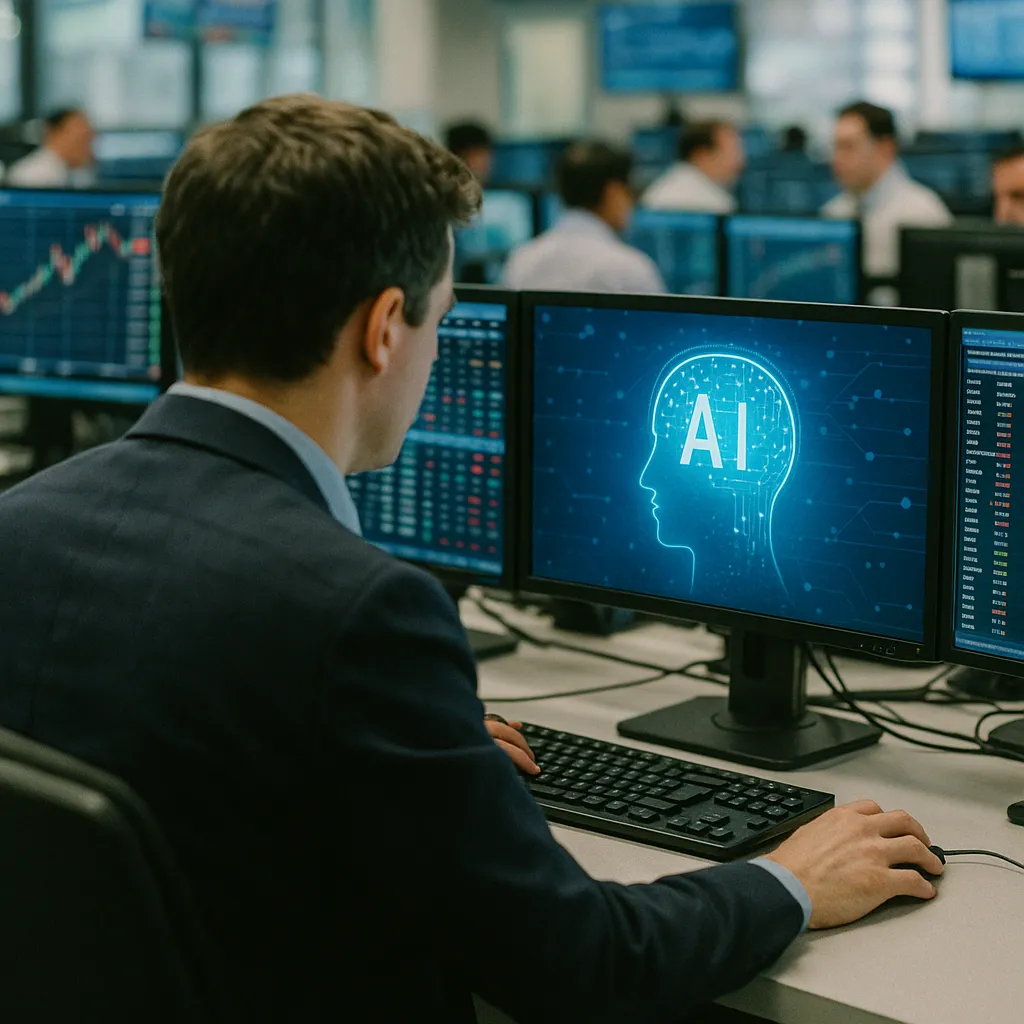
Goldman Sachs and Lloyds Launch Autonomous AI Agents as Banking's Agentic Era Arrives
Goldman Sachs is deploying Anthropic Claude-powered autonomous agents for trade accounting and client onboarding, while Lloyds Banking Group expects enterprise-wide agentic AI to add £100 million in value.
Why this matters
Goldman Sachs is deploying Anthropic Claude-powered autonomous agents for trade accounting and client onboarding, while Lloyds Banking Group expects enterprise-wide agentic AI to add £100 million in value.
Goldman Sachs and Lloyds Deploy Autonomous AI Agents as Banking's Agentic Era Arrives
By Hector Herrera | April 12, 2026 | Finance
Goldman Sachs is deploying Anthropic Claude-powered autonomous agents to handle trade accounting and client onboarding. Lloyds Banking Group expects AI agents to generate £100 million in value by automating fraud investigations and complex complaints. Banking has crossed a threshold: AI is no longer a productivity tool layered on top of human work. It is becoming a semi-autonomous decision-maker operating under human oversight.
Financial disclaimer: This article covers industry trends and corporate AI deployments. It does not constitute investment advice.
What Happened
Two of the world's major financial institutions made concrete agentic AI commitments this week. At Goldman Sachs, Claude-powered agents—built on Anthropic's large language model—are handling core trade accounting and client onboarding workflows. These aren't assistants that draft emails for a human to review; they are agents that initiate and complete multi-step financial processes with defined human checkpoints.
At Lloyds Banking Group, reporting from Surfside Capital Advisors documents an enterprise-wide agentic AI rollout expected to add £100 million in value primarily through automation of fraud investigations and complex customer complaints—two workflow categories that previously required skilled analyst time and often took days to resolve.
More than 66% of banking institutions now rate AI as a high strategic priority, with most planning to increase AI budgets by at least 10% this year.
Context
The financial industry has been using AI for years—credit scoring, algorithmic trading, fraud detection—but those systems operated on narrow, well-defined tasks with static rule sets. The current shift is different in kind.
Get this in your inbox.
Daily AI intelligence. Free. No spam.
Agentic AI refers to systems that can pursue multi-step goals, make intermediate decisions, use tools (APIs, databases, document systems), and complete complex tasks end-to-end with minimal human direction per step. The human remains in the loop, but at a supervisory level rather than a step-by-step approval level.
That distinction has profound implications for how financial services are delivered, staffed, and regulated.
Details
Goldman Sachs's deployment of Anthropic Claude is notable because Anthropic has positioned itself as the safety-focused AI lab, and Goldman is making a deliberate choice about which AI provider to trust with core financial operations. Trade accounting errors have real monetary consequences. Client onboarding errors create compliance exposure. Goldman's selection of Claude signals that "safety" is now a procurement criterion in financial AI, not just a marketing claim.
Lloyds's £100 million value projection is quantified, which is rarer than you'd expect in corporate AI announcements. The company is specific about the use cases: fraud investigations and complex complaints. Both are currently handled by trained analysts. The agentic system would gather evidence, run checks against multiple systems, apply policy rules, and produce a resolution recommendation or decision—compressing timelines from days to potentially hours or minutes.
Impact
For banking customers: Faster fraud resolution is a concrete consumer benefit. If your account is compromised, a system that can investigate and begin recovery procedures in minutes rather than days is materially better than the current experience. Complex complaint resolution is similar: the bottleneck is usually human review time, not policy clarity.
For financial analysts and compliance staff: The workflows being automated—fraud investigation, client onboarding, trade accounting reconciliation—are among the highest-volume, most time-consuming tasks in financial operations. The staffing implications are real. Roles focused on routine investigation and reconciliation are in the most direct exposure path. Roles requiring judgment, client relationship management, and regulatory interpretation are more durable.
For bank competitors: If Goldman and Lloyds are deploying production agentic systems now, smaller regional banks and credit unions face a structural cost and speed disadvantage that will compound over time. The technology is available to everyone, but the implementation capacity—data infrastructure, integration work, compliance review—concentrates at institutions with scale.
For regulators: Autonomous AI agents making decisions in regulated financial contexts create accountability questions that existing frameworks weren't designed to answer. Who is responsible when an AI agent makes an incorrect fraud determination that harms a customer? What audit trails are required? Expect guidance from the OCC, FCA, and Federal Reserve in the next 12 to 18 months.
What to Watch
The Goldman deployment is particularly important to watch because Anthropic's Constitutional AI approach—which prioritizes predictable, values-aligned behavior over raw capability—is being tested at production scale in a high-stakes financial environment. If Claude-powered agents perform reliably at Goldman, it validates the safety-focused development approach and accelerates its adoption across the industry.
Watch for Q2 and Q3 earnings calls from major banks. When CFOs start attributing productivity gains or cost reductions specifically to agentic AI, you'll have confirmation that the technology is delivering on the ROI projections being made now.
Hector Herrera covers finance and AI for NexChron.
Hector Herrera is an AI systems architect and the founder of Hex AI Systems. He designs and runs AI systems in production and writes daily about how AI is reshaping business, government and everyday life. 20+ years building for the web. Houston, TX.