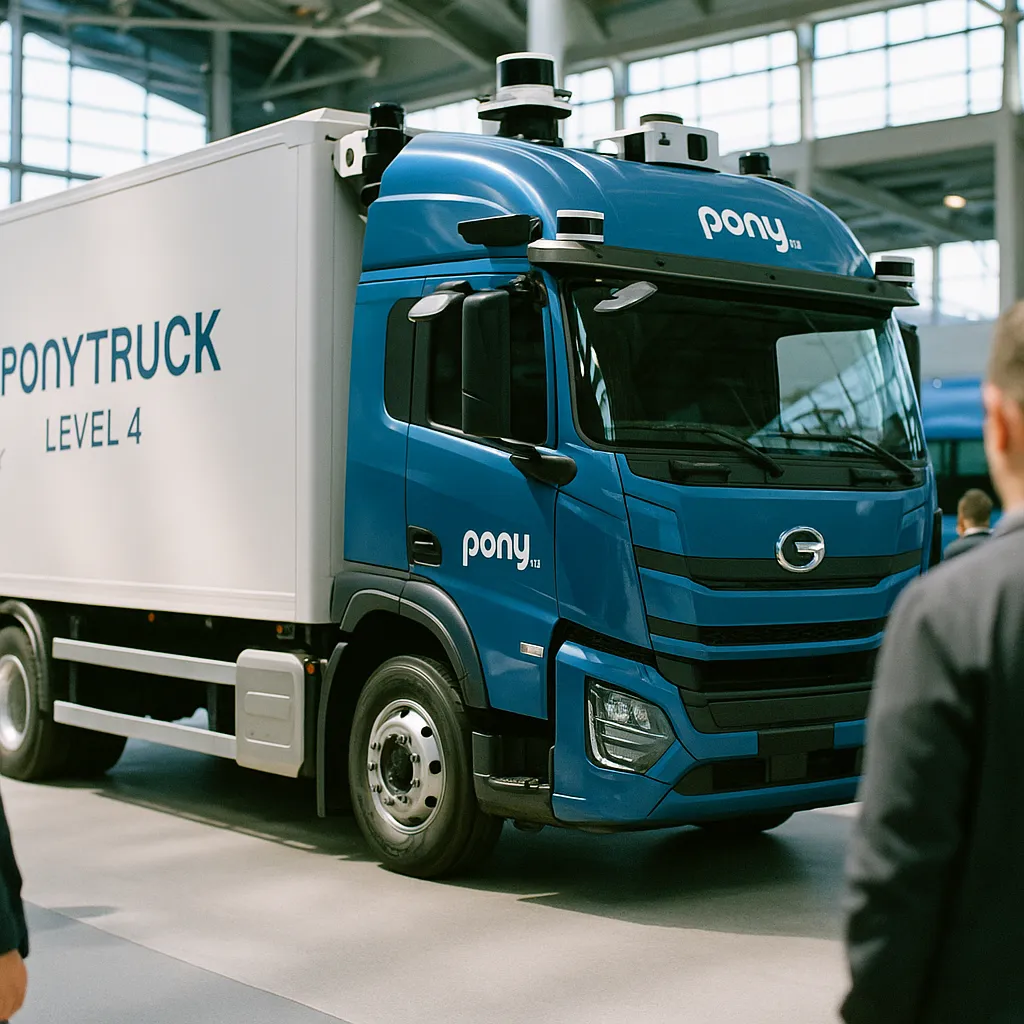
Pony.ai and GAC Commercial Vehicle debuted a Level 4 autonomous heavy truck at IAA 2026 with 70% lower hardware costs and 30% lower freight cost per ton-kilometer, targeting volume production before year-end.
Pony.ai and GAC Commercial Vehicle debuted a Level 4 autonomous heavy-duty truck at IAA Transportation 2026 in Hanover on September 14, cutting the cost of the autonomous driving kit 70% compared to prior generations and projecting a 30% reduction in freight cost per ton-kilometer at commercial scale. The Gen-4 T9 shares its compute platform with Pony.ai's existing 1,400-vehicle robotaxi fleet—a cross-vehicle-segment platform strategy that is now moving from development to volume production.
Why it matters: A 70% hardware cost reduction on a Level 4 truck targeting volume production before year-end isn't a concept demonstration. It's a commercial threshold being crossed.
Pony.ai's Platform Strategy
Pony.ai has operated robotaxis in China since 2018 and expanded internationally with its Gen-7 platform. The decision to share compute hardware between the Gen-4 robotruck and the Gen-7 robotaxi fleet is the central cost lever: rather than developing separate autonomous driving systems for each vehicle category, Pony.ai amortizes development and production costs across a larger combined deployment base.
The result is a 70% reduction in the autonomous driving kit cost—historically the single largest barrier to profitable commercial deployment of self-driving vehicles. At this cost level, logistics operators can begin building business cases that don't require waiting for another generation of hardware improvement.
GAC Commercial Vehicle, one of China's major state-backed truck manufacturers, provides the production infrastructure that allows Pony.ai's autonomous kit to reach scale in ways a pure-software company cannot on its own.
Gen-4 T9 Specifications
From Pony.ai's IAA announcement:
Get this in your inbox.
Daily AI intelligence. Free. No spam.
- Level 4 autonomy — no driver required within defined operational design domains
- Shared compute platform with Pony.ai's 1,400-vehicle Gen-7 robotaxi fleet
- 70% reduction in autonomous driving hardware cost vs. prior generation
- 30% projected reduction in freight cost per ton-kilometer at commercial scale
- Volume production begins before year-end 2026
- Target markets: long-haul routes, port logistics, dedicated freight corridors
- International expansion to Europe and the Middle East within two years
The focus on ports and dedicated routes is deliberate. Level 4 autonomy requires a defined operational design domain (ODD)—a bounded set of conditions the system is validated to handle. Ports and dedicated freight corridors offer the predictable, controlled environments where ODD boundaries can be drawn tightly, enabling reliable Level 4 operation before technology can handle all highway conditions at scale.
The Economics of Autonomous Freight
The 30% freight cost reduction per ton-kilometer is the number that matters most for logistics operators evaluating Pony.ai's timeline.
Long-haul trucking economics are driven primarily by driver cost, fuel, and equipment maintenance. An autonomous system eliminates driver cost entirely in ODD-validated routes and optimizes fuel consumption through consistent driving patterns. At 30% total freight cost reduction, autonomous trucking becomes economically superior to human-operated freight on dedicated routes without requiring operational conditions broader than port and highway-corridor environments.
The competitive implication for operators:
- Carriers that pilot autonomous freight now will have real-world cost performance data by 2027–2028
- Carriers that wait will be price-competed by operators who don't carry driver cost in their per-mile calculation
- The question isn't whether this technology disrupts trucking economics—it's the speed and geographic scope of adoption
International Expansion Timeline
Pony.ai announced plans to expand Gen-4 T9 operations to Europe and the Middle East within two years of the IAA unveiling. That timeline puts initial international deployments in 2027–2028, likely beginning with port operations where regulatory frameworks for autonomous freight are most developed.
The IAA Transportation venue in Hanover is a deliberate signal: Europe's logistics industry is the intended early international customer, and the announcement positions Pony.ai directly in front of the operators and regulators who will determine whether European commercial deployments happen on that timeline.
What to Watch
Volume production commencement before year-end 2026 is the first milestone to verify. Pony.ai's ability to execute on that schedule—while managing ongoing robotaxi operations and beginning the regulatory approval process for European markets—will determine whether the Gen-4 T9 represents a genuine commercial inflection point or a well-staged IAA showcase.
By Hector Herrera | Sources: PR Newswire / Pony.ai
Did this help you understand AI better?
Your feedback helps us write more useful content.
Get tomorrow's AI briefing
Join readers who start their day with NexChron. Free, daily, no spam.