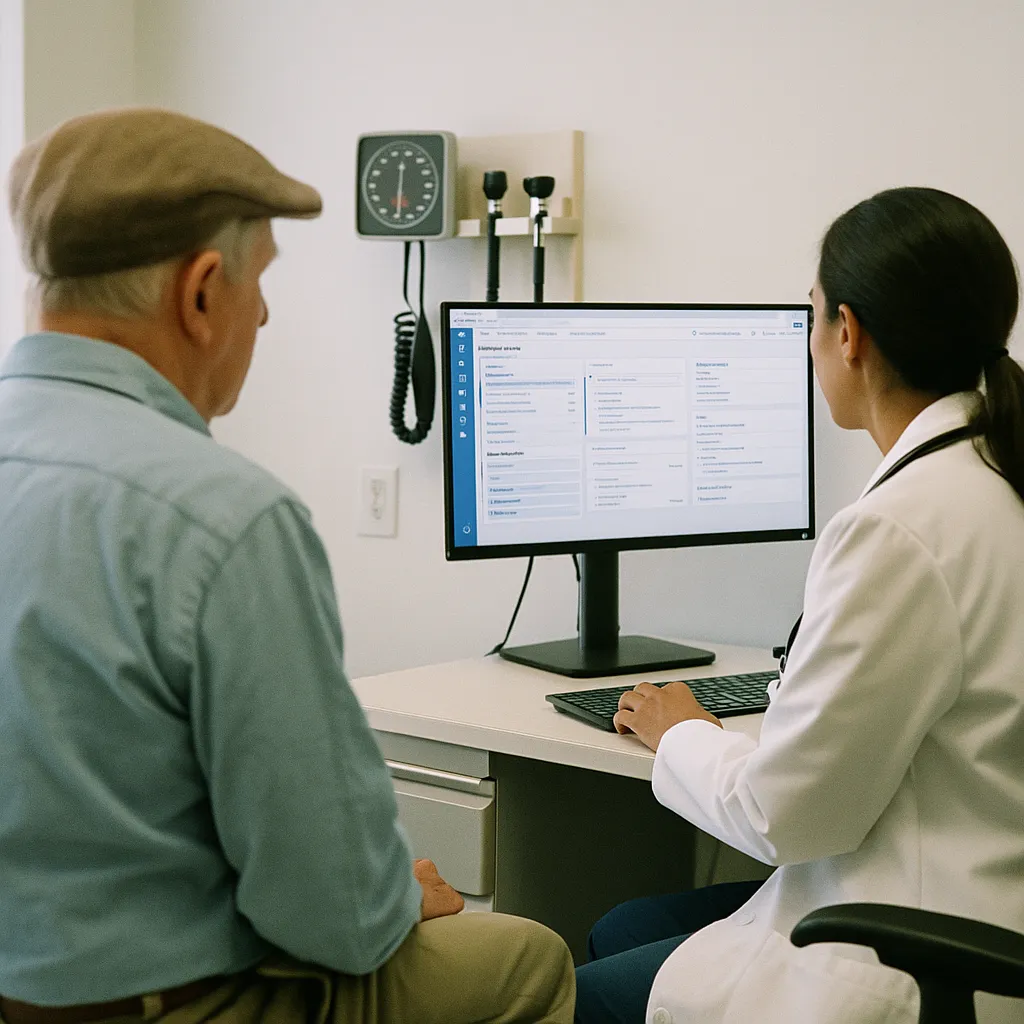
Four major U.S. health systems have embedded AI directly into clinical workflows — and the outcome data is starting to arrive. With 80% of U.S. physicians now using AI, double the 2023 rate, the AHA profiles what scaled deployment actually looks like.
Four Health Systems Show AI Scaling From Pilot to Patient Care
By Hector Herrera | May 13, 2026 | Health
Four major U.S. health systems have crossed a significant threshold: AI is no longer running in pilot programs alongside clinical workflows — it is embedded in them. With 80% of U.S. physicians now using AI on the job, double the rate from 2023, the American Hospital Association's Center for Health Innovation has profiled these systems offering the most concrete outcome data yet from real deployments at real scale.
The Shift From Adoption to Execution
Two years ago, the dominant conversation in health system AI was whether to adopt. That conversation has moved. The question now is execution — specifically, how fast proven tools can scale without compromising the safety margins that make clinical AI worth deploying in the first place.
The AHA's profiles offer a practical roadmap that smaller systems and still-piloting hospitals will use to calibrate their own investments.
Advocate Health: 22 Sites, 63,000 Patients Annually
The clearest example of scaled clinical AI deployment comes from Advocate Health, one of the largest nonprofit health systems in the country. Advocate has embedded FDA-approved AI imaging models across 22 diagnostic sites, targeting three conditions where earlier detection changes outcomes:
- Pulmonary embolisms — blood clots in the lungs, which are fatal if missed and treatable if caught quickly
- Rib fractures — often missed on initial reads, with implications for pain management and detecting abuse
- Brain aneurysms — time-sensitive findings where detection speed directly affects intervention options
The system projects these tools will benefit 63,000 patients annually through earlier detection. The FDA-approved status matters operationally: these are not experimental models running in parallel to human readers. They are integrated into the diagnostic workflow as a standard component.
Twenty-two diagnostic sites at a single system is a meaningful scale marker. Most published clinical AI deployments involve one or two locations. Twenty-two means the system has standardized governance, handled integration challenges across different imaging equipment and EHR configurations, and built the training and override protocols that sustained operation requires.
Get this in your inbox.
Daily AI intelligence. Free. No spam.
Why Physician Adoption Doubled in Two Years
The 80% physician AI adoption figure deserves disaggregation. The fastest-growing application is ambient documentation: AI that listens to a patient encounter, drafts the clinical note, and submits it for physician review. This addresses one of the most persistently cited sources of physician burnout — administrative time — without inserting AI into clinical judgment itself.
Beyond documentation, the clinical applications gaining traction across all four profiled systems include:
- Predictive deterioration scoring in ICU and post-surgical settings — flagging patients whose vitals indicate early-stage decline before it becomes a crisis
- Sepsis detection models that identify laboratory and vital sign patterns associated with infection before the clinical picture becomes obvious
- Readmission risk scoring that flags high-risk discharges for additional follow-up
Administrative AI Is Funding Clinical AI
A pattern visible across all four systems is that administrative AI applications are generating ROI that justifies — and in some cases funds — clinical investments. Revenue cycle automation handling prior authorizations, claims routing, and billing reconciliation produces measurable efficiency gains with lower regulatory and safety risk than clinical applications.
This matters for health systems evaluating their AI roadmaps. The capital required for clinical AI governance infrastructure is not trivial. Administrative AI that reduces FTE costs in coding and billing creates the budget space to invest in clinical deployment properly.
The Governance Infrastructure Nobody Talks About
AI performance in a controlled pilot and AI performance at operational scale are different problems. A model that performs well on a validation dataset encounters the full diversity of real patients, varying imaging equipment, different clinical cultures, and genuine edge cases.
The health systems that have successfully scaled share a governance structure: defined escalation protocols (when the physician must override, and how that override is documented), ongoing performance monitoring (tracking model outputs against clinical outcomes, not just against prior reads), and clear liability frameworks that establish who is responsible when an AI-assisted diagnosis is wrong.
None of this is glamorous. It is what separates a sustainable clinical AI program from a liability event.
What to Watch
The next measurement milestone for Advocate Health and the other systems profiled is outcome reporting — not projected benefits, but published data showing whether AI-assisted detection is changing mortality, morbidity, or time-to-intervention at the scale of 63,000 annual patients. That data, when it arrives, will drive the next adoption wave across mid-tier health systems watching to see whether the outcomes justify the investment.
Health disclaimer: This article covers healthcare technology deployments and is intended for informational purposes only. It is not medical advice. Clinical decisions should always be made by qualified healthcare professionals.
Did this help you understand AI better?
Your feedback helps us write more useful content.
Get tomorrow's AI briefing
Join readers who start their day with NexChron. Free, daily, no spam.