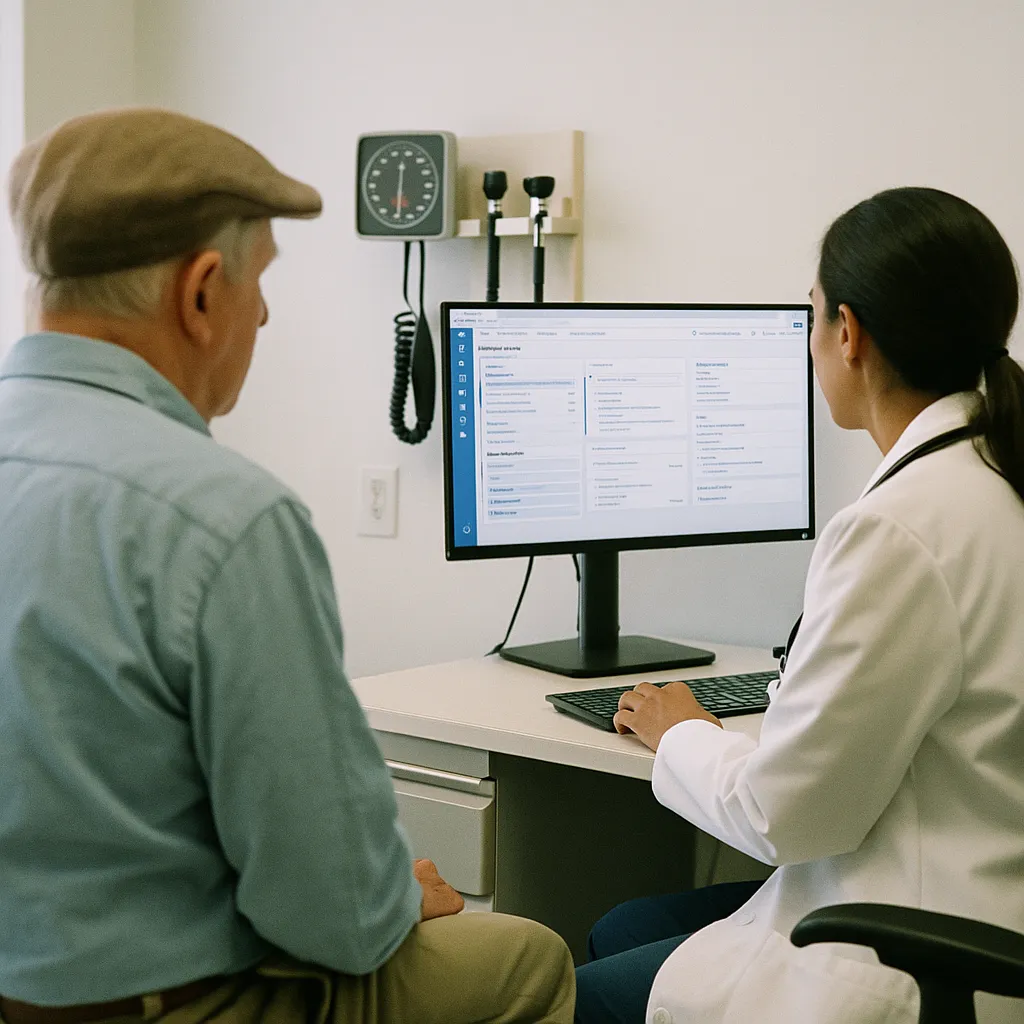
Boston teaching hospitals are drafting formal AI diagnostic protocols after studies showed AI matching or outperforming ER physicians, making Massachusetts a national bellwether for clinical AI governance.
Massachusetts Hospitals Are Confronting AI's Role in Clinical Diagnosis — and Running Out of Time to Decide
By Hector Herrera | May 12, 2026
Boston teaching hospitals are drafting formal protocols for AI-assisted diagnosis after a series of studies showed AI systems outperforming emergency room physicians using only electronic health records — and Massachusetts is becoming the first state in the country to grapple seriously with what that means for medical oversight, liability, and the future of clinical training. WBUR reported this week that the state is emerging as a national bellwether for how the US healthcare system will govern AI at the point of care.
The urgency is not hypothetical. The technology is already in hospitals. The question is who's responsible when it's right — and when it's wrong.
What the Research Says
The evidence base for AI diagnostic capability has accumulated faster than healthcare institutions can absorb. Several peer-reviewed studies have now demonstrated that AI systems can match or outperform physicians on specific conditions — including certain cancers, sepsis prediction, and cardiovascular risk — when working from structured electronic health record (EHR) data alone.
The qualifier matters: on specific conditions, using structured data. These systems are not general diagnosticians. A trained model that excels at flagging early-stage diabetic retinopathy from retinal scans may perform worse than a first-year resident at recognizing an atypical presentation of appendicitis in a patient with a confusing symptom history. Context, nuance, and lateral thinking remain human advantages.
But the honest reading of the literature is that AI systems are diagnostically competitive in a growing set of high-frequency, data-rich clinical scenarios — and competitive means the baseline question of whether to use them is no longer theoretical.
Boston Teaching Hospitals at the Center
Massachusetts General Hospital, Brigham and Women's, and the broader Mass General Brigham system have been among the most active in piloting AI diagnostic tools in clinical settings. That depth of engagement is why the state is where the policy question is sharpest.
Get this in your inbox.
Daily AI intelligence. Free. No spam.
What hospitals are now confronting:
- Protocol gaps. Most institutions have deployed AI tools without defining when clinicians are required to consult them, when they can override them, or how disagreements between AI output and clinical judgment should be documented.
- Liability ambiguity. If a physician overrides an AI recommendation and the patient suffers harm, is the physician liable? What if the physician follows the AI recommendation and the AI was wrong? Current medical malpractice law was not written for this scenario.
- Documentation requirements. Should AI-assisted diagnoses be logged differently in the EHR than fully human diagnoses? If so, how? No standard exists.
- Informed consent. Do patients have a right to know if AI was involved in their diagnosis? Massachusetts is considering requiring disclosure.
The Deskilling Concern
The concern that tracks most closely with the entry-level job problem in other industries is physician deskilling — the possibility that clinicians who routinely defer to AI recommendations will gradually lose the diagnostic reasoning abilities that made them capable of identifying AI errors in the first place.
This is not a hypothetical slippery slope. Aviation has documented analogous effects with autopilot dependency; pilots who rely heavily on automation can show degraded manual flying skills in emergencies. The question for medicine is whether diagnostic reasoning — a cognitively demanding skill developed through years of seeing patients — can erode if the act of formulating a differential diagnosis is increasingly delegated to a system.
Medical educators in Boston are raising this explicitly. A clinician who supervises AI outputs for five years without regularly working through diagnoses independently may have difficulty course-correcting when the AI is confidently wrong. And AI diagnostic systems are not reliably wrong in obvious ways — they sometimes fail precisely at unusual presentations that require the kind of pattern-breaking reasoning that human clinicians are trained to apply.
What State Policy Could Look Like
Massachusetts is considering several regulatory approaches, none yet final:
- Mandatory disclosure to patients when AI diagnostic tools were used in their care
- Minimum documentation standards for AI-assisted diagnosis in EHRs
- Liability allocation rules that clarify physician and hospital responsibility when AI recommendations are followed or overridden
- Training requirements for clinicians using AI tools, with continuing education attached to AI-assisted clinical roles
The state's approach will likely influence federal guidance from the FDA and the Centers for Medicare & Medicaid Services, both of which have been slow to produce specific rules for AI in clinical diagnosis.
The Stakes
Healthcare is both the highest-stakes and the most data-rich domain for AI deployment. The potential benefits — earlier diagnosis, fewer missed conditions, more consistent care across geographies — are real and documented. AI can surface a sepsis risk score at 2 a.m. when the attending is managing four other critical patients. That has value.
The risks are equally real. A miscalibrated diagnostic model deployed at scale across a health system can systematically miss conditions in populations underrepresented in its training data — a documented failure mode in AI systems trained primarily on data from academic medical centers serving non-representative patient populations.
The governance question Massachusetts is working through is not whether to use AI in diagnosis. That ship has sailed. The question is under what rules, with what accountability, and with what protections for patients who never consented to be part of an ongoing experiment in clinical AI.
What to Watch
The key near-term indicators are whether Mass General Brigham publishes its AI diagnostic protocols — which would set a de facto industry standard — and whether Massachusetts legislation advances that mandates patient disclosure. Federal action from the FDA or HHS on AI in diagnosis would move faster than state law but has shown no signs of urgency. The first major malpractice case involving an AI diagnostic recommendation, whenever it arrives, will define the legal landscape in ways regulation has not.
Hector Herrera covers AI in healthcare and government policy at NexChron. Source: WBUR
Did this help you understand AI better?
Your feedback helps us write more useful content.
Get tomorrow's AI briefing
Join readers who start their day with NexChron. Free, daily, no spam.