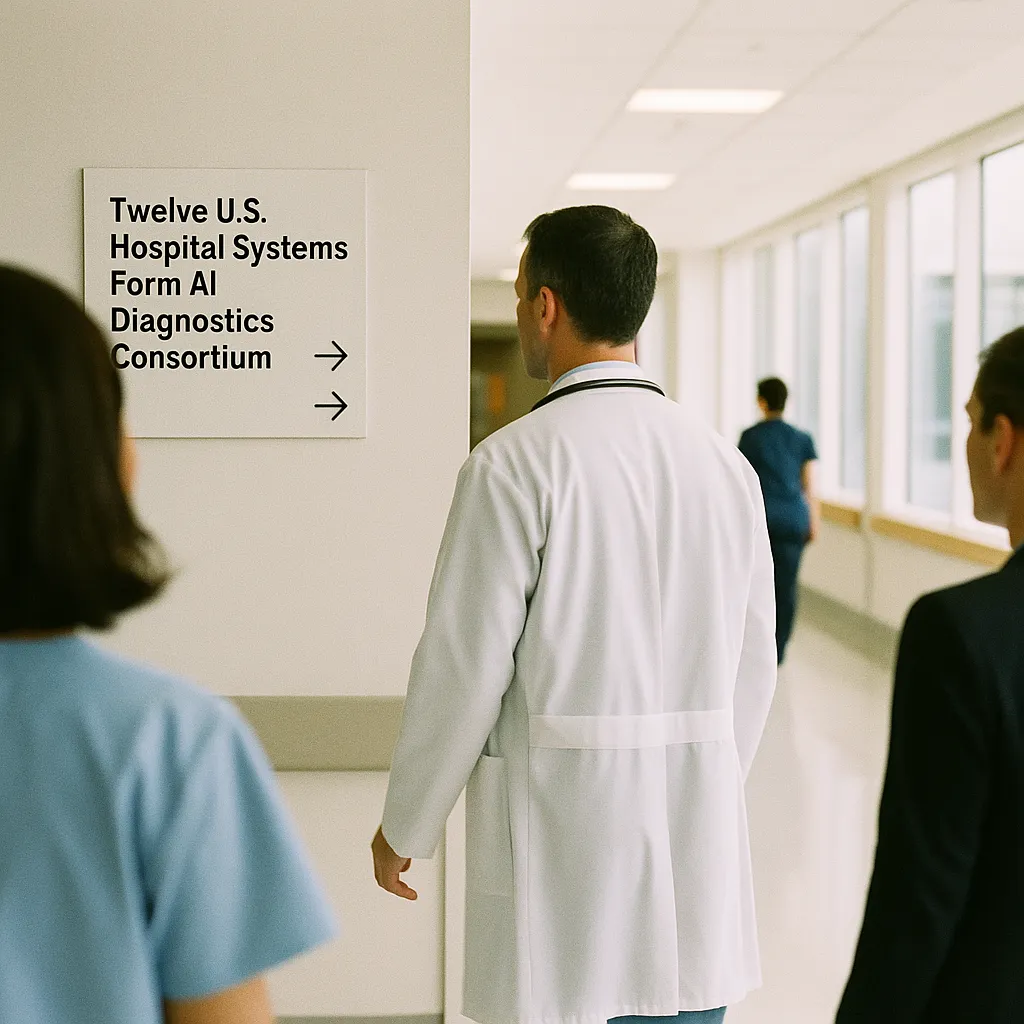
Twelve major U.S. health systems have joined Aidoc in a formal consortium to share AI governance frameworks and outcomes data—and publish a replicable playbook for hospitals still on the sidelines.
Twelve major U.S. health systems—including Advocate Health Care, Cedars-Sinai Medical Center, Mount Sinai Health System, Northwell Health, and Northwestern Medicine—have joined an Aidoc-led consortium to accelerate diagnostic AI deployment and publish a replicable governance playbook for non-member hospitals. The coalition signals that competing health systems are willing to share operational infrastructure when the barrier to AI adoption is governance, not technology.
Why it matters: Diagnostic AI has stalled not because the tools don't work, but because each hospital has been rebuilding compliance frameworks, training workflows, and outcomes measurement from scratch. This consortium gives the industry a shared starting point.
What the Consortium Is Building
The coalition, reported by Chief Healthcare Executive, includes twelve of the most operationally sophisticated health systems in the U.S. Beyond the five named institutions, seven additional major systems have joined without public disclosure. Together they represent thousands of hospital beds, dozens of imaging centers, and radiology volumes that dwarf most individual institutions.
The consortium has three core commitments:
- Shared outcomes data — each member contributes de-identified performance metrics on diagnostic AI tools, building a cross-institutional evidence base no single hospital could generate alone
- Training frameworks — standardized approaches to onboarding clinicians on AI-assisted diagnostics, reducing the wide variation in how physicians actually use these tools at the bedside
- Adoption playbook — documented tactics for moving from pilot to production deployment, published openly for non-member hospitals
The governance playbook is explicitly designed to be adoptable by community hospitals and regional systems that lack the internal resources to build their own.
Aidoc's Position
Aidoc is an AI medical imaging company with FDA clearances covering conditions including pulmonary embolism, intracranial hemorrhage, aortic aneurysm, and incidental findings in radiology scans. Its platform integrates into existing radiology reading workflows, flagging critical findings before the formal read is complete.
Get this in your inbox.
Daily AI intelligence. Free. No spam.
By anchoring the consortium, Aidoc gains simultaneous access to outcomes data from twelve leading health systems—a competitive moat against rivals like Viz.ai, RapidAI, and Intelerad. For the health systems, Aidoc provides the technical platform while they provide clinical credibility and peer-reviewed validation weight.
The Governance Gap This Closes
The FDA cleared more than 950 AI-enabled medical devices through 2025, yet clinical adoption has lagged clearance by years at most institutions. The reason is a four-part compliance burden every hospital must navigate independently:
- Population validation — verifying that an FDA-cleared tool performs consistently on the institution's specific patient demographics and imaging equipment
- Workflow integration — embedding AI outputs into existing EHR and PACS (picture archiving and communication systems) environments without disrupting established read workflows
- Clinician training — teaching radiologists, hospitalists, and emergency physicians when to trust, override, or escalate AI findings—and documenting that training for accreditation purposes
- Audit infrastructure — building the data trails that satisfy The Joint Commission, state health departments, and legal review in the event of an adverse outcome
A consortium playbook addresses all four with documented approaches from institutions that have already navigated them at scale.
Impact by Institution Type
Academic medical centers get a validated starting point, though they will still need to confirm performance against their specific populations and IT stacks.
Community hospitals stand to benefit most. Smaller systems typically lack the internal teams to build governance frameworks from scratch. A peer-reviewed playbook from twelve major health systems dramatically lowers the cost of responsible AI adoption—and gives CFOs something defensible to show their boards.
Patients are the downstream beneficiary. Diagnostic AI's most documented clinical impact has been in reducing time-from-scan-to-treatment for strokes, pulmonary embolisms, and traumatic brain injuries—conditions where hours directly determine outcomes. Faster, more consistent AI deployment across more facilities translates directly into more lives where early detection makes the difference.
What to Watch
The consortium's first real test is whether its playbook demonstrably shortens time-to-deployment at non-member hospitals that adopt it. Measurable results would create pressure on the Centers for Medicare & Medicaid Services and The Joint Commission to treat similar frameworks as accreditation requirements rather than voluntary guidance.
Aidoc has previously announced ambitions to expand beyond radiology imaging into broader clinical decision support. The consortium gives it a clinical validation infrastructure—and a network of flagship co-signers—that could accelerate that expansion into new diagnostic domains.
Did this help you understand AI better?
Your feedback helps us write more useful content.
Get tomorrow's AI briefing
Join readers who start their day with NexChron. Free, daily, no spam.