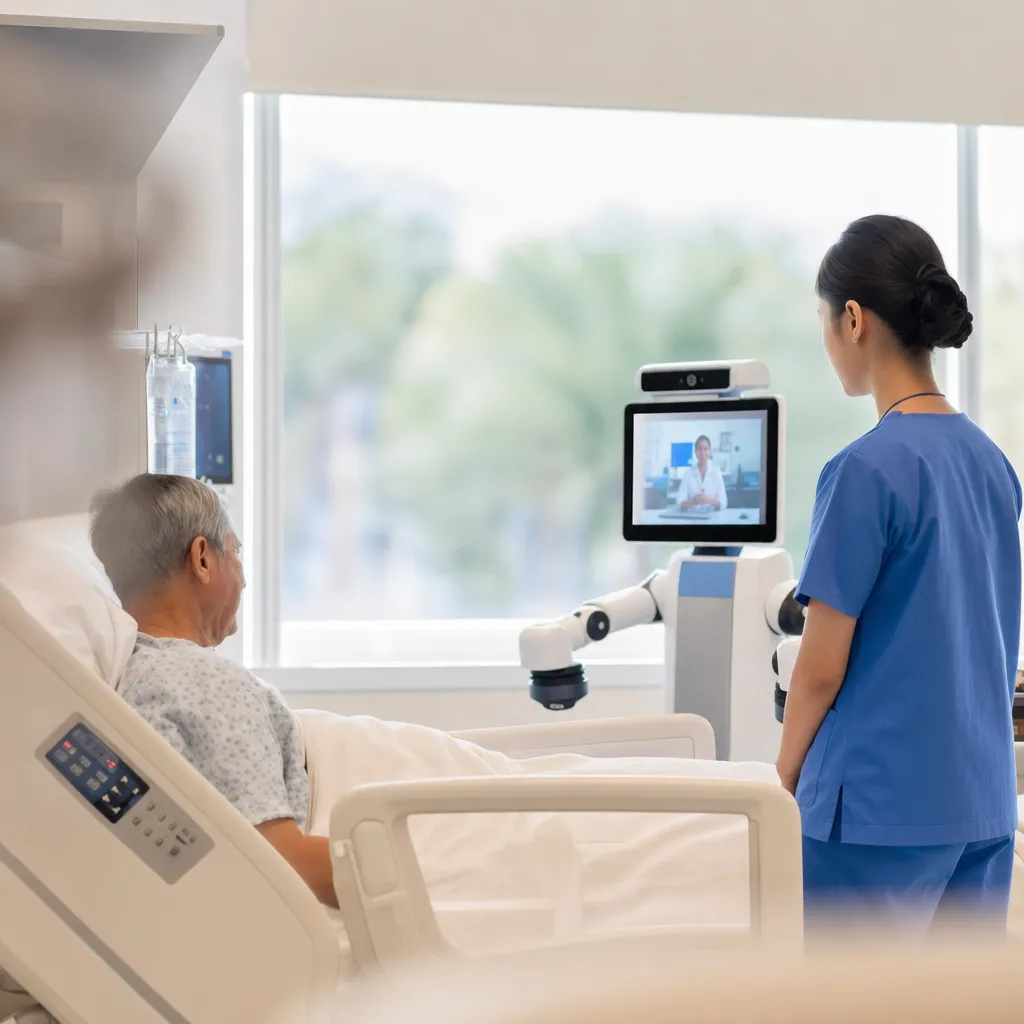
80% of US hospitals now use AI clinically or operationally, with over 1,000 FDA-cleared tools available — but implementation infrastructure gaps, not algorithm quality, remain the primary barrier to impact.
Clinical AI Adoption Crosses 80% in US Hospitals, But Implementation Gaps Leave Most Impact Unrealized
By Hector Herrera | September 13, 2026
Roughly 80% of US hospitals now use AI in at least one clinical or operational function, and more than 1,000 AI tools have received FDA clearance — a milestone that shifts the industry conversation from "will hospitals adopt AI?" to "why isn't it working better?" The answer, according to a new peer-reviewed narrative review, is not the algorithms. It's everything around them.
The 80% Threshold
A narrative review published in PubMed Central documents the current state of clinical AI adoption across US hospitals as of 2026. The 80% adoption figure is significant not because it proves AI works in healthcare, but because it removes the adoption question from the debate. The field has moved past early adopters and innovators. Hospitals that don't use AI in any capacity are now the outlier.
What that 80% doesn't capture is depth of deployment. Using an AI-powered scheduling tool counts. So does a clinical decision support alert in an EHR (Electronic Health Record) system that a physician can click through in two seconds. The headline number includes both meaningful deployments and nominal ones.
Where AI Is Actually Working: Radiology
Radiology leads every other clinical specialty in quantifiable AI progress. The reasons are structural:
- Medical imaging is a well-defined computational task — pattern recognition in a bounded domain — that neural networks handle well
- FDA clearance pathways for imaging AI are established; the regulatory process is more predictable than for other AI medical device categories
- Radiologists are already working in digital systems — PACS (Picture Archiving and Communication Systems) — that AI tools can integrate with directly
In practice, AI is performing scan prioritization — flagging critical findings like potential bleeds or fractures for immediate radiologist review rather than working through cases in order of arrival — and anomaly detection across X-ray, CT, and MRI modalities.
The measurable outcome: faster time-to-diagnosis for time-sensitive conditions and reduced missed finding rates in high-volume scan environments.
Get this in your inbox.
Daily AI intelligence. Free. No spam.
Where AI Isn't Working: Nursing
Nurses represent the largest clinical workforce, and nursing workflows remain largely unoptimized by AI despite the overall adoption numbers. The PMC review documents a specific, quantifiable gap: nurses still lose 15 to 20 minutes per hour to administrative tasks — documentation, medication reconciliation, care coordination handoffs — that AI should theoretically reduce.
The reasons the gains haven't materialized in nursing are practical, not technical:
- EHR interoperability — AI documentation tools often don't integrate smoothly with the EHR systems nurses work in
- Alert fatigue — nurses already receive a high volume of clinical alerts; poorly calibrated AI systems add noise rather than signal
- Workflow integration — AI tools designed for physician workflows don't map to the continuous, mobile, multi-patient nature of nursing work
The same PMC review notes that 77% of healthcare professionals report time lost to inaccessible data — information that exists somewhere in the system but cannot be retrieved quickly when needed at the bedside. AI that could surface the right data at the right time would address this directly, but building it requires deep integration with hospital data infrastructure that most vendors haven't achieved.
The 1,000 FDA-Cleared Tool Problem
More than 1,000 AI tools now hold FDA clearance for medical use. That sounds like evidence of maturity. It's also a procurement and implementation problem.
Hospital CIOs and clinical informatics teams are now navigating a market with more cleared AI tools than any organization can realistically evaluate, implement, or maintain. The FDA clearance process establishes that a tool performs as intended in its evaluated use case — it doesn't evaluate whether a hospital can implement it effectively, maintain it as the underlying AI models drift over time, or train clinical staff to use it appropriately.
The result is a common pattern: hospitals acquire cleared AI tools, implement them partially, and find adoption rates among clinicians lower than expected — not because the tools don't work technically, but because implementation infrastructure (training, workflow integration, ongoing monitoring) was under-resourced.
The Real Barrier Is Infrastructure, Not Algorithms
The PMC review's central conclusion is direct: implementation infrastructure gaps, not algorithm quality, are the primary barrier to scaling AI's healthcare impact.
What that means in practice:
- Data access and interoperability — AI tools need access to patient data across systems (EHR, imaging, lab, pharmacy) that are often siloed
- Clinical workflow integration — AI output needs to reach clinicians in the systems they already use, at the moment they need it, without adding steps
- Governance and monitoring — AI tools in production need ongoing performance monitoring; model drift (where a tool's accuracy degrades as patient populations change) is a real operational problem
- Training and adoption — clinicians who don't understand what an AI tool is doing, or don't trust it, won't use it effectively regardless of its technical performance
None of these are software problems. They're organizational and operational problems that require sustained commitment from hospital leadership, IT, and clinical leadership simultaneously.
What to Watch
The healthcare AI market is shifting from acquisition to accountability. Watch for hospital systems — particularly large integrated delivery networks — to begin publishing AI performance data as part of their quality reporting, either voluntarily or in response to CMS (Centers for Medicare & Medicaid Services) incentive structures. The hospitals that can demonstrate measurable clinical outcomes from AI deployment — not just adoption rates — will be the ones shaping what the next generation of healthcare AI procurement looks like.
This article is informational and does not constitute medical advice.
Did this help you understand AI better?
Your feedback helps us write more useful content.
Get tomorrow's AI briefing
Join readers who start their day with NexChron. Free, daily, no spam.