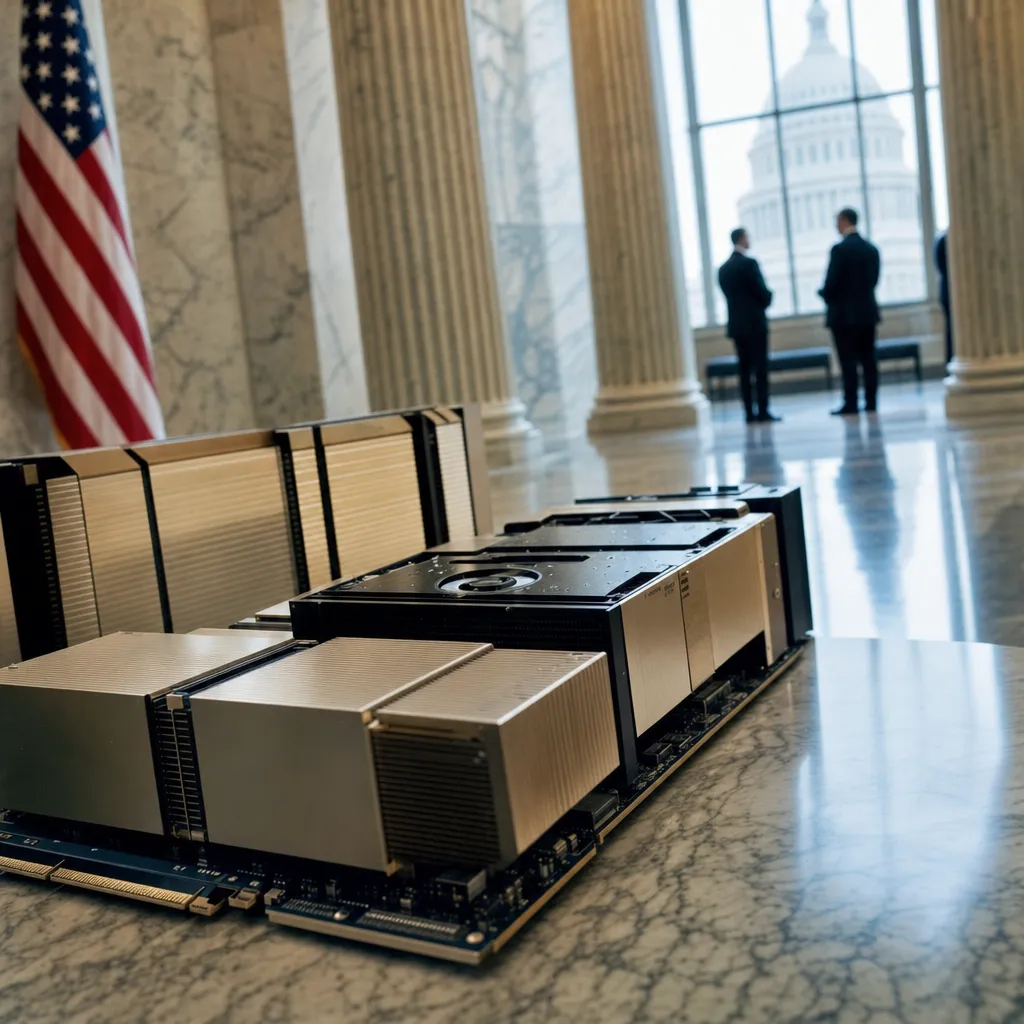
The Commerce Department issued an interim rule requiring data centers in five third-country markets to get U.S. licenses before granting Chinese customers remote access to advanced Nvidia and AMD AI chips, closing a major export control loophole.
U.S. Closes AI Chip Data Center Loophole That Let China Access Nvidia Hardware Remotely
By Hector Herrera | November 17, 2026 | Government
The Commerce Department issued an interim rule on November 16 requiring data centers in Singapore, Malaysia, Thailand, Indonesia, and Brazil to obtain a U.S. government license before allowing Chinese customers remote access to advanced Nvidia and AMD AI chips. The rule closes a loophole that let adversarial nations reach restricted hardware without ever importing a single chip — and gives data centers already serving restricted customers 90 days to get licensed or cut them off.
The Gap the Rule Is Closing
U.S. export controls on advanced AI chips have been in effect since October 2022. The October 2022 rules, updated in October 2023 and again in 2024, restricted physical shipment of Nvidia H100 and successor GPUs to China and other restricted countries. But they had a structural blind spot: the controls applied to hardware, not to network access.
A cloud operator in Singapore or Brazil could legally import Nvidia's most advanced chips, rack them in a data center, and then rent compute time to Chinese enterprises over the internet. The Chinese customer never touched restricted hardware — their prompts just traveled across a fiber cable instead of a shipping container. Commerce Department officials have acknowledged this gap was real and was being exploited at scale.
What the New Rule Requires
Under the interim rule:
Get this in your inbox.
Daily AI intelligence. Free. No spam.
- Five countries are covered: Singapore, Malaysia, Thailand, Indonesia, and Brazil — all major third-country cloud hubs with significant Chinese enterprise customer bases
- License required before restricted access: Data centers must obtain a U.S. government export license before provisioning compute access to Chinese customers on restricted chip hardware (Nvidia H100, H200, Blackwell-class GPUs and AMD MI300-class chips)
- 90-day grace period: Data centers already running Chinese customers on covered hardware have three months to either obtain a license or terminate the access
- "Deemed export" logic: The rule extends the existing "deemed export" framework — which treats sharing technical information with a foreign national as an export — to cover virtual compute access
The rule applies to entities on the U.S. Entity List and to customers from countries subject to chip export restrictions, including China, Russia, and several other designated nations.
Why These Five Countries
Singapore, Malaysia, Thailand, Indonesia, and Brazil are not random selections. They are the top-volume cloud hosting markets outside the U.S., EU, and directly restricted countries. Singapore alone hosts data centers for every major hyperscaler and dozens of regional cloud operators, many of which have served significant Chinese enterprise workloads since the 2022 controls made direct China deployment more difficult.
The rule notably does not cover the EU, UK, Japan, South Korea, Australia, or other close U.S. allies — a deliberate architecture that keeps allied cloud operators outside the new licensing burden while targeting the third-country conduit problem.
Impact on Cloud Operators
Data centers in these five markets face a commercial and compliance decision. Obtaining a license requires demonstrating know-your-customer controls — verifying who is accessing compute, for what purpose, and that the customer is not on a restricted list. That is a meaningful compliance infrastructure investment for operators who have competed largely on price and density.
For Chinese enterprise customers who have been routing AI compute through third-country clouds, the rule effectively extends the chip embargo to their workloads regardless of geography. Retraining on domestic Chinese chips — Huawei Ascend, Cambricon, or others — becomes the alternative.
The largest U.S. and European hyperscalers (AWS, Azure, Google Cloud, Oracle Cloud) already have robust sanctions compliance infrastructure and are unlikely to have been serving restricted Chinese customers directly. The rule hits smaller and mid-tier operators who have competed for Chinese business explicitly.
What to Watch
The rule is published as an interim rule, meaning it takes effect immediately but Commerce is accepting comments during a review period — leaving the door open for adjustments based on industry feedback. Watch for legal challenges from affected cloud operators arguing the rule exceeds Commerce's authority under the Export Administration Regulations. Also watch whether China routes remaining compute demand through countries not yet covered — India, the UAE, and several Southeast Asian markets outside the five named.
Did this help you understand AI better?
Your feedback helps us write more useful content.
Get tomorrow's AI briefing
Join readers who start their day with NexChron. Free, daily, no spam.