NVIDIA and US Manufacturers Declare Physical AI's ChatGPT Moment Has Arrived
NVIDIA announced partnerships with major U.S. manufacturing and robotics companies during National Robotics Week, with CEO Jensen Huang declaring that physical AI has reached its commercial inflection point as manufacturer interest in LLMs doubled to 35%.
Why this matters
NVIDIA announced partnerships with major U.S. manufacturing and robotics companies during National Robotics Week, with CEO Jensen Huang declaring that physical AI has reached its commercial inflection point as manufacturer interest in LLMs doubled to 35%.
NVIDIA and US Manufacturers Declare Physical AI's Inflection Point Has Arrived
By Hector Herrera | April 12, 2026 | Manufacturing
NVIDIA has announced partnerships with major U.S. manufacturing and robotics companies to accelerate AI deployment on factory floors, with CEO Jensen Huang declaring at National Robotics Week that the industry has reached its inflection point for physical AI. The data behind that claim is concrete: manufacturer interest in large language models for factory operations jumped from 16% to 35% in a single year, while interest in humanoid robots climbed from 8% to 13%.
What Happened
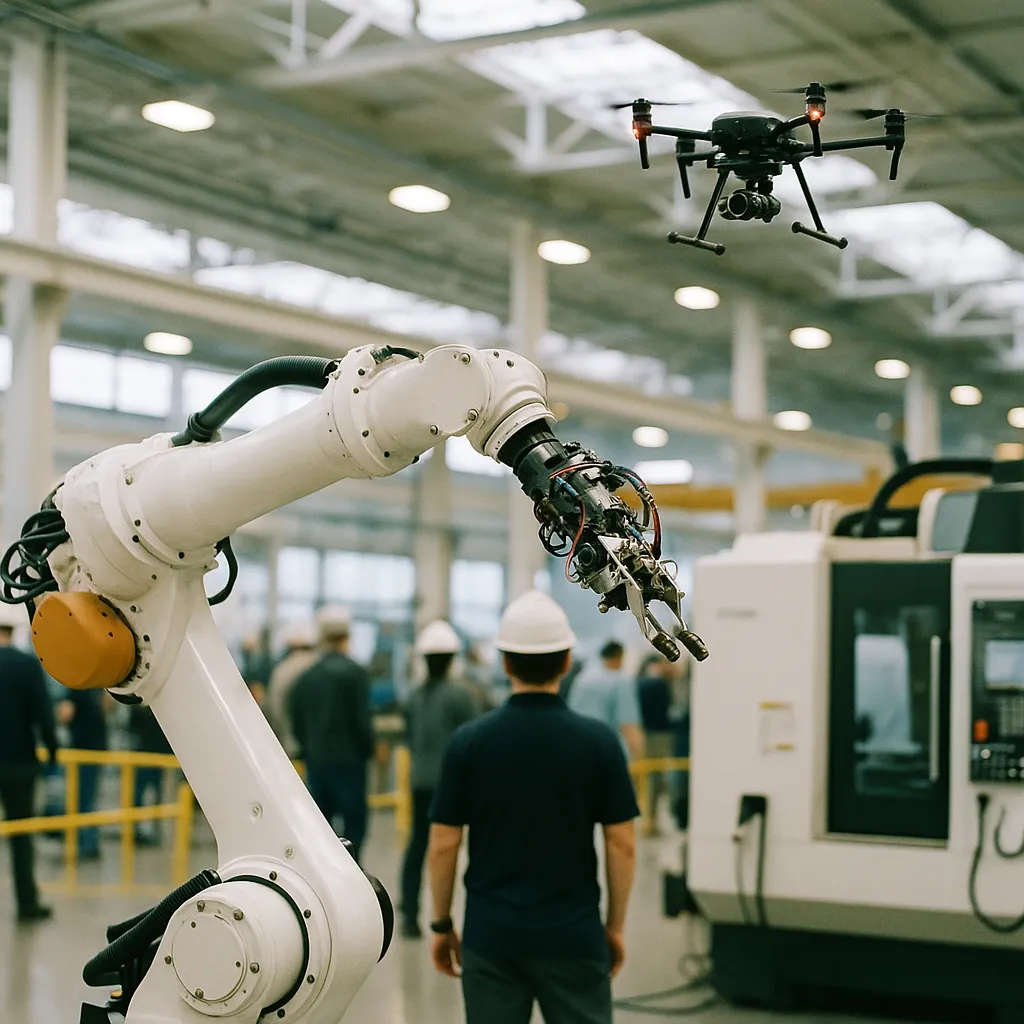
NVIDIA announced a series of partnerships with U.S. manufacturing and robotics companies during National Robotics Week, positioning its AI hardware and software platforms as the foundation for physical AI deployment at commercial scale. Jensen Huang framed the moment as equivalent to ChatGPT's launch for language AI—the point at which the technology moved from research to production across the industry.
Industry survey data released alongside the announcements documents the inflection point claim: manufacturer interest in LLMs for factory operations more than doubled year-over-year (16% to 35%), and humanoid robot interest grew from 8% to 13%.
Context
Physical AI—the application of AI systems to control and coordinate physical hardware in the real world—has been a research priority at major AI labs and robotics companies for years. The challenge is harder than software AI for a fundamental reason: physical systems can fail in ways that software systems cannot. A language model that generates a wrong answer is a nuisance; a robot that misapplies force on an assembly line is a safety problem.
The industrial robotics sector has historically relied on deterministic, pre-programmed systems. You program a robot arm with precise movement sequences for a specific task; it performs that task with high reliability. The limitation is inflexibility—every new task requires reprogramming by a specialized engineer, and the robot cannot adapt to variation in the physical environment.
AI-enabled robots can learn tasks from demonstration, adapt to variation in parts or environments, and perform work that wasn't explicitly programmed. The theoretical capability has existed for years. Commercial deployment at scale has lagged because the hardware, software, and integration tooling wasn't mature enough for production environments with real safety and reliability requirements.
Get this in your inbox.
Daily AI intelligence. Free. No spam.
NVIDIA's announcements signal the industry's collective judgment that those maturity thresholds have now been crossed.
Details
NVIDIA's role in physical AI is primarily through two platforms: Isaac (robotics simulation and training) and Omniverse (the digital twin environment used to design and test physical systems in simulation before deployment). These platforms allow manufacturers to train AI systems on simulated factory environments, validate their behavior before deploying physical hardware, and continuously retrain on real-world data.
The partnerships announced during National Robotics Week include manufacturing, logistics, and robotics companies that will deploy these platforms. Specific partner names beyond the general announcement have not all been disclosed, but the pattern is consistent: NVIDIA provides the AI compute and software stack; manufacturing companies provide the domain expertise and deployment environments.
The year-over-year interest data in the announcements comes from industry surveys. Interest data is not the same as deployment data—a company interested in humanoid robots has not necessarily purchased one. But the trajectory from 8% to 13% interest in humanoid robots in a single year suggests the market is moving faster than most predictions from three years ago anticipated.
Impact
For manufacturers: The window to develop internal AI capability before competitors is narrowing. Factories that begin physical AI deployments now—starting with specific, high-value use cases like quality inspection, pick-and-place logistics, and predictive maintenance—will accumulate operational data and institutional knowledge that later adopters will not have.
For manufacturing workers: The deployment wave is targeting tasks that are physically repetitive, ergonomically demanding, and subject to high error rates: precision assembly, quality inspection, material handling. These are real jobs. The history of industrial automation suggests that productivity gains from automation don't automatically translate to employment gains for affected workers without deliberate policy intervention.
For robotics startups: NVIDIA's platform approach creates a de facto standard for physical AI development. Startups building on Isaac and Omniverse gain access to tools, ecosystems, and customer relationships that would take years to build independently. They also become dependent on NVIDIA's platform decisions. The tradeoff is worth understanding before committing.
For international competition: U.S. physical AI investment is explicitly framed in competition with Chinese manufacturing robotics investment. China has been the world's largest industrial robot market for a decade. NVIDIA's National Robotics Week timing and U.S.-partner focus is not accidental—it positions domestic AI-driven manufacturing as a strategic priority.
What to Watch
The humanoid robot number deserves specific attention. Going from 8% to 13% manufacturer interest in a year sounds incremental, but it represents a market that is expanding its addressable industrial use cases. Companies like Figure, Agility Robotics, Boston Dynamics, and 1X are all developing humanoid systems for industrial deployment. NVIDIA provides simulation infrastructure for several of them.
The first meaningful humanoid robot deployments at Fortune 500 manufacturing facilities will be the signal to watch for. When a major automaker or consumer goods manufacturer announces sustained humanoid robot deployment—not a pilot, not a demonstration—the inflection point claim will be validated with production evidence.
Hector Herrera covers manufacturing and AI for NexChron.
Key Takeaways
✓By Hector Herrera | April 12, 2026 | Manufacturing
Hector Herrera is an AI systems architect and the founder of Hex AI Systems. He designs and runs AI systems in production and writes daily about how AI is reshaping business, government and everyday life. 20+ years building for the web. Houston, TX.