AI data centers are demanding power faster than the grid's seven-to-ten-year interconnection timeline can handle, forcing utilities and the DOE to promote battery-bridge connections and speed-first grid frameworks.
AI Data Centers Are Outrunning the Grid—Utilities Say the Seven-Year Build Timeline Has to Go
By Hector Herrera | May 21, 2026
America's power grid was designed for a world where electricity demand grew slowly and predictably. AI data centers are not that world. A Utility Dive analysis finds that hyperscale AI facilities are demanding electricity at a pace the current grid interconnection queue—which averages seven to ten years for new large-load connections—cannot accommodate. The implication is stark: the country's AI infrastructure ambitions are running directly into a physical infrastructure bottleneck, and the utilities sector now agrees something fundamental has to change.
The bottleneck is not a lack of electricity generation. It is a permitting, interconnection, and transmission buildout process designed for a slower era.
How the Queue Works—and Why It Doesn't
When a data center developer wants to connect a new facility to the grid, they enter an interconnection queue managed by regional transmission organizations. The process involves multiple rounds of engineering studies, infrastructure upgrade cost negotiations, and regulatory approvals. For transmission-level connections—the scale an AI hyperscale campus requires—the typical timeline runs seven to ten years from application to energization.
That timeline was tolerable when new large loads came online at a pace measured in years. AI data center construction is now measured in months. Microsoft, Google, Amazon, and Meta have announced or broken ground on more than 200 gigawatts of planned AI data center capacity through 2030. The grid interconnection queue cannot process that volume on its existing timeline without creating multi-decade backlogs.
The result is that approved, funded, ready-to-build data centers cannot get power. Not because the power does not exist. Because the process for connecting them to it is too slow.
Battery Storage as the Bridge
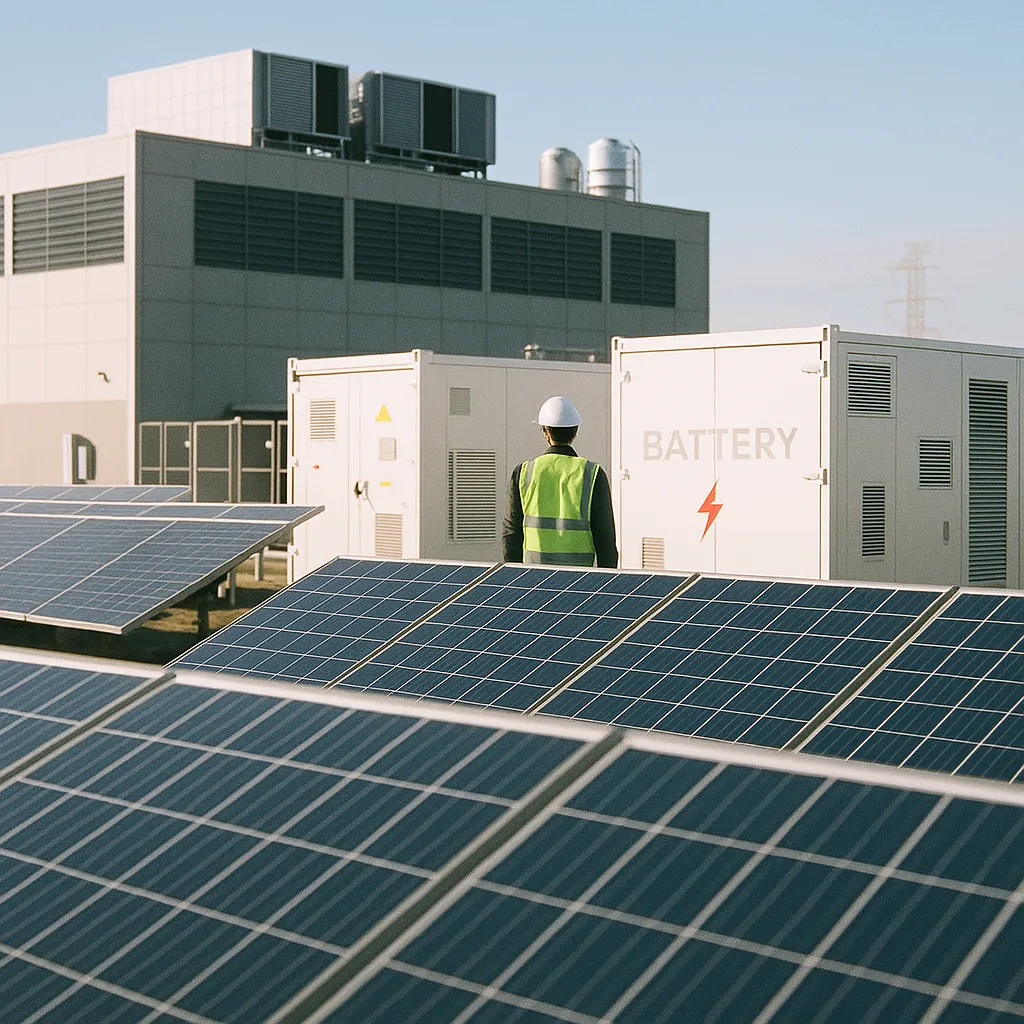
The emerging practical solution is battery energy storage systems (BESS)—large-scale lithium-ion battery installations co-located with data centers that allow facilities to interconnect years earlier than a direct transmission connection would permit.
The mechanism: a data center with on-site battery storage can connect to the grid at a lower capacity level—one that does not require the full transmission upgrade the facility's peak demand would otherwise necessitate. The batteries absorb peak loads, shaving the demand curve that grid planners evaluate during interconnection studies. The facility draws from storage during peak periods; the grid replenishes storage during off-peak hours.
Get this in your inbox.
Daily AI intelligence. Free. No spam.
Schneider Electric, one of the largest data center infrastructure providers, is now actively promoting battery-integrated grid connection strategies as a standard offering rather than a specialty configuration. The DOE is advancing "speed-first" grid frameworks that allow modular, staged interconnection rather than requiring full infrastructure completion before any power flows.
Battery bridge connections can reduce interconnection timelines from seven to ten years to two to four years in favorable circumstances—still not fast by the data center industry's standards, but feasible within a realistic capital planning horizon.
The Permitting Layer
Battery storage solves the queue bottleneck but does not address the permitting layer. Environmental review processes for transmission line upgrades, substation construction, and large-scale battery installations add their own timelines that run in parallel with interconnection studies.
Several states—Texas, Georgia, and Virginia, which host the largest concentrations of U.S. data center capacity—have moved to streamline permitting for data center power infrastructure. Virginia passed legislation in 2025 creating a dedicated review track for data center grid connections. Texas has historically had faster grid connection processes under ERCOT's ISO structure than Eastern interconnections, which is one factor driving hyperscale investment concentration there.
At the federal level, the public opposition to data center siting that blocked several projects in 2025 has not disappeared. Communities concerned about noise, water consumption, and visual impact continue to challenge permits at the local level, adding uncertainty that battery-and-speed-first frameworks cannot address.
The Climate Complication
Battery storage solves a grid timing problem. It does not solve the carbon accounting problem. Data centers drawing grid power during off-peak hours to recharge batteries are drawing from whatever generation mix is on the grid at that hour—which in most U.S. markets includes significant coal and natural gas.
The DOE's speed-first framework is agnostic on carbon. It is focused on physical connection timelines. Tech companies that have made carbon-neutral or net-zero commitments will need additionality agreements—contracts ensuring that new renewable generation is brought online specifically to cover their load—to maintain the integrity of those commitments while using battery bridge connections.
Microsoft's acknowledged retreat from its 2030 clean energy target set a precedent: when grid reality collides with sustainability commitments, grid reality is winning. The speed-first framework accelerates that collision by explicitly prioritizing connection speed over generation mix.
What to Watch
The DOE is expected to finalize its speed-first interconnection guidance before the end of 2026. How aggressively regional transmission organizations adopt the framework will determine whether battery bridge connections become a standard tool or a niche workaround.
The seven-year timeline was never immutable. It was a process artifact from a planning regime designed for a different demand environment. The AI buildout has made that regime unsustainable. What replaces it—and whether the replacement maintains grid reliability while it speeds things up—is the question utility regulators are now under real pressure to answer.
Hector Herrera covers AI infrastructure and energy for NexChron.
Did this help you understand AI better?
Your feedback helps us write more useful content.
Get tomorrow's AI briefing
Join readers who start their day with NexChron. Free, daily, no spam.