John Deere acquired Orchard AI on November 20, gaining a vehicle-mounted camera system that maps orchards fruit-by-fruit at 95%+ accuracy — pushing Deere from row crops into the high-value specialty agriculture market.
John Deere acquired Orchard Robotics — commercially branded Orchard AI — on November 20, gaining a vehicle-mounted camera system that uses machine learning to analyze fruit crops at the individual plant level. The deal gives Deere the capability to map orchards fruit-by-fruit at greater than 95% accuracy across yield, size, color, disease, and harvest timing — then connect those insights directly to equipment decisions. Financial terms were not disclosed.
The acquisition moves Deere decisively into specialty agriculture, a category it has historically underserved. Row crops — corn, soybeans, wheat — have been the core of Deere's precision agriculture business. High-value orchards and nut groves have different requirements, and Orchard AI is built specifically for them.
What FruitScope Does
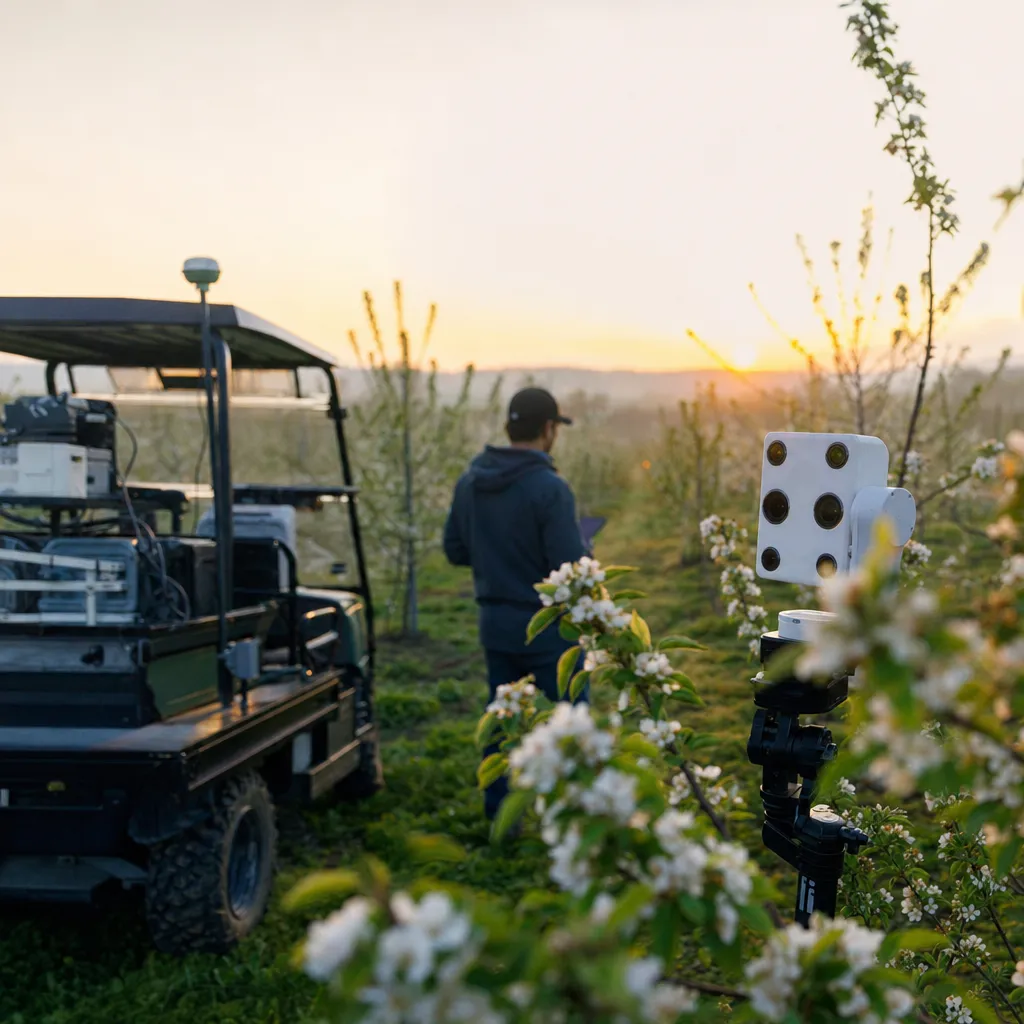
Orchard AI's core product, FruitScope, deploys a camera array on a vehicle that drives through orchard rows, capturing hundreds of images per tree. Machine learning models process those images in near-real time to build a fruit-by-fruit map of an orchard's current state.
According to Robotics and Automation News, FruitScope's accuracy rate exceeds 95% across all measured variables: fruit count, size distribution, color (a proxy for ripeness), disease incidence, and projected yield. That's not a directional estimate — it's the kind of precision that makes supply-chain commitments possible.
The output goes well beyond traditional yield estimation methods. Manual scouting gives growers a sample-based approximation across a small fraction of trees. Satellite and aerial imagery captures canopy stress but can't see into the canopy or distinguish fruit characteristics at the resolution growers need for packing and processing decisions. FruitScope operates at the resolution the problem actually requires: the individual tree, the individual fruit.
Why Specialty Agriculture Is Different
Traditional precision agriculture was built for row crops. Those crops grow in uniform, high-volume conditions where remote sensing and satellite imagery are effective. Variable-rate fertilizer and irrigation systems can operate on zone-based maps derived from satellite NDVI (normalized difference vegetation index) data because the crop is consistent across large areas.
Get this in your inbox.
Daily AI intelligence. Free. No spam.
Specialty crops — almonds, pistachios, walnuts, apples, citrus, table grapes — don't work that way. Tree density, canopy variation, and the significance of individual-tree health make row-crop tools poorly suited to orchard management. A satellite pixel covers multiple trees. An aerial image can't see through the canopy. Manual scouting is slow and covers too small a fraction of the orchard to be statistically reliable at scale.
This is exactly why the specialty agriculture data problem has persisted: the tools that solved row crops didn't translate. Orchard AI solved it by moving the sensor close to the tree and capturing data at the resolution the problem requires.
How It Fits Deere's Precision Equipment
John Deere's value in precision agriculture is the connection between data and equipment action. Its precision sprayers adjust application rates field-by-field based on sensor data. Its harvesting platforms can be calibrated to crop conditions.
FruitScope's plant-level data creates a richer instruction set for those systems. Where generic NDVI data tells a sprayer that a section of orchard is under stress, Orchard AI's output can identify which trees have confirmed disease versus which are simply denser canopy, and what the fruit load is on each tree going into harvest season. That granularity supports:
- Variable-rate spraying calibrated to actual disease incidence rather than zone averages
- Pruning decisions grounded in actual yield load per tree rather than visual inspection
- Harvest scheduling optimized to fruit development across individual rows rather than block averages
- Supply chain commitments grounded in crop-level data — packing houses and processors sign advance contracts based on volume projections; better data means fewer over- and under-estimates
The Market Opportunity
Row crops represent the bulk of North American farmland by acreage. But specialty crops represent the bulk of farm revenue per acre. Almonds, pistachios, and walnuts in California's Central Valley, apple orchards in Washington state, citrus operations in Florida and Texas — these are high-capital businesses where better data has an outsized economic return per improved decision.
John Deere has been weaker in specialty crops than in row crops for most of its precision agriculture history. Its equipment lineup has expanded into orchards in recent years, but its precision data capabilities lagged. The Orchard AI acquisition changes that directly — Deere now owns plant-level AI analytics for fruit and nut crops, paired to equipment that can act on the insights.
For growers, the pitch is a closed loop: Orchard AI scans the orchard, Deere equipment executes the resulting prescriptions, and the yield data from harvest feeds back into the following season's models. That's the precision agriculture flywheel that Deere has built for row crops, now available for specialty agriculture.
What to watch: Integration timelines will determine how quickly FruitScope data flows into Deere's precision equipment platforms. Watch also for how Deere prices the combined offering — FruitScope as a standalone scanning service versus FruitScope bundled with Deere equipment purchases will signal whether Deere is treating this as a data business or a hardware accelerant.
Did this help you understand AI better?
Your feedback helps us write more useful content.
Get tomorrow's AI briefing
Join readers who start their day with NexChron. Free, daily, no spam.