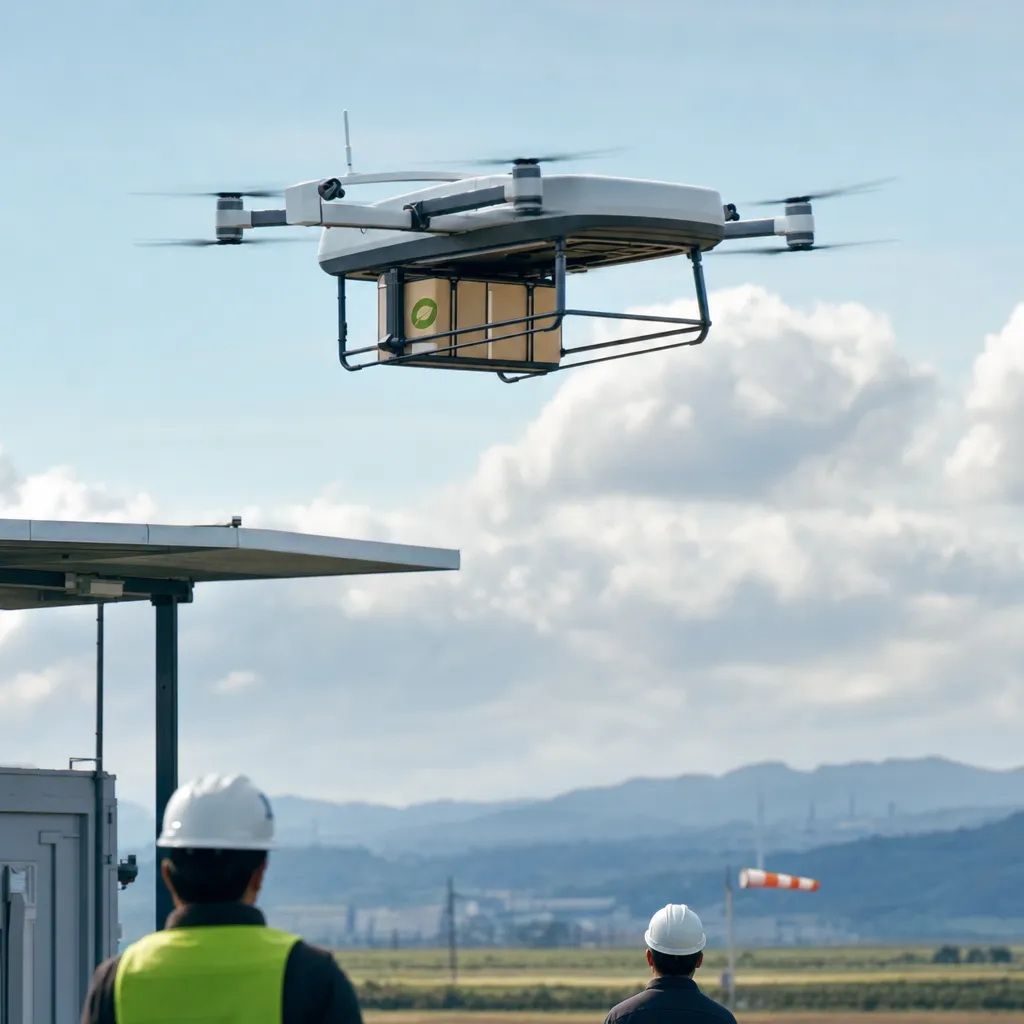
Uber Eats and Zipline launched commercial drone food delivery in Spring, Texas on November 17, targeting one million drone deliveries per day by 2029 — the first large-scale pairing of a ride-share platform with autonomous drone delivery.
Uber Eats and Zipline Launch Commercial Drone Delivery in Texas, Target 1 Million Daily Flights
Uber Eats and Zipline launched commercial drone food delivery in Spring, Texas on November 17, with expansion to dozens of US cities planned. The partnership targets one million drone deliveries per day by end of 2029 — the first large-scale commercial marriage of a ride-share logistics platform with autonomous AI-guided drone delivery at urban scale.
What Launched and Where
According to TechCrunch's reporting, the service began in Spring, Texas — a Houston suburb of roughly 70,000 people — with delivery coverage for Uber Eats restaurant partners in the area. Zipline's drones operate autonomously from fixed launch facilities, using AI-guided navigation to deliver packages to specific GPS coordinates in residential yards and driveways. Deliveries drop from approximately 30 feet in a small package, eliminating the need for a landing pad.
Zipline is not new to this. The company has been operating autonomous drone delivery in Rwanda, Ghana, and other markets since 2016, primarily for medical supply delivery to rural health clinics. Its US expansion is newer — it has operated commercial drone delivery in select markets for the past two years, primarily for large retailers. This is its first integration with a major food delivery platform, which changes the economic model fundamentally.
Why Food Delivery Is the Scale Unlock
Zipline's previous US deployments worked with anchor retailers (Walmart was a reported early partner) and operated in suburban environments where large fixed facilities could serve a defined radius. The economics were favorable for high-margin, time-sensitive goods — prescriptions, electronics — but volume was limited.
Uber Eats changes the volume equation. The platform processes tens of millions of food delivery orders per week in the United States. Even capturing a small fraction of those orders for drone delivery — specifically short-distance orders in suburban geographies where airspace is relatively clear — creates the transaction volume needed to justify the infrastructure investment in drone fleets and launch facilities.
The one million daily deliveries target by 2029 is ambitious. For context, Uber Eats currently processes roughly 15-20 million total orders per day across all delivery modes globally. One million drone deliveries per day would represent roughly 5-7% of that total — a meaningful share, but achievable if the Texas launch scales to dozens of cities as planned.
Get this in your inbox.
Daily AI intelligence. Free. No spam.
How the Technology Works
Zipline's drones for the US consumer market operate differently from its early medical delivery drones:
- Fixed-wing hybrid design — the aircraft takes off vertically like a multirotor but cruises in fixed-wing mode for efficiency, allowing 24-mile range and 70+ mph cruise speed
- Autonomous navigation — AI-guided flight planning routes around obstacles, weather, and controlled airspace using real-time data
- Package delivery without landing — a small package descends on a tether from low altitude, eliminating the safety footprint of a landing drone
- Noise profile — Zipline has published acoustic data showing its fixed-wing design is significantly quieter than multirotor competitors at distance, which matters for residential acceptance
FAA integration is the regulatory backbone. Zipline operates under FAA Part 135 (commercial air carrier) certification, which is the same certification category as commercial airlines and charter operators. That certification is significantly harder to obtain than the Part 107 certification that covers most commercial drone operations, but it allows operations beyond visual line of sight (BVLOS) and over populated areas — the operational envelope required for urban food delivery.
What Makes This Different From Previous Drone Delivery Attempts
Amazon Prime Air, Wing, and other drone delivery services have been announcing launches for a decade with limited commercial scale to show for it. Several structural factors distinguish this partnership:
Distribution network advantage. Zipline provides the aircraft and operations; Uber Eats provides the customer acquisition and demand aggregation. Zipline does not need to build its own consumer app or merchant relationships — it plugs into an existing network of millions of active users and tens of thousands of restaurant partners.
Proven technology in production environments. Zipline is not a lab demo. The company has completed over 2 million commercial deliveries in international markets, more than any other drone delivery operator globally. Its AI navigation, logistics software, and operational procedures are tested.
Regulatory clarity. The FAA's Beyond Visual Line of Sight (BVLOS) rulemaking, finalized in 2024, created a clearer path for urban drone operations. Zipline's existing Part 135 certification positions it ahead of competitors that are still working through the regulatory process.
The Path to One Million Daily Flights
The 2029 target requires Zipline to build out fixed launch infrastructure — called "nests" in company terminology — across dozens of US cities. Each nest serves a defined delivery radius, and the number of nests determines total capacity. At the implied volumes, Zipline and Uber would need to operate hundreds of active nests across the country, each housing and launching dozens of aircraft daily.
The capital requirement is significant. Nest construction, drone fleet procurement, and staffing represent a large fixed-cost base that scales ahead of revenue. Zipline has raised over $800 million in total funding; whether that is sufficient to reach one million daily flights without additional capital raises is unclear.
What to Watch
Watch the Spring, Texas launch data over the next 90 days — specifically completion rates (percentage of accepted orders successfully delivered) and customer satisfaction scores. If those numbers hold at Zipline's international market performance levels, the case for rapid city expansion is strong. Also watch whether the FAA's Urban Air Mobility integration framework, still in development, creates regulatory clarity or new barriers for the city expansion plan. Any neighborhood zoning or noise ordinance challenges in early expansion cities will signal how much community acceptance friction Uber and Zipline will need to manage at scale.
Did this help you understand AI better?
Your feedback helps us write more useful content.
Get tomorrow's AI briefing
Join readers who start their day with NexChron. Free, daily, no spam.