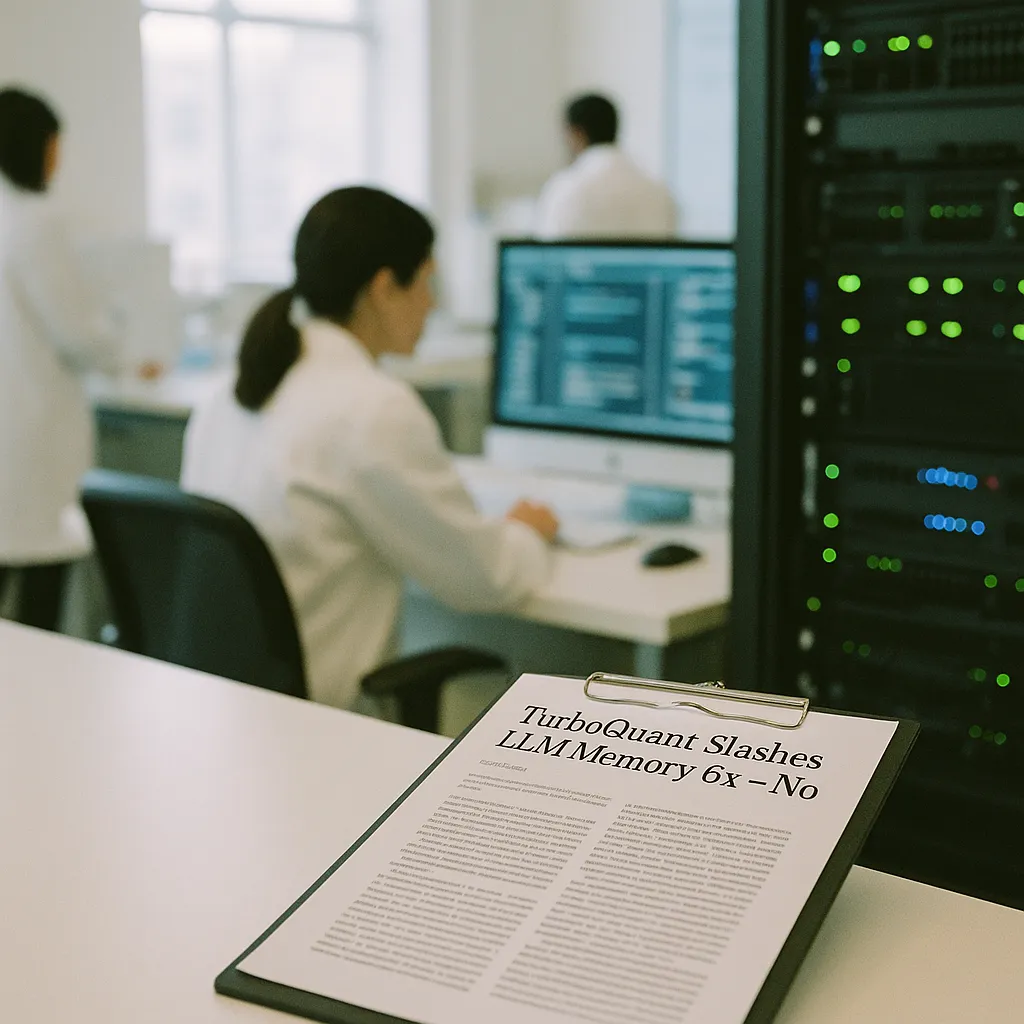
Google DeepMind's TurboQuant compresses AI inference memory 6x with zero accuracy loss and no retraining, delivering 8x faster throughput on H100 GPUs. It's already open source.
Google TurboQuant Slashes LLM Memory 6x — No Retraining Required
By Hector Herrera | June 13, 2026 | Science · Breaking News
Google DeepMind's TurboQuant algorithm, presented at ICLR 2026, compresses the part of AI inference that consumes 80–90% of GPU memory by 6x — with zero accuracy loss — and requires no model retraining to deploy. On H100 GPUs, it delivers 8x faster processing throughput. The code is already open source. This is a meaningful engineering advance in how efficiently large language models run, and it has immediate implications for AI infrastructure costs and on-device AI.
To understand why this matters, you need to know what a KV cache is.
What a KV Cache Is and Why It Eats Memory
When a large language model processes a conversation or a long document, it doesn't re-read every word from scratch every time it generates a new token. Instead, it stores intermediate calculations — called "keys" and "values" — in memory so it can reference previous context quickly. This storage is the KV cache (key-value cache).
As conversations get longer, the KV cache grows. On a 100,000-token conversation — the kind that document analysis or multi-turn research sessions routinely require — the KV cache can occupy 80–90% of total GPU memory. That leaves very little room for the model itself, forces expensive memory management operations, and is the primary bottleneck limiting how many simultaneous conversations a single GPU can handle.
Current best practice compresses KV cache data to 8 bits (8-bit quantization). TurboQuant pushes that to 3 bits — less than half — while maintaining output quality.
What TurboQuant Actually Does
The algorithm achieves extreme compression by applying different precision levels to different parts of the KV cache based on how sensitive each part is to compression error. Some keys and values can tolerate aggressive compression with no detectable impact on output; others are highly sensitive and need more precision. TurboQuant identifies and handles both dynamically.
Get this in your inbox.
Daily AI intelligence. Free. No spam.
The result, according to Google Research:
- 6x reduction in KV cache memory footprint
- 8x improvement in processing throughput on NVIDIA H100 GPUs
- Zero accuracy degradation on standard benchmarks
- No retraining required — works on already-deployed models
That last point is critical. Most efficiency techniques require retraining the model with the optimization baked in — a process that can take weeks and millions of dollars. TurboQuant is a post-deployment optimization. You apply it to models you already have, running infrastructure you already own.
What This Means for AI Infrastructure
For data center operators, 6x KV cache compression means a single GPU can serve roughly 6x as many simultaneous long-context conversations. That translates directly to cost: if you're spending $10M/month on inference infrastructure, TurboQuant-equivalent efficiency gains could theoretically collapse that to the $1-2M range for the same workload. Reality will be messier, but the direction is unambiguous.
For AI labs and startups competing on inference costs, this is exactly the kind of efficiency gain that resets pricing floors. OpenAI, Anthropic, Google, and Mistral all compete partly on cost-per-million-tokens. When Google releases an open-source algorithm that cuts inference memory consumption 6x, it raises the competitive bar for everyone.
For on-device AI, the implications are significant. Smartphones and edge devices have constrained memory. Long-context conversations — the kind that make AI actually useful as a persistent assistant — have been impractical on-device partly because of KV cache memory demands. TurboQuant changes that calculus. Running a full conversation history on a phone becomes more feasible.
The Bigger Shift: Efficiency Over Parameters
ICLR 2026 is emerging as the conference where the research community signaled a strategic turn from raw scaling — making models bigger — toward efficiency at every layer of the stack. TurboQuant is one data point in that shift, alongside quantization advances from Meta, speculative decoding improvements from multiple labs, and hardware-aware training techniques from NVIDIA.
The industry spent 2020-2023 racing to build larger models. The competitive frontier in 2026 is running those models faster, cheaper, and on smaller hardware. Efficiency has become the new scaling.
What to Watch
TurboQuant is open source now. Watch for major inference frameworks — vLLM, TensorRT-LLM, Ollama — to integrate it over the next few months. When it ships in production inference stacks, it moves from research result to deployed standard. That's when the cost impact becomes real at scale.
Source: Google Research Blog — TurboQuant: Redefining AI Efficiency with Extreme Compression
Did this help you understand AI better?
Your feedback helps us write more useful content.
Get tomorrow's AI briefing
Join readers who start their day with NexChron. Free, daily, no spam.