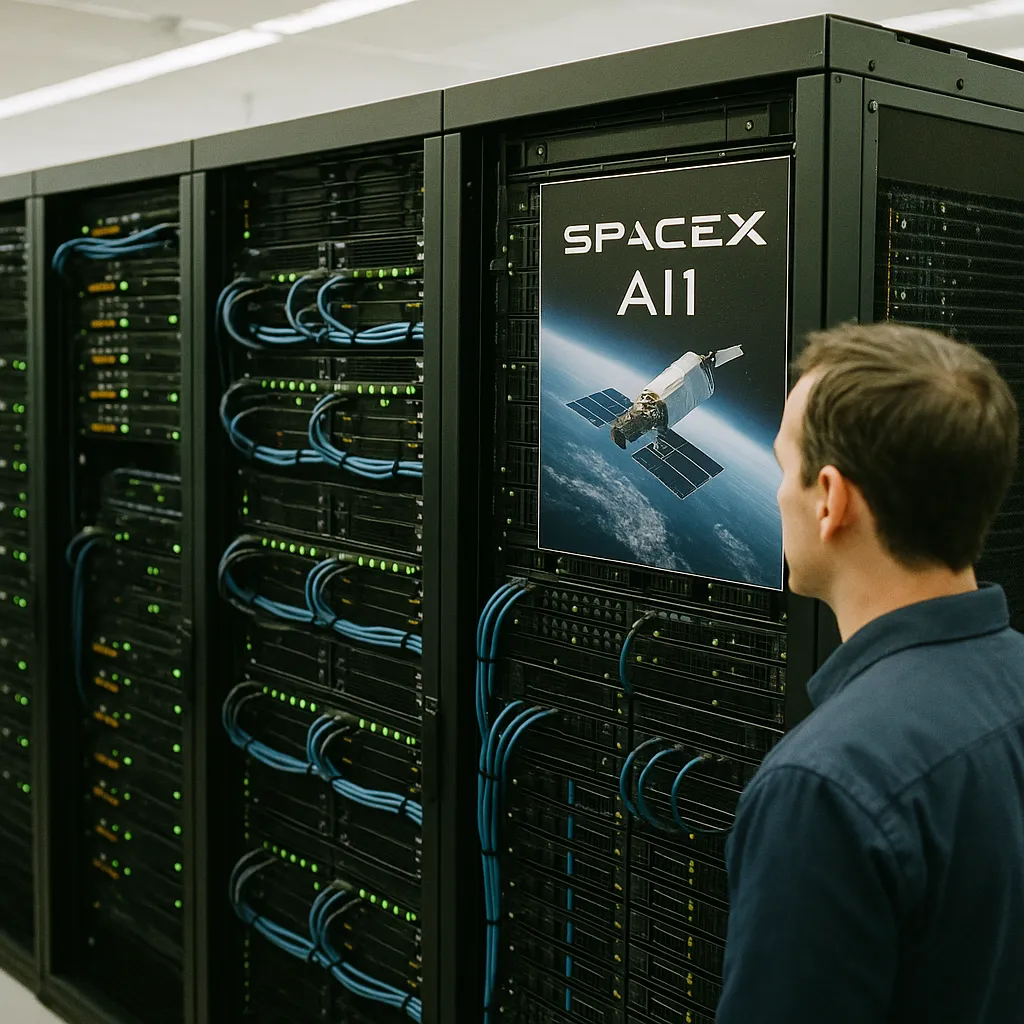
SpaceX is pricing its $1.75 trillion IPO tomorrow, and the AI1 orbital data center satellite in the filing is a real hardware program — but analysts say the power and thermal economics of running AI workloads from low Earth orbit remain unproven.
SpaceX AI1 Orbital Data Center: Space-Based AI Compute Is Real — The Economics Aren't Yet
By Hector Herrera | June 10, 2026
SpaceX is preparing to price its SpaceX-xAI IPO at a $1.75 trillion valuation tomorrow, and buried in the filing is a satellite that could reshape how AI compute gets delivered — if anyone can make the numbers work. The AI1 orbital data center is a real piece of hardware on the roadmap, with two prototypes slated for early 2027. But independent analysts reviewing the filing say the core economics of running AI workloads from low Earth orbit remain unproven.
The concept isn't science fiction. SpaceX has spent years building Starlink's orbital manufacturing and deployment pipeline. Applying that infrastructure to compute — rather than just connectivity — is a logical extension. But "logical" and "economical" are different things.
What the Filing Says
The AI1 satellite is a large platform — 70 meters wingspan — designed to host 150 kilowatts of peak AI compute capacity in low Earth orbit (LEO). LEO sits roughly 200 to 2,000 kilometers above Earth, close enough for low-latency communication and high enough to benefit from near-constant solar power exposure.
SpaceX's roadmap calls for:
- Two prototypes launching in early 2027
- A megaconstellation of up to one million satellites over time
- Revenue already underwriting the near-term build: according to the IPO filing, Anthropic and Google are paying SpaceX a combined $2.17 billion per month for xAI data-center capacity on the ground
That last number matters. SpaceX isn't funding AI1 speculatively — it already has major AI labs as paying customers for xAI's terrestrial capacity. AI1 is the bet on what comes next.
The Two Problems Analysts Can't Ignore
Power per dollar. On the ground, a modern hyperscale data center can deliver several megawatts of AI compute per rack at a cost structure refined over decades. In orbit, you're generating power from solar arrays, converting it to usable compute power, and doing all of it in a chassis that had to survive a rocket launch. The 150 kW target for AI1 is modest by data-center standards — a single Nvidia GB200 NVL72 rack draws around 120 kW. Getting from prototype to competitive cost-per-FLOP against terrestrial alternatives is a significant engineering and financial gap.
Thermal management. On Earth, data centers cool servers with air, water, or liquid immersion — cheap and abundant. In the vacuum of space, heat can only leave via radiation (there's no medium to carry it away by convection). Radiating away the waste heat from 150 kW of sustained AI compute requires large radiator panels. Scaling to a megaconstellation compounds the problem exponentially.
Get this in your inbox.
Daily AI intelligence. Free. No spam.
Independent analysts cited in the TechTimes review of the filing describe both challenges as unresolved. SpaceX has not published a cost-per-kilowatt-hour or cost-per-inference projection for AI1.
Why Anyone Is Paying Attention
Three reasons make this more than a footnote in an IPO filing.
First, the SpaceX execution track record. Starlink went from concept to roughly 7,000 operational satellites in about six years. If anyone has the manufacturing and launch cadence to iterate orbital hardware at scale, it's SpaceX.
Second, the grid problem. AI data centers are straining terrestrial power grids in ways that are becoming a political and regulatory constraint. A compute platform that runs on solar power in orbit — outside the reach of local utility commissions and land-use fights — is an attractive concept regardless of current economics.
Third, the existing customer relationships. Anthropic and Google aren't paying $2.17 billion a month combined because they have nowhere else to turn. They're paying because xAI's capacity is valuable now. If AI1 delivers even a fraction of the orbital compute density its roadmap describes, those customers are already in the ecosystem.
What This Means Right Now
For businesses buying AI compute today: nothing changes. Terrestrial GPU clusters — from AWS, Azure, Google Cloud, CoreWeave, and others — remain the only scalable option for at least the next two to three years. AI1 is a prototype program, not a product.
For infrastructure investors and data-center operators: AI1 is a long-horizon signal worth tracking. If SpaceX solves the thermal and power-economics problems — and it has solved harder problems before — the orbital compute market could eventually compete on specific workload types, particularly latency-sensitive inference at global scale.
For the IPO: the $1.75 trillion valuation is being priced tomorrow. AI1 is part of the story SpaceX-xAI is telling investors. Whether the market prices it as credible execution or aspirational marketing will be visible in the opening trade.
What to Watch
The prototype launches in early 2027 are the first real test. Watch for SpaceX to publish power and thermal performance data from AI1 prototypes — or notably not publish it. If the numbers look competitive, expect Google and Anthropic to quietly negotiate orbital capacity options into their existing ground agreements. If the prototypes reveal the economics gap is wider than the filing implies, AI1 becomes a footnote rather than a product line.
The IPO prices tomorrow. The physics gets tested next year.
Sources: TechTimes — SpaceX AI1 Orbital Data Center analysis, June 10 2026
Did this help you understand AI better?
Your feedback helps us write more useful content.
Get tomorrow's AI briefing
Join readers who start their day with NexChron. Free, daily, no spam.