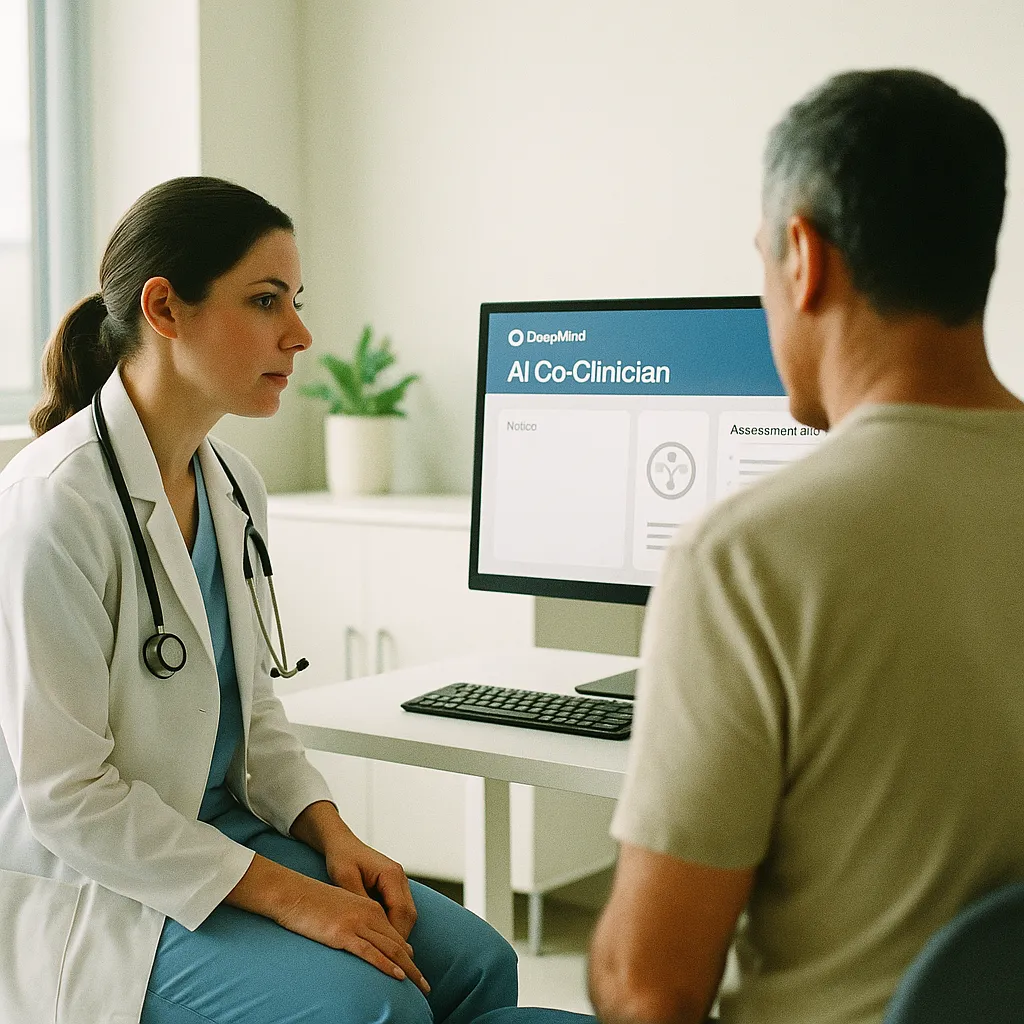
Google DeepMind announced an AI co-clinician system built to provide real-time diagnostic support during patient encounters — moving AI from back-office documentation into clinical decision-making.
Google DeepMind's AI Co-Clinician Designed to Work Alongside Doctors at the Point of Care
By Hector Herrera | May 4, 2026 | Health
Google DeepMind has announced an AI co-clinician system built to provide real-time diagnostic support to physicians during patient encounters — not as a back-office documentation tool, but as an active participant in clinical decision-making. The shift matters because it moves AI from the administrative periphery of medicine into the room where diagnoses are made and treatments decided.
Background
AI in healthcare has spent the past several years earning incremental trust: reading radiology images, flagging medication interactions, summarizing discharge notes. That work has built a credibility foundation, with multiple peer-reviewed studies confirming that AI diagnostic models now routinely match or outperform human clinicians in controlled settings. DeepMind is now attempting to convert that research record into a live clinical tool that operates in real time, at the bedside or consultation desk, alongside a human physician who remains the decision-maker.
What DeepMind Announced
The AI co-clinician is designed to analyze patient data — symptoms, history, lab results, vitals — and surface diagnostic possibilities, flag anomalies, and prompt the physician to consider pathways they might otherwise miss under time pressure. The framing is deliberate: the system is positioned as a "co-clinician," not a replacement. It is meant to support physician judgment, not substitute for it.
Key elements of the announcement:
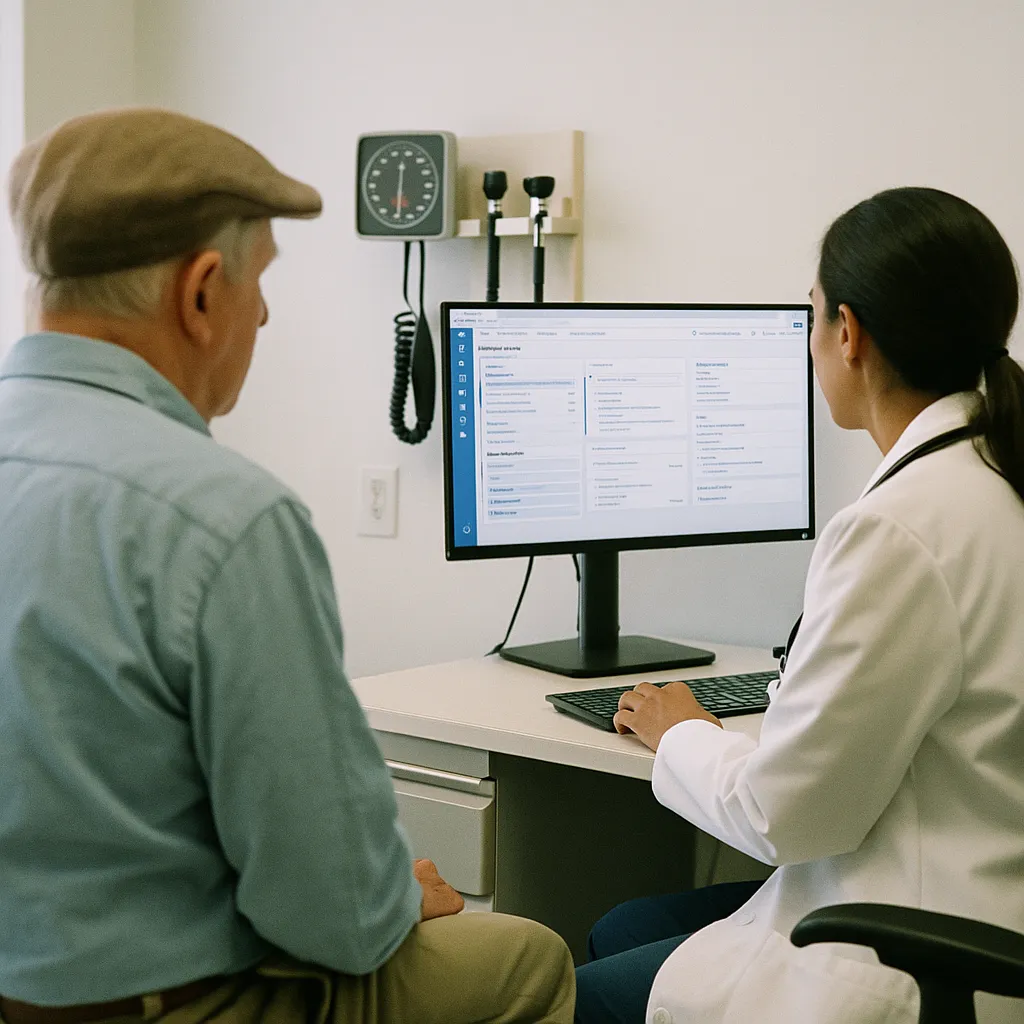
- Point-of-care integration — the system is designed to work within existing clinical workflows, not require parallel data entry
- Real-time output — differential diagnoses and flags surface during the encounter, not after
- Physician remains accountable — DeepMind has consistently emphasized human oversight as a design constraint, not an afterthought
- Governance questions deferred — the company has not announced a specific deployment timeline or regulatory clearance pathway for the United States
Why Point-of-Care AI Is Different
There is a meaningful distinction between AI that helps a radiologist review a scan overnight and AI that is present when a physician is deciding, in real time, whether a patient's chest pain is cardiac or musculoskeletal. Point-of-care AI operates under time pressure, with incomplete information, in an environment where cognitive load is already high. The consequences of a false positive or a missed flag are immediate.
Get this in your inbox.
Daily AI intelligence. Free. No spam.
This is why the clinical and legal communities have been cautious about this category of AI. Back-office AI errors can be caught and corrected before they touch a patient. Point-of-care AI errors can influence a treatment decision within minutes of being generated.
The Liability and Trust Problem
No major AI co-clinician system has yet established a clear legal framework for what happens when the AI's suggestion contributes to a bad outcome. Current malpractice law assigns liability to the physician, who is assumed to be the decision-maker of record. But as AI systems become more sophisticated and more present in clinical encounters, that assumption is increasingly difficult to defend as a complete answer.
Three questions health systems will need to resolve before deploying a system like this:
- Who is liable if the AI misses a diagnosis the physician relied on it to flag? The physician? The hospital? DeepMind? All three?
- How do physicians maintain diagnostic skill when AI is always present? There is documented evidence of skill atrophy in aviation when pilots rely heavily on autopilot systems — the same concern applies to medicine.
- What does informed consent look like for patients? Should patients know their physician is using an AI co-clinician, and do they have the right to decline?
None of these questions have settled answers in 2026. The AI diagnostic model outperforming a physician in a controlled study is not the same thing as an AI co-clinician performing reliably across the full chaos of a real emergency department shift.
For hospital administrators and clinical informatics teams, the DeepMind announcement accelerates a decision timeline that many organizations have been comfortable deferring.
The competitive pressure is real. Health systems that deploy effective AI diagnostic support — if it works as described — can process more patients with fewer diagnostic errors. That creates an outcome and efficiency gap that competing systems will feel in their quality metrics and payer negotiations within a few years.
The risk is also real. Deploying AI that physicians don't trust, or that generates alert fatigue by flagging too many low-probability diagnoses, creates its own harm. The history of clinical decision support is littered with systems that were technically functional but clinically useless because they generated too many false alarms and were systematically ignored.
What to Watch
The next meaningful signal will be whether DeepMind pursues FDA clearance through the De Novo pathway as a clinical decision support tool or attempts to position the system as general information software — a distinction that determines whether it is regulated at all under current U.S. law. Health system procurement teams and clinical informatics directors should be watching for peer-reviewed deployment data, not just controlled-study benchmarks, before committing to evaluation partnerships.
Source: Google DeepMind AI Co-Clinician Explained
Did this help you understand AI better?
Your feedback helps us write more useful content.
Get tomorrow's AI briefing
Join readers who start their day with NexChron. Free, daily, no spam.