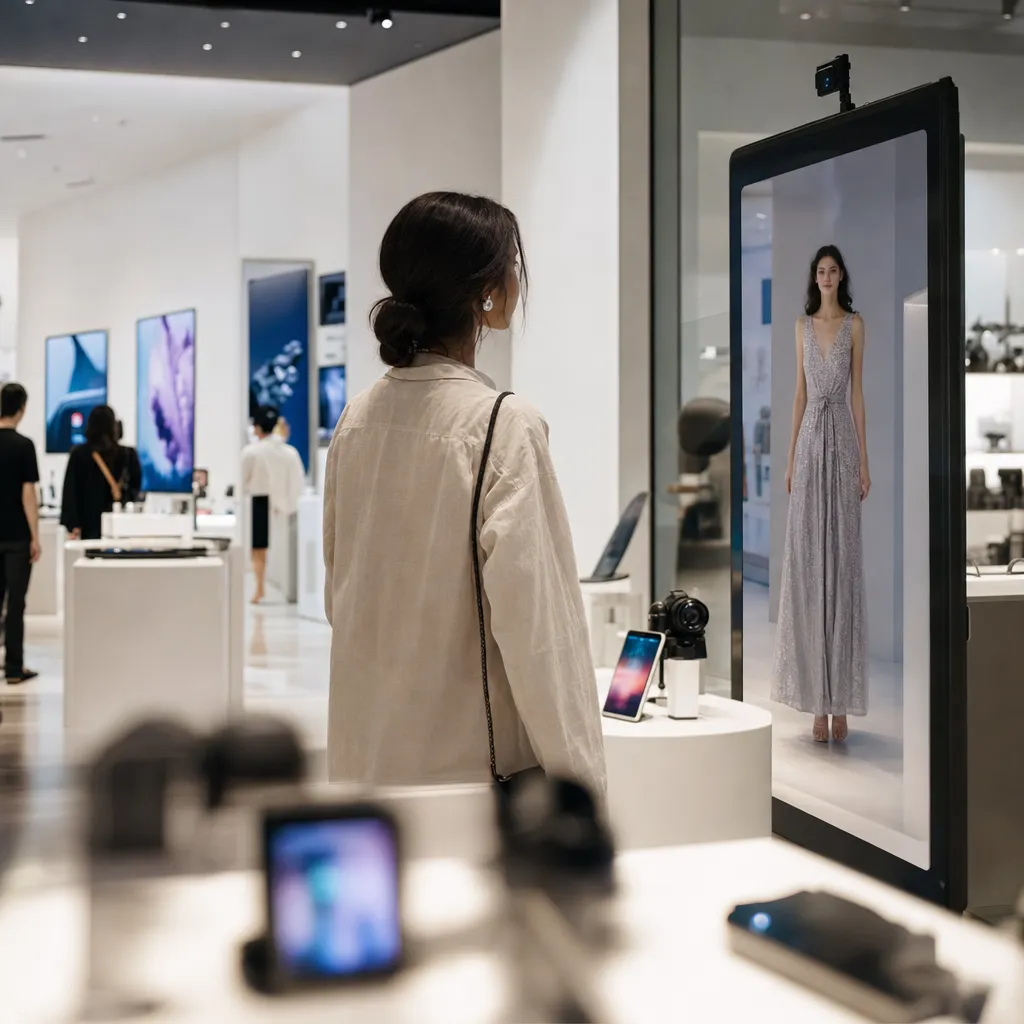
AI-powered virtual try-on has crossed from novelty to commercial necessity, with a 393% year-on-year surge in AI-sourced retail traffic and a 31% reduction in product returns.
AI-powered virtual try-on technology has crossed from retail experiment to commercial necessity, backed by an Adobe survey of 5,000 consumers showing a 393% year-on-year surge in AI-sourced retail traffic. Retailers deploying virtual mirror technology are reporting a 31% reduction in product returns — a ROI signal now driving board-level urgency around AI investment decisions heading into the 2026 holiday season.
What Changed in 2026
For most of the past decade, virtual try-on technology existed in retail as a pilot feature — good press, low adoption. That changed in 2025 and accelerated sharply through 2026. According to the industry analysis published November 12, three shifts converged to push AI virtual mirrors past the novelty threshold:
1. Model accuracy crossed an acceptability threshold. Earlier virtual try-on systems produced artifacts and misalignments that made customers distrust the output. Current AI models — particularly those using 3D body mapping and physics-based fabric simulation — produce results close enough to in-person fitting that return rates meaningfully decline.
2. Consumer trust caught up with the technology. The Adobe survey found respondents now rate AI-generated fit guidance as more reliable than size charts and comparable to in-store fitting room visits for apparel purchases. That closing of the trust gap is what unlocks conversion at scale.
3. Mobile distribution reached saturation. AI virtual mirrors that required dedicated hardware kiosks were always limited deployments. The shift to phone-camera-based try-on — requiring no retailer hardware investment — removed the deployment cost barrier that kept most brands to pilot scale.
The Numbers
The core data points from the November 12 report:
Get this in your inbox.
Daily AI intelligence. Free. No spam.
- 393% year-on-year increase in AI-sourced retail traffic (Adobe survey, 5,000 respondents)
- 31% reduction in product returns for retailers deploying virtual try-on technology
- Returns reduction is now the primary ROI driver cited by retail executives in AI investment decisions
- The report frames 2026 as the year the ROI case for AI-powered personalization became undeniable
Returns are the right metric to anchor on. For most apparel retailers, return rates run 20–40%, with each return costing $15–30 in reverse logistics, restocking, and lost resale value. A 31% reduction in that cost base, applied at scale, generates ROI that justifies AI investment even at high implementation costs. For retailers with annual revenue in the billions, the math becomes compelling quickly.
Who's Deploying
The technology stack has concentrated around a small number of AI platform providers: Snap's AR fitting tools, Google's Try It On feature in Shopping, Amazon's Virtual Try-On for Shoes, and fashion-specific AI vendors including Vue.ai and Reactive Reality. Major luxury brands including Gucci and Louis Vuitton have deployed virtual try-on as a brand differentiator; fast fashion and mass-market retailers are following on pure ROI grounds.
The holiday 2026 window is the first cycle where most major apparel retailers have virtual try-on available at scale — meaning Q4 2026 will serve as the first real test of whether the 393% traffic lift and 31% returns reduction hold up at peak seasonal volume.
From Competitive Advantage to Competitive Necessity
The virtual mirror data point is significant beyond apparel. It demonstrates a pattern that retail AI investors and executives have been waiting for: an AI application where the ROI case becomes undeniable from published data alone, rather than requiring internal A/B test results that most retailers treat as proprietary.
Once a 31% returns reduction is public, boards that have been asking "where's the ROI?" face a more direct question: why haven't we deployed this? That dynamic — from "interesting pilot" to "competitive necessity" — is what characterizes technology inflection points in retail. The report frames 2026 as the year that inflection became permanent for AI virtual mirrors.
The implications extend to adjacent categories. If AI-powered virtual try-on generates a 31% returns reduction in apparel, the natural next tests are furniture (high returns due to fit and color mismatch), eyewear, cosmetics, and home decor. Each of those categories has existing virtual try-on efforts that will now be pulled forward by the ROI data established in apparel.
What to Watch
Expect major apparel and footwear retailers to announce virtual try-on deployment or expansion as part of holiday 2026 earnings calls in early 2027. Watch for consolidation in the AI try-on vendor space: a technology with proven 31% returns reduction will attract acquisition interest from both retail platforms and logistics companies whose economics depend directly on returns volume. The first major acquisition of a virtual try-on AI vendor by a logistics company would signal that the returns reduction story is being monetized upstream, not just at the retailer level.
Source: GlobeNewswire – AI Disruption in Virtual Mirror Technology
Did this help you understand AI better?
Your feedback helps us write more useful content.
Get tomorrow's AI briefing
Join readers who start their day with NexChron. Free, daily, no spam.