A World Economic Forum analysis finds that AI-enabled tools — not government policy — have become the primary driver of renewable energy deployment speed, as global renewables added 793 GW in 2025 and surpassed coal in electricity generation for the first time.
WEF: AI Is Now Driving the Energy Transition Faster Than Any Policy Could
By Hector Herrera | May 14, 2026 | Energy
The force moving renewable energy deployment fastest right now isn't a government mandate or a carbon price. It's AI. A World Economic Forum analysis published this week argues that AI-enabled tools have become the primary driver of renewable energy deployment speed — and points to a structural milestone to back the claim: in 2025, for the first time, renewables surpassed coal in global electricity generation.
The numbers underlying that milestone are striking. Global renewable capacity additions reached 793 gigawatts in 2025, with solar alone accounting for 83% of new capacity. The WEF attributes a meaningful share of that growth not to policy incentives — which have been inconsistent across major economies — but to AI optimization that is making renewable energy cheaper, more predictable, and more manageable at scale.
What AI Is Actually Doing in Energy
The WEF analysis identifies two areas where AI is having the largest concrete impact on renewable energy deployment:
Forecasting accuracy. AI platforms can now predict solar irradiance and wind energy output at more than 95% accuracy. That number matters because the fundamental economic obstacle to renewables has always been intermittency — solar doesn't generate at night, wind doesn't blow on calm days, and grid operators need to predict supply to balance the grid. At 95%-plus forecast accuracy, the volatility discount that grid planners applied to renewable energy — the extra cost of backup capacity and grid stabilization — compresses significantly. Renewables become easier to integrate and cheaper to commit to at scale.
Real-time grid balancing. As renewables grow from a marginal share of the grid to a majority source, managing supply variability in real time becomes a core grid operation challenge. AI grid management systems can adjust dispatch decisions, storage deployment, and demand-response signals faster than human operators or rule-based systems. This capability is what allows grids with 40%, 60%, or 80% renewable penetration to maintain reliability — something that was considered technically difficult to achieve at those levels a decade ago.
The 793 GW Number in Context
To understand what 793 gigawatts of new renewable capacity in a single year means: the entire U.S. power grid — all sources combined — has roughly 1,300 GW of installed capacity. In 2025, the world added more than half that equivalent in renewables in one year. Solar at 83% of additions means roughly 658 GW of solar alone was installed — driven by dramatic cost declines in panel manufacturing, accelerated installation timelines, and favorable financing conditions in key markets including China, India, the United States, and Europe.
Get this in your inbox.
Daily AI intelligence. Free. No spam.
The structural turning point the WEF highlights — renewables surpassing coal in global electricity generation — is the product of two simultaneous trends: renewables growing fast and coal declining in many markets. China still accounts for the majority of global coal generation, but even there, solar installations are outpacing coal additions by a significant margin.
Where AI's Role Is Most Direct
The WEF analysis is careful not to claim AI gets full credit for the renewable buildout. Policy, financing, and manufacturing scale all play roles. But the AI contribution is most direct in three specific mechanisms:
Siting and planning. AI tools are reducing the time required to assess potential renewable sites by processing satellite imagery, weather data, grid proximity, and permitting complexity simultaneously. Projects that previously took 18–24 months of feasibility analysis are being scoped in weeks.
Grid interconnection modeling. One of the largest bottlenecks to renewable deployment in the U.S. and Europe is the grid interconnection queue — the backlog of projects waiting for studies to assess how they can connect to the grid. AI-assisted interconnection studies can run faster and model more scenarios, helping reduce queue timelines.
Operations and maintenance. AI predictive maintenance for wind turbines and solar installations is extending equipment life and reducing unplanned downtime. Turbine failures that require expensive crane operations to repair are increasingly flagged weeks in advance through sensor data analysis.
The Tension With AI's Own Energy Demand
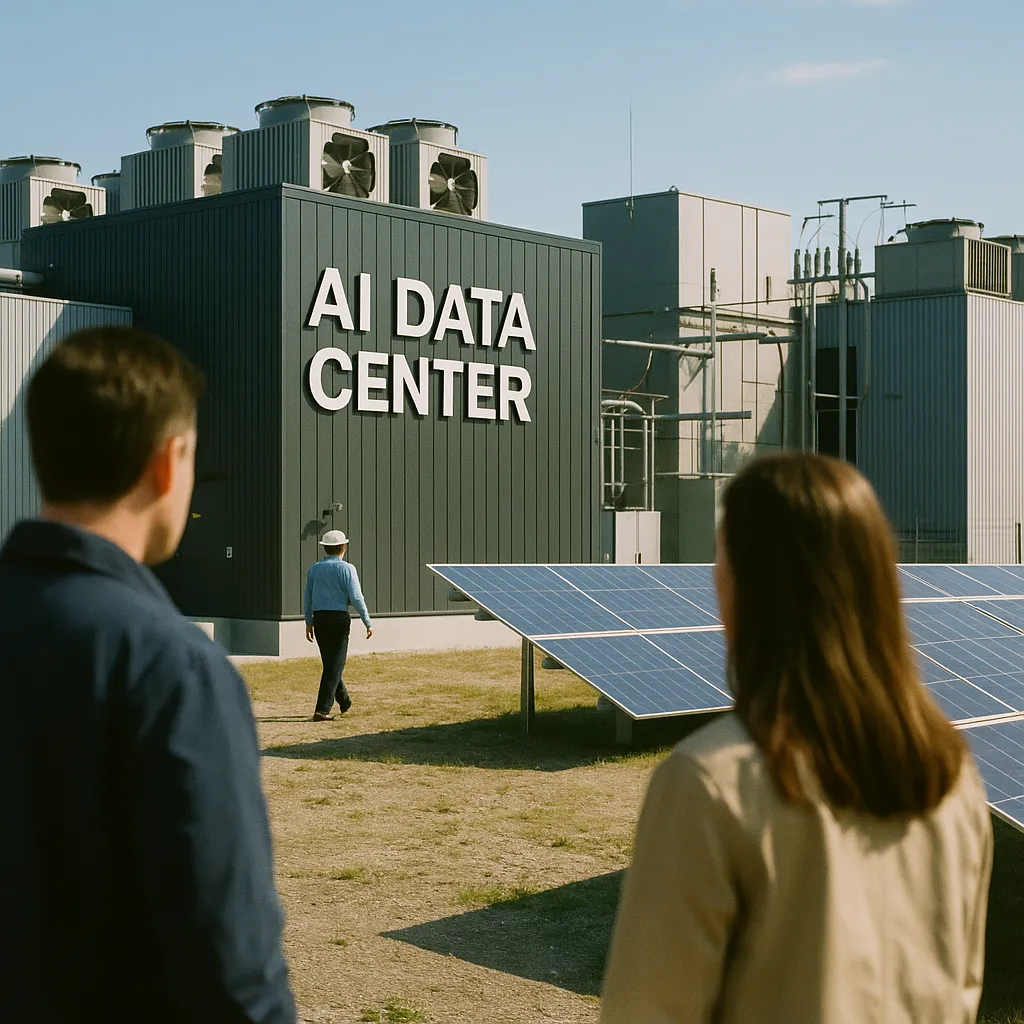
Any honest accounting of AI's role in the energy transition has to acknowledge the counter-pressure: AI data centers are themselves a significant and growing source of electricity demand. Data center power consumption is projected to double or more by 2030 as AI training and inference workloads expand, with much of that new demand concentrated in regions where renewables are not yet the dominant grid source.
The net effect — AI accelerating renewable deployment on one side while adding energy demand on the other — is genuinely uncertain. The WEF report takes the optimistic view: that AI-driven efficiency gains and renewable deployment acceleration will outpace AI's own energy appetite. That claim deserves scrutiny. The power demand AI data centers are creating is real and immediate; the renewable deployment benefits are distributed across the global grid and accrue over longer timelines.
What to Watch
The 2026 renewable deployment numbers — expected to be released by the International Energy Agency in early 2027 — will be the next meaningful data point. If solar continues at or above 2025's pace, and if AI grid operators continue to enable higher renewable penetration without reliability degradation, the WEF's thesis about AI as the energy transition's primary accelerant will gain stronger empirical support.
The more immediate signal to watch: whether AI data center demand begins visibly distorting grid planning decisions in ways that slow renewable integration — the opposite of the WEF's thesis. Several U.S. grid operators have already flagged this concern in recent interconnection studies.
Hector Herrera covers AI, energy systems, and climate technology for NexChron.
Did this help you understand AI better?
Your feedback helps us write more useful content.
Get tomorrow's AI briefing
Join readers who start their day with NexChron. Free, daily, no spam.