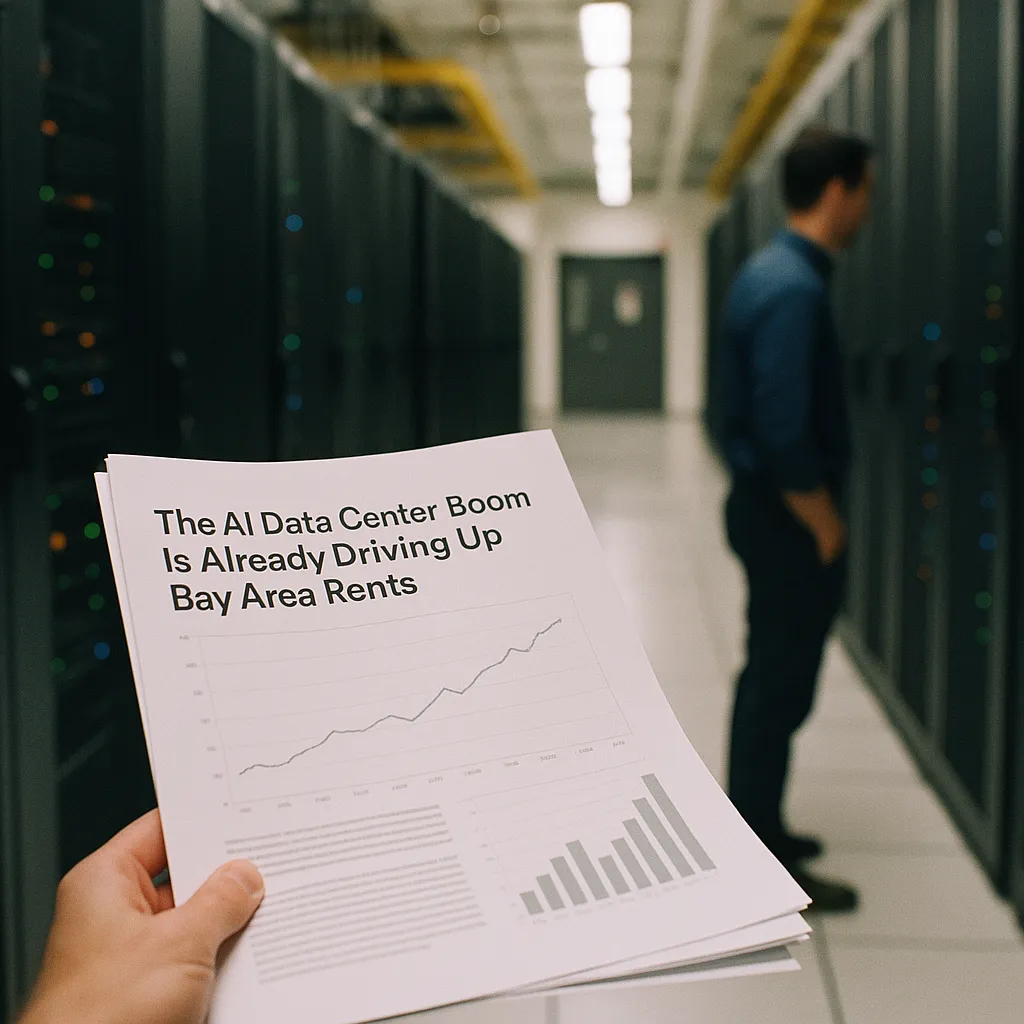
An Oaklandside investigation documents how AI firm expansion is driving rent increases and displacing small businesses, with AI companies already occupying 17 million square feet across the Bay Area.
The AI Data Center Boom Is Already Driving Up Bay Area Rents. Oakland Documents the Damage.
By Hector Herrera | June 6, 2026 | Real Estate
An Oaklandside investigation published June 4 documents what housing researchers have warned about for two years: AI company expansion is a direct and measurable driver of rising rents and real estate pressure across the Bay Area, with AI firms now occupying approximately 17 million square feet of regional space. This isn't a future projection. Small businesses and long-term residents in neighborhoods adjacent to planned data center sites in Oakland are already experiencing displacement pressure.
The AI industry's land footprint is growing faster than the Bay Area's strained real estate market can absorb. JLL Research projects AI firms could add another 20 to 35 million square feet by 2030 — more space than currently occupied, added over four years, in a region with severe infrastructure constraints and almost no margin for additional demand.
What the Investigation Found
The Oaklandside report documents several specific dynamics:
- Oakland small businesses near planned data center sites are already experiencing lease pressure and early displacement, with some receiving buyout offers or facing rent increases they can't absorb
- Long-term residents in affected neighborhoods face rent increases tied, at least in part, to commercial real estate demand from tech sector expansion
- The pattern mirrors what happened in San Francisco's Mission District and SoMa neighborhoods during the first tech boom — but with AI companies requiring industrial-scale power infrastructure that pulls demand toward specific geographic corridors near substations and fiber access points
- Data centers require industrial-zoned land near power infrastructure — a specific geography that overlaps with historically affordable industrial neighborhoods in East Oakland
The investigation names the pressure as AI-driven rather than treating it as generic tech sector growth. That distinction matters for policy: different industries require different land types, and AI data centers' power and cooling requirements create demand concentration in specific locations that can be mapped and anticipated.
Why AI Real Estate Demand Is Different
Previous tech booms drove office space demand. AI infrastructure drives industrial space demand. The two affect different neighborhoods.
A software company needs Class A office space in walkable urban cores. An AI data center needs:
Get this in your inbox.
Daily AI intelligence. Free. No spam.
- Massive electrical capacity — typically 50 to 200 megawatts per hyperscale facility
- Industrial zoning that permits large electrical infrastructure and cooling systems
- Fiber connectivity to regional internet exchange points
- Water access for cooling
Those requirements point to Oakland's industrial east and waterfront districts — neighborhoods that were, until recently, affordable operating environments for small manufacturers, warehouses, and working-class businesses. As data center developers bid up industrial land, existing tenants face displacement even before a single server goes online.
The Renter Connection
The link from data center demand to residential rent isn't obvious at first, but the mechanism is documented in other markets:
- Data center construction and operation creates demand for nearby workers — construction crews, facilities management, security staff, technical engineers
- Worker influx drives residential demand in adjacent neighborhoods
- Existing residents compete against higher-income newcomers for limited housing stock
- Landlords — anticipating further demand — increase rents preemptively
Northern Virginia's Ashburn corridor, the densest concentration of data centers in the world, saw residential pressure follow data center density over a decade. The Bay Area is compressing that timeline because the demand shock is larger and the existing housing shortage is more acute.
The Policy Gap
As of the June 4 publication, there is no Oakland-specific AI data center zoning policy under active consideration. The city's planning infrastructure is primarily oriented toward residential infill and traditional commercial development — not the specific requirements of hyperscale data center development.
That policy gap matters. Without proactive zoning frameworks and community benefit agreements tied to data center development approvals, the economic gains from AI infrastructure buildout will flow primarily to landowners and developers. Displacement costs fall on existing residents and small businesses who had no stake in the decision to site a data center in their neighborhood.
Other cities facing similar pressure — Phoenix, Columbus, and Chicago have all seen aggressive data center land acquisition — should be watching Oakland's response as a policy test case.
What This Means for Real Estate
For real estate professionals, the Oaklandside investigation signals several durable trends:
- Industrial real estate near power infrastructure will remain the hottest commercial asset class through the end of the decade as AI buildout continues
- Community opposition to data center projects will intensify as displacement evidence accumulates and becomes harder to contest
- Municipalities with industrial land near substations — not just in California — should expect acquisition pressure and should develop data center-specific land use policies before the deals are done
For housing advocates, the report is a call for intervention while options remain. Oakland has more policy leverage today than it will in 2028 when the JLL demand projections are closer to materializing and existing tenants have already been pushed out.
What to Watch
Watch for Oakland City Council to take up data center zoning in direct response to the Oaklandside investigation. Also watch JLL's Q3 2026 Bay Area industrial real estate report for updated absorption data — if AI firm space demand is tracking ahead of the 20–35 million square foot projection, pressure on affected neighborhoods will accelerate faster than current policy timelines anticipate.
Sources: Oaklandside — Oakland AI Housing Displacement Investigation
Did this help you understand AI better?
Your feedback helps us write more useful content.
Get tomorrow's AI briefing
Join readers who start their day with NexChron. Free, daily, no spam.