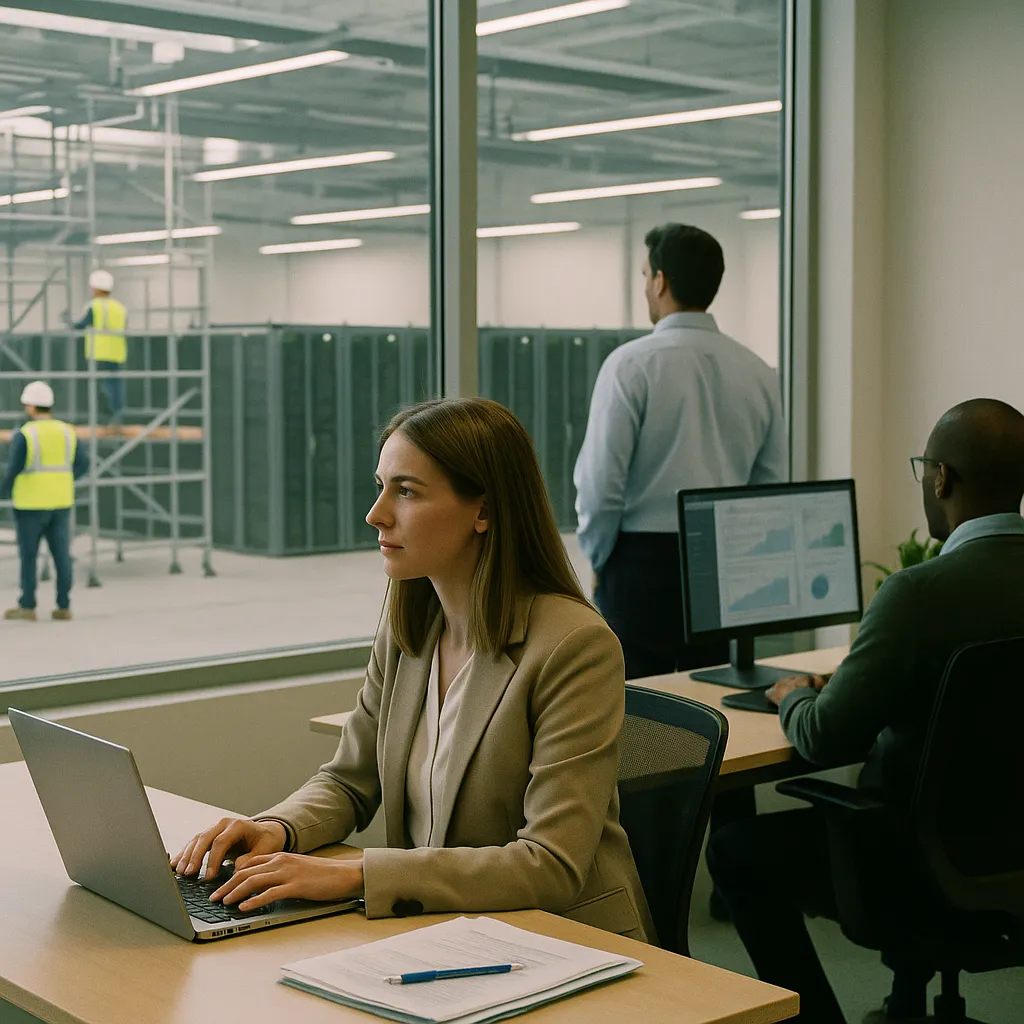
AI automation is shrinking office space demand while data center outlays have risen to match general office construction spending for the first time, driving 'Powered Land' near substations to $150,000 per acre.
AI Is Collapsing Office Demand While 'Powered Land' Pushes Data Center Farmland to $150,000 Per Acre
By Hector Herrera | June 4, 2026
AI is simultaneously destroying one real estate category and inflating another. Office construction spending has declined steadily from its 2020 peak as AI automation reduces the white-collar headcount that drives office demand. At the same time, data center outlays have risen to match general office construction spending for the first time, while farmland near high-voltage substations — rechristened "Powered Land" by developers — now trades for more than $150,000 per acre in some secondary markets. This is not a gradual rebalancing. It is a sector-level rotation happening faster than the commercial real estate industry can reprice.
The Office Collapse
Office vacancy rates have been elevated since the pandemic-era shift to remote work, but AI is creating a second, distinct pressure on demand. As AI tools automate routine white-collar work — data analysis, document drafting, customer correspondence — companies are hiring fewer knowledge workers per unit of output. Fewer workers means less desk space.
According to The Real Deal's analysis, office construction spending has declined from its 2020 peak and continues on a downward trajectory. That decline is now structural, not cyclical. Companies are not waiting for workers to return to the office. They are redesigning workflows to require fewer workers altogether.
The math is straightforward: if a company uses AI agents to handle tasks that previously required 20 analysts, it needs less than half the office footprint, regardless of whether those analysts work in-person or remotely.
The Powered Land Premium
On the opposite end of the real estate market, a new asset class has emerged: Powered Land — parcels of land within transmission distance of high-voltage substations that can support the electrical infrastructure modern data centers require.
In Columbus, Ohio, farmland rezoned for data center use is now trading at more than $150,000 per acre. Comparable agricultural land without data center potential trades at a fraction of that price. The premium reflects a single constraint: power.
Get this in your inbox.
Daily AI intelligence. Free. No spam.
Data centers require vast amounts of electricity, and the national grid has limited capacity to connect new large-scale loads quickly. Sites adjacent to existing high-capacity transmission infrastructure — substations capable of supplying hundreds of megawatts — are effectively irreplaceable in the near term. Land developers who identified these sites early are seeing extraordinary returns.
Meta's 5 Billion Signal
The scale of data center investment driving this land premium is illustrated by one company: Meta raised its 2026 data center spending forecast to $125–$145 billion — a number that would make it one of the largest real estate and infrastructure investors in American history by annual outlay.
Meta is not alone. Microsoft, Google, Amazon, and Oracle are each spending tens of billions on data center expansion. That level of capital deployment requires physical infrastructure at scale: land, power, cooling, and connectivity. The scarcest of these constraints is power access, which explains why Powered Land commands premium pricing far exceeding its agricultural or light industrial equivalent.
NIMBY Opposition as a Market Constraint
Not all data center development is proceeding smoothly. NIMBY (Not In My Backyard) opposition — from local residents, environmental groups, and municipal governments concerned about water use, noise, and visual impact — is increasingly blocking projects in established markets.
Maine recently vetoed a proposed data center project despite its economic development potential. Similar opposition has slowed projects in Northern Virginia, the Pacific Northwest, and parts of the Southwest.
The effect of NIMBY pushback is to concentrate data center development in secondary and rural markets where opposition is weaker and land is cheaper — exactly the dynamic producing the Powered Land premium in places like Columbus rather than in coastal metros. That displacement creates an unusual geography: some of the most valuable commercial real estate in America is now in rural Ohio, not Manhattan or San Francisco.
The Real Estate Industry's Adaptation Problem
For commercial real estate investors and developers, the simultaneous decline of office and rise of data centers creates a difficult portfolio problem. Office assets — long the most liquid and prized commercial real estate category — are repricing downward without a clear floor. Many investors bought office buildings at cap rates (net operating income divided by purchase price — a yield measure) that assumed stable tenancy at pre-AI workforce levels.
Data centers, by contrast, have strong demand but require specialized expertise. Not every office developer can pivot to data center development, and the capital requirements are substantially higher. A trophy office tower might cost $300–$500 million. A large hyperscale data center campus can exceed $1 billion.
The market is bifurcating: capital flowing aggressively into data centers and industrial properties near power infrastructure, while office assets in markets without significant tech tenants face persistent vacancy and declining valuations.
What to Watch
The critical variable is pace. If AI automation reduces office demand faster than the industry can reposition or convert existing buildings, distressed office assets could become a broader financial stability risk — especially for regional banks heavily exposed to commercial real estate lending. Conversely, if grid infrastructure expansion accelerates, the Powered Land premium could normalize as power access becomes less scarce. Watch Q3 2026 office vacancy reports in major metros for the pace of demand decline, and track Federal Energy Regulatory Commission transmission queue data for signs of grid capacity relief.
Source: The Real Deal — Will AI Kill Commercial Real Estate? (June 2026)
Did this help you understand AI better?
Your feedback helps us write more useful content.
Get tomorrow's AI briefing
Join readers who start their day with NexChron. Free, daily, no spam.