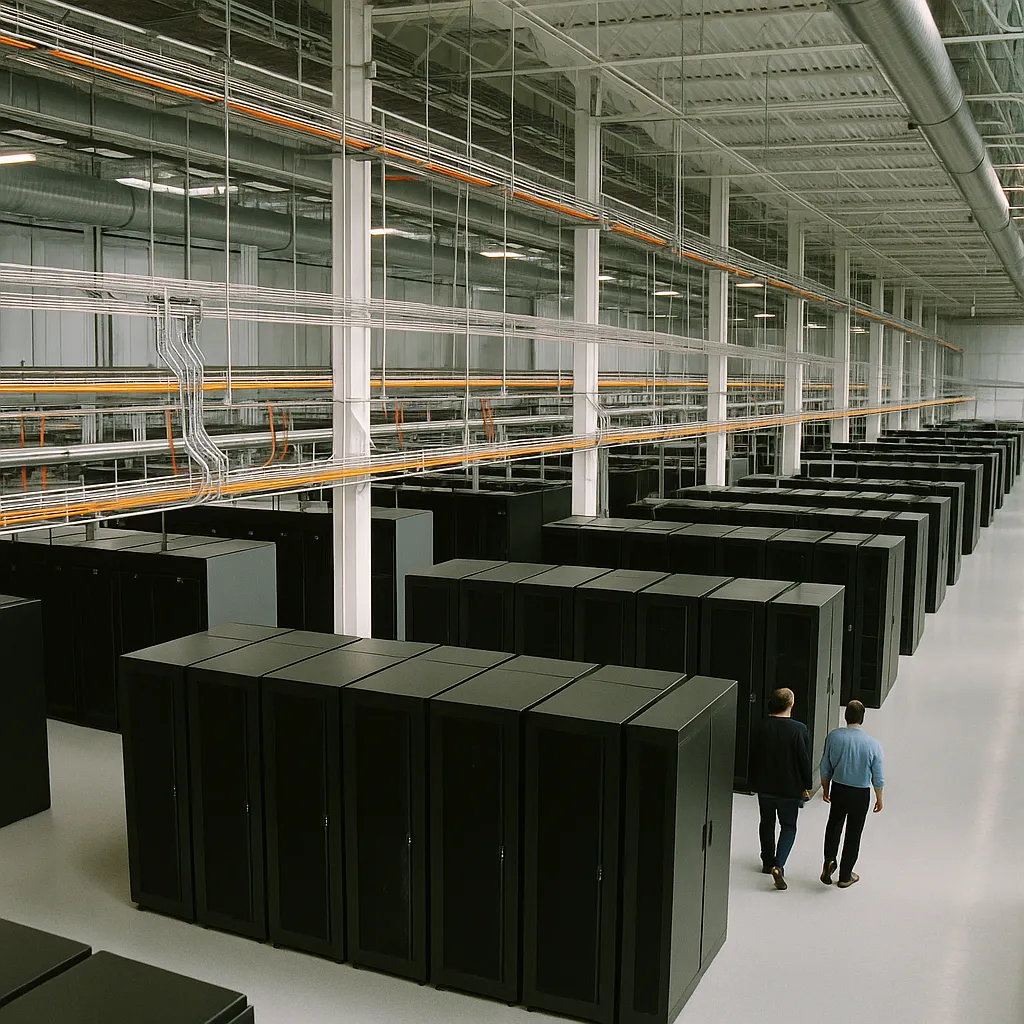
Digital Realty signed its largest single lease ever — 200 megawatts in Charlotte driven by AI demand — and raised full-year 2026 revenue guidance to $6.65–$6.75 billion, confirming AI infrastructure as the dominant force reshaping commercial real estate.
Digital Realty Signs 200 MW AI Data Center Lease — Its Largest Ever — and Raises 2026 Revenue Guidance
By Hector Herrera | May 24, 2026 | Real Estate
Digital Realty has signed its largest single lease in company history — 200 megawatts of data center capacity in Charlotte, North Carolina, driven entirely by AI infrastructure demand — and raised its full-year 2026 revenue guidance to $6.65–$6.75 billion on the strength of record Q1 bookings. The deal is the clearest data point yet that AI compute demand is not a forecast anymore. It is the single most powerful force reshaping commercial real estate in 2026.
A 200 MW lease is not a typical commercial real estate transaction. It is closer to acquiring a small city's worth of electrical infrastructure inside a building.
The Deal in Numbers
According to Complete AI Training's reporting on Digital Realty's updated guidance:
- Lease size: 200 megawatts — Digital Realty's largest single lease ever signed
- Location: Charlotte, North Carolina
- Demand driver: AI infrastructure — the tenant is not publicly named but the nature of the capacity is explicitly AI workload
- 2026 revenue guidance: Raised to $6.65–$6.75 billion (prior guidance not specified, raise attributed to Q1 booking strength)
- Q1 2026 bookings: Record quarter for the company
Digital Realty operates 300+ data centers across 50+ metros globally. Charlotte has emerged as a significant secondary data center market alongside Northern Virginia, Phoenix, and Dallas — partly because land is cheaper and power permitting has moved faster than in constrained primary markets.
Get this in your inbox.
Daily AI intelligence. Free. No spam.
Context: AI Is Rewriting Data Center Economics
Data center real estate operated on roughly predictable enterprise IT refresh cycles for most of the past two decades. A hyperscaler would sign a 5–10 MW lease, build out slowly, and expand over years. AI training and inference changed those dynamics entirely.
Scale: A single large language model training run can consume tens of megawatts continuously for months. Inference at production scale for a model like GPT-4 or Claude requires sustained power at a level that makes traditional enterprise IT look negligible.
Speed: AI companies are building capacity as fast as possible to stay ahead of demand. Hyperscaler capital expenditures in Q1 2026 collectively exceeded $60 billion — and data center real estate is where a significant portion of that spend lands.
Geography: AI data center demand has broken out of Northern Virginia's dominance and is accelerating in Charlotte, Columbus, Kansas City, and other secondary markets with available land, water access for cooling, and increasingly renewable-friendly power grids.
What This Means for Real Estate
Industrial and data center properties are widening their lead. Across commercial real estate asset classes, industrial and data center properties have seen the fastest rent premium growth in 2026. Office remains challenged. Retail is recovering but slowly. Data centers are in a different category.
Secondary markets are becoming primary ones. Prior NexChron coverage tracked how Northern Virginia's dominance is being challenged as power constraints and permitting slowdowns push AI tenants into new geographies. Charlotte's emergence as a 200 MW lease market confirms that shift is structural, not temporary.
Public opposition is growing. AI data centers are facing community opposition in some markets over water usage, noise, and strain on local power grids. Charlotte's deal signals the tenant found a viable regulatory environment — a factor that will increasingly determine which metros capture the next wave of AI infrastructure spend.
What to Watch
Digital Realty's Q2 earnings call will reveal whether the 200 MW Charlotte lease is a one-time record or the start of a new scale benchmark for the company. Also watch for the tenant's identity — large AI infrastructure leases at this scale typically come from hyperscalers (Microsoft, Amazon, Google) or fast-scaling AI companies with committed capital. The power source for 200 MW in Charlotte — coal, natural gas, renewables — will draw scrutiny from sustainability-focused investors tracking AI's carbon footprint.
Did this help you understand AI better?
Your feedback helps us write more useful content.
Get tomorrow's AI briefing
Join readers who start their day with NexChron. Free, daily, no spam.