Your daily AI intelligence for November 03, 2026.
Good morning. Here's your AI intelligence for Tuesday, November 03, 2026.
Regulation closes in — from three directions at once
The biggest regulatory story of the week landed Monday when nine state attorneys general filed coordinated lawsuits against OpenAI over ChatGPT's alleged failures to protect children. The complaint spans nine states and marks the broadest state-level enforcement action against any AI company in U.S. history. OpenAI has invested in safety tooling, but the states argue those measures fall short of what minors actually encounter on the platform. Expect this coalition to grow.
Meanwhile, Congress is moving on healthcare. Sen. Bill Cassidy introduced the PATIENT AI Act, which would expand AI's role in diagnosis and treatment while requiring patient consent before AI participates in clinical decisions. A new survey adds weight to that requirement: 91% of patients say they want to be told explicitly when AI is involved in their care. The bill doesn't ban AI in medicine — it frames guardrails as the price of admission.
In finance, Hong Kong's central bank moved first with a different approach. The HKMA launched Project SAGE, the first government-led framework specifically designed to govern AI agents making autonomous financial decisions. The framework acknowledges that AI agents are already operating in live markets. What SAGE tries to do is define who is accountable when they act — a question no regulator has fully answered yet.
AI is rewriting the law faster than courts can keep up
A Stanford Law scholar published an analysis arguing that the real legal risk from large language models isn't hallucination — it's accuracy. AI systems can now surface exploitable loopholes in contract language, tax codes, and regulatory frameworks faster than the institutions that write those rules can close them. When AI gets the law systematically right, it becomes a powerful tool for anyone willing to use it asymmetrically. This isn't hypothetical: it's already happening in contract disputes and regulatory arbitrage. The question is whether the legal system can adapt at the speed of inference.
Get this in your inbox.
Daily AI intelligence. Free. No spam.
Google enters the creative stack, Shopify enters every conversation
Google launched Flow on Monday — a Gemini-powered creative studio that combines video generation, image creation, and production workflow tools in a single platform. It puts Google in direct competition with Adobe Firefly, Runway, and Sora. The differentiator Google is betting on: Gemini's multimodal context handling across a full production pipeline, not just individual generation tasks.
Shopify's Autumn '26 edition took a different kind of creative leap — embedding Shop Pay natively inside third-party AI agents for the first time. A shopper can now complete a purchase inside a chat conversation without being redirected anywhere. Sidekick, Shopify's merchant assistant, now has memory, code execution, and web search, moving it from advisor to operator. The implication for retail is significant: AI agents are becoming the new checkout lane.
The physical AI moment is here
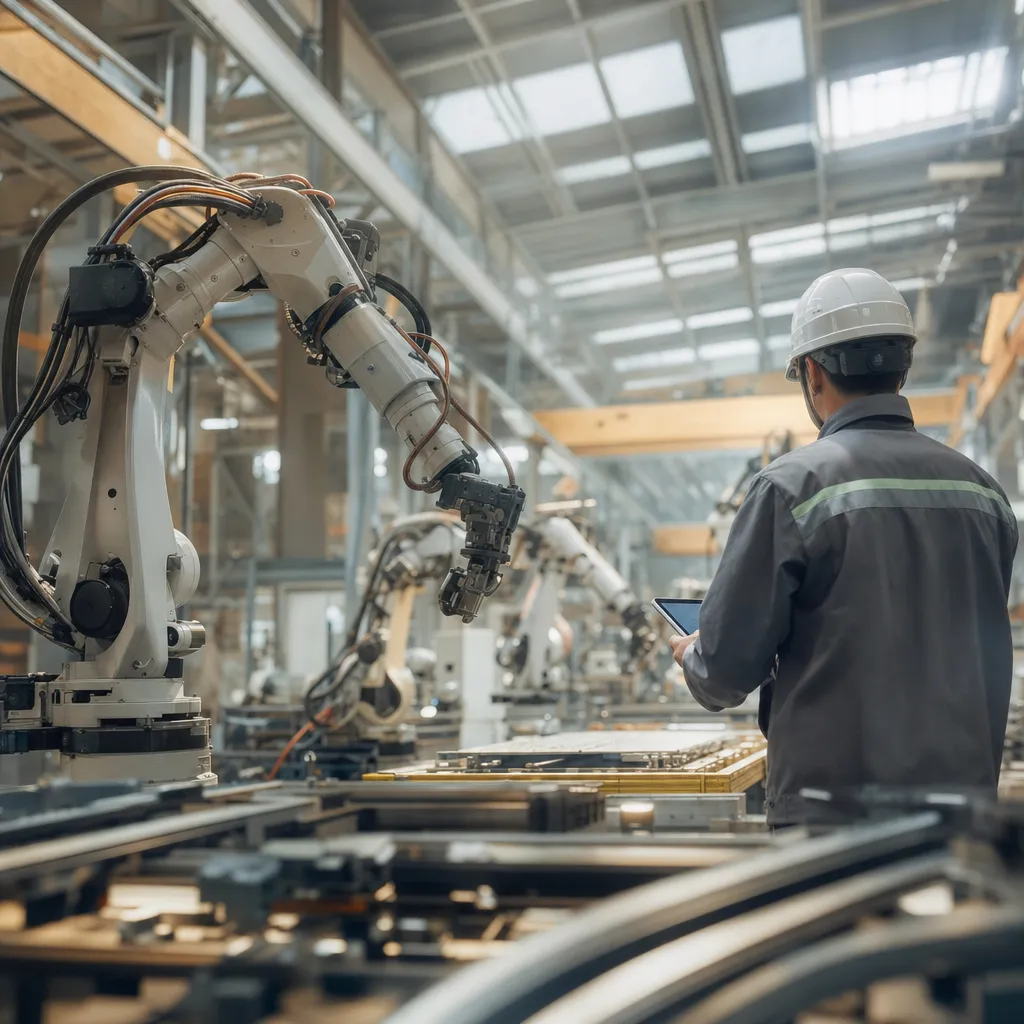
Robotics and physical AI companies raised more than $1 billion in a single week. That number matters not because the dollar amount is unprecedented, but because the money is moving into commercial deployment, not research. Warehouse automation, factory AI, and robotic logistics are shipping product, not pitching demos. The sector has crossed a threshold, and this week's funding rounds are evidence of it.
Gartner complicates the optimism. The analyst firm warns that roughly 30% of employees let go in AI-driven layoffs will be rehired by their former employers by 2029 — at significantly higher salaries. The pattern: companies automate, discover the automation doesn't perform as expected in real conditions, then hire back the humans they let go at a premium because institutional knowledge doesn't transfer to a model. The cost of that lesson is going to be steep.
The home gets smarter — and more private
Local AI processing is quietly replacing cloud-dependent architectures in next-generation smart home products. The driver is a combination of consumer privacy fatigue and better edge hardware. Manufacturers are now shipping hubs that run AI-powered automation entirely on-device, with no data sent to a remote server. Open standards — Matter being the most prominent — are making interoperability viable without locking consumers into proprietary ecosystems. This is a slower story than the funding headlines, but it may be the more durable one.
OpenAI responds to the grid criticism
OpenAI launched the Grid Protectors Program, committing its future data center campuses to reduce electricity draw during peak grid stress events. The program is a direct response to sustained criticism that AI infrastructure is a net drain on the power grid. The commitments are forward-looking — tied to campuses not yet built — which means immediate impact is limited. But the direction is right, and other hyperscalers will face pressure to follow.
The evidence base for AI in schools is shaky
An Education Week investigation found that the meta-analyses most often cited to justify AI adoption in schools are methodologically compromised and riddled with conflicts of interest. Many studies are funded by vendors, many lack control groups, and the outcomes measured don't map cleanly to what educators actually care about. This lands at a moment when Google Classroom with Gemini and ChatGPT for Teens are being pushed into districts with minimal independent outcome data. Districts should ask hard questions before signing contracts.
Telecom goes AI-native in Bahrain
Ericsson and Batelco deployed AI-native radio scheduling across Bahrain's live mobile network — placing AI directly in the operational loop of real-time spectrum allocation. This is a commercial deployment, not a trial, and part of Ericsson's broader Middle East push to move AI from the analytics layer into the core radio stack. The significance: AI making autonomous decisions about spectrum is a different category of deployment than AI making recommendations to human operators.
What to watch today
- Whether additional state AGs join the OpenAI child safety coalition. Nine is already the largest coordinated action against an AI company, but the mechanics of the case will determine whether this produces real enforcement or settles quietly.
- How Adobe, Runway, and Sora respond to Google Flow's launch. Google has distribution and model depth — incumbents will need to differentiate fast.
- Congressional reception for the PATIENT AI Act. Cassidy has cross-aisle reach, and the 91% patient consent figure gives the bill political cover. Watch for co-sponsors.
Did this help you understand AI better?
Your feedback helps us write more useful content.
Get tomorrow's AI briefing
Join readers who start their day with NexChron. Free, daily, no spam.