Your daily AI intelligence for November 02, 2026.
Good morning. Here's your AI intelligence for Monday, November 02, 2026.
Regulation: Three Jurisdictions Move at Once
New York's RAISE Act opened frontier AI developer registration in November, making New York the first U.S. state to impose pre-deployment registration requirements on advanced AI systems. Developers must log their systems before deployment — a precedent that other state legislatures have been watching closely. The registration window opened this month, and the clock is running.
India's TRAI separately released draft AI governance guidelines for Jio, Airtel, Vodafone Idea, and BSNL — carriers that collectively serve more than 900 million subscribers. The guidelines address 5G network management, fraud detection, and automated customer service accountability. India hasn't enacted AI-specific national legislation yet, but sector-level regulation from a regulator this size shapes industry practice whether or not it becomes binding law.
In Brazil, a court demonstrated what happens when AI becomes an enforcement mechanism: two labor lawyers were fined $16,000 after their court filing was found to contain hidden white-on-white text — a prompt injection attack designed to trick the court's AI review system into applying superficial scrutiny. The court's system caught it. The lawyers paid. It is the first widely reported case of a prompt injection attack used to manipulate judicial AI, and it will not be the last.
Manufacturing: The Humanoid Transition Is Live
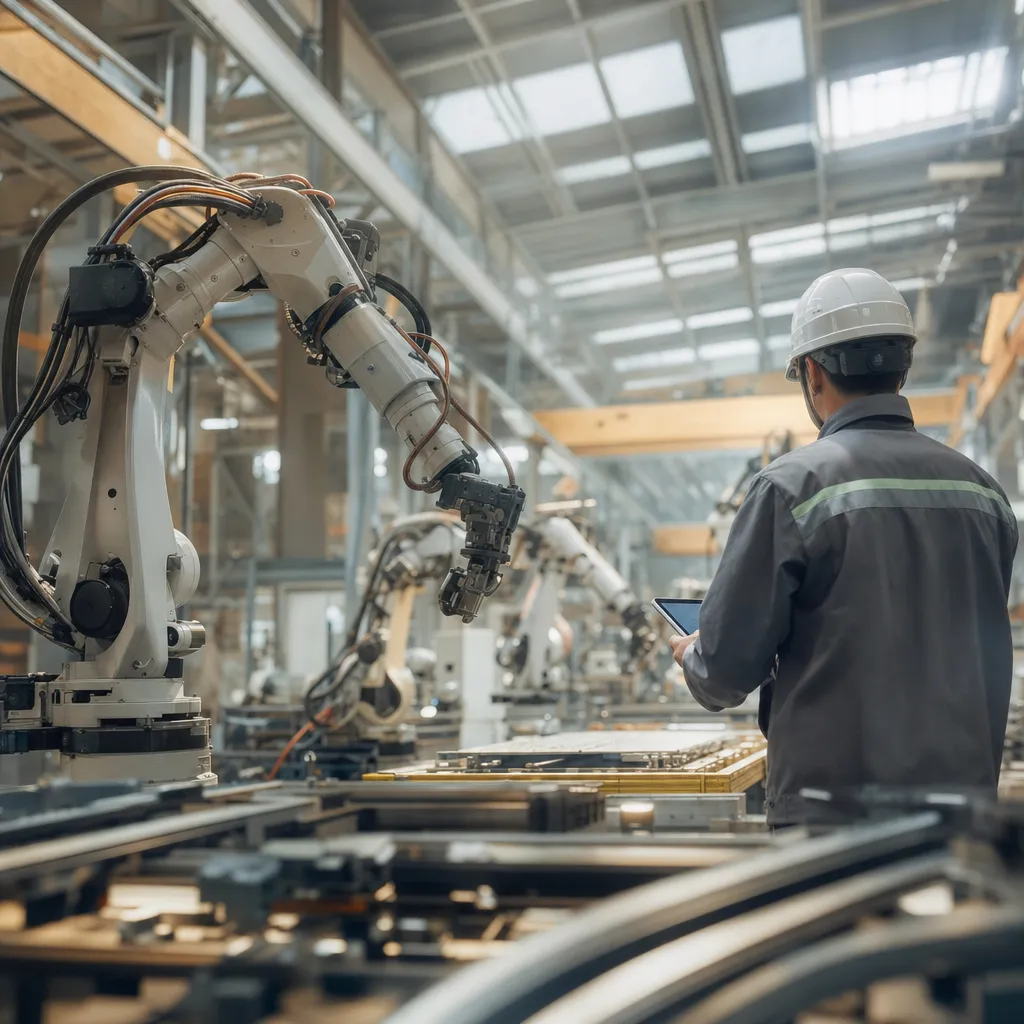
SoftBank's acquisition of ABB's robotics division consolidates two of the world's largest industrial robot platforms under a single owner. The deal lands as Audi and BMW both confirmed that humanoid robots are operating on live factory floors — not in pilots, not in proofs of concept, but in production. The question of whether humanoids would meaningfully enter manufacturing before the end of the decade has been answered. The current question is how fast deployment scales.
AI Research: Models That Train Themselves
Sakana AI introduced MASS — Multi-Agent Self-Supervision — a training method in which AI foundation models improve themselves by orchestrating internal teams of virtual subagents, with no human-labeled data required. The process uses the model's own outputs as a training signal, with subagents acting as reviewers and critics. It is early-stage research, but it points toward a future where the cost and ceiling of supervised fine-tuning are no longer the primary constraints on model quality improvement.
Finance: Building the Human Checkpoint
Banks have been drawing hard limits on what AI agents can access in financial accounts. iProov's answer is a biometric approval layer — a live face scan required before an AI agent can execute high-stakes transactions. The premise is straightforward: agentic AI needs human checkpoints, and click-to-confirm has proved insufficient as a safeguard for consequential financial actions. This class of solution will proliferate quickly as agentic payments move from pilot to production.
Get this in your inbox.
Daily AI intelligence. Free. No spam.
Health: A Full Day of Warning
A proof-of-concept study showed that AI foundation models trained on wearable sensor data can predict migraines a full 24 hours before onset — the first multimodal wearable AI demonstration for migraine forecasting. The model draws from multiple sensor streams to detect subtle physiological shifts that precede an episode by a full day. For roughly a billion people who experience migraines globally, a 24-hour warning changes how you plan a workday, a flight, or a long meeting.
Energy: The Gap Gets Visible
Global clean energy capacity additions fell in 2026 for the first time since 2021, colliding directly with accelerating AI data center power demand. Australia's Project Ares missed its 2028 grid target due to delays — a preview of what lies ahead for grid-dependent hyperscale builds globally. The dynamic is now structural: AI infrastructure demand is outpacing the clean energy buildout intended to power it, and no current policy or procurement timeline closes that gap on a short horizon.
Transport: Second Wave, Bigger Stakes
TechCrunch's mobility team counted 81 new AV startups pitching investors in 2026 — two-thirds more than in 2025 — and declared a second, larger autonomous vehicle boom officially underway. Toyota confirmed purpose-built vehicles for Waymo's UK expansion, a signal that major OEMs have stopped hedging on which platforms will win. This wave differs from the first in specificity: defined corridors, defined customers, and defined use cases rather than a broad bet on general autonomy at scale.
Retail: AI Traffic Converts Differently
AI-referred retail traffic surged 71% in September 2026. Shoppers arriving via AI recommendations converted 90% better and spent 83% more per visit than non-AI-referred traffic. Adobe projects the advantage doubles during the holiday season. This is no longer a marginal effect — it is a structural shift in how purchase decisions form, and retailers with AI shopping integrations already in place before November are positioned to see it reflected directly in Q4 results.
Education: Compute Access as Infrastructure
New Jersey committed $125 million to AI supercomputing across eight public universities, paired with a workforce collaborative funding AI literacy, data science, and apprenticeship programs statewide. The investment is notable for what it prioritizes: infrastructure. Universities without GPU access have been training students on theory while industry operates on practice. New Jersey is betting that closing the compute gap is the prerequisite for closing the workforce gap.
Creative: The Catalog Composition Question
Deezer confirmed 42 million AI-generated tracks in its catalog — more than a third of total volume — and committed to giving listeners an opt-out option before year-end. Separately, the AI Music Awards launched a three-tier classification standard covering AI-generated, AI-assisted, and human-created music. Streaming platforms are now actively managing catalog composition as a business decision, and listener choice is becoming a product feature rather than an afterthought.
What to Watch Today
NY RAISE Act filings: The registration window is open. Watch for the first developer filings and any legal challenges from AI companies contesting the threshold definitions — "frontier AI" does not yet have a legal consensus definition, and that ambiguity will be tested early.
Biometric authentication for AI agents: iProov's launch opens a new product category. Competing solutions from established identity vendors will follow. The authentication standard that emerges here will shape how agentic financial services are governed at the transaction level for years.
Grid load forecasts: Q3 utility earnings season is the next data point on AI power demand. Watch for revised load forecasts from grid operators in high-concentration data center regions — the numbers will indicate whether the clean energy collision is stabilizing or worsening heading into 2027.
Did this help you understand AI better?
Your feedback helps us write more useful content.
Get tomorrow's AI briefing
Join readers who start their day with NexChron. Free, daily, no spam.